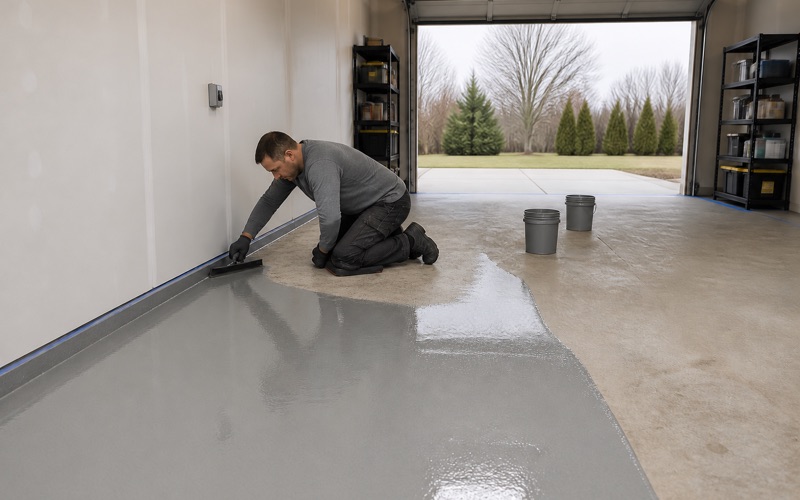
Colton Epoxy Flooring installs epoxy flooring in Yucaipa, CA, and the useful thing to say about this city up front is that there is no typical Yucaipa garage. We have more than twenty years of concrete coating behind us in this region, and Yucaipa is where a quote given over the phone is least likely to survive contact with the actual slab. That is not a criticism of the city; it is a consequence of it having been built steadily over seventy years rather than in one wave.
The build curve here is genuinely broad rather than concentrated. Three distinct jobs coexist: a large 1960s and 1970s two-car attached era, a substantial 2000s three-car tract era, and a pre-1950 tier still sitting on original slabs. Each of those needs different preparation, carries different risk and prices differently. Anyone quoting a flat rate across this city is averaging three jobs that have little in common.
It is also the substantial city in this part of the foothills, with an owner-occupied detached pool larger than the neighboring foothill communities combined by nearly a factor of two, and enough residential volume on its own to support a route. That means we are here regularly rather than making a special trip, which keeps mobilization costs sensible.
Three Garage Generations, One City
The 1960s and 1970s Two-Car Bay
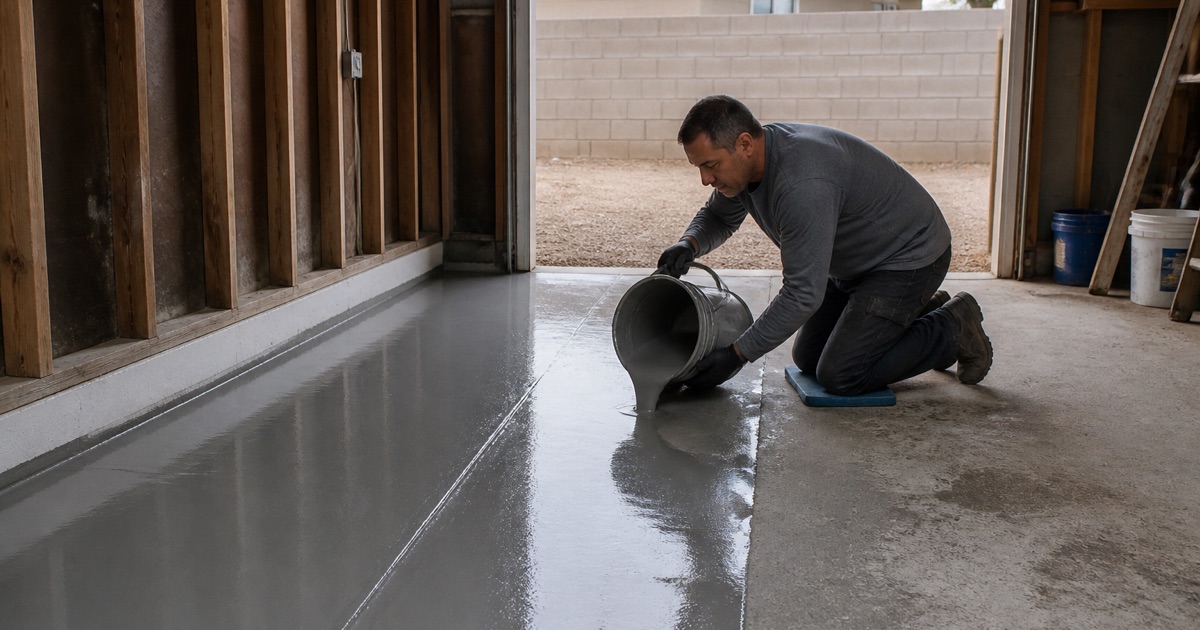
The largest single group is a two-car attached garage on a slab now 50 to 65 years old. Those floors arrive with a predictable set of conditions: control-joint and shrinkage cracking, threshold lipping, edge curling, decades of oil where the car has sat, and frequently a failed one-part paint on top of it.
Moisture is the live question on this tier, because under-slab vapor retarders were not routine practice through much of that period. That is not a reason to avoid the work; it is a reason to test before ordering rather than after a coating lifts. On this tier the test is the most valuable few minutes in the entire job.
The 2000s Three-Car Tract Garage
At the other end sits a 15 to 25 year old slab, almost certainly placed over a modern vapor retarder and often never coated. That is the most straightforward version of this job, and the price reflects it.
A three-car bay is not simply a larger two-car bay for pricing purposes, though. The added run changes material batching and the working sequence across the slab, and on a hot day it changes how many people need to be on site to keep a wet edge moving. A three-car bay on a hot afternoon is where an under-resourced crew leaves a visible set edge.
The Pre-1950 Detached Garage
The oldest tier is a detached garage on its original slab, typically smaller and narrower than anything built since. Concrete from before 1950 was commonly placed with no under-slab vapor retarder at all, so testing there is scope rather than an upsell. Vapor moving up through unprotected concrete does not harm the slab; it pushes whatever is bonded on top of it off.
Those buildings also change the practical shape of the work — less room to maneuver, tighter turns for equipment, more hand grinding at the perimeter, and slab edges that have broken down where a door has rested for seventy years. None of that makes the job harder to do well; it makes it slower, and a quote should say so rather than discovering it on the day.
Looking for epoxy flooring closer to Running Springs? See Epoxy Flooring Services in Running Springs.
Why We Look Before We Quote
A Phone Quote Would Be Wrong
In a single-generation tract city, a build era and a square footage get close enough to a number to be useful. Here they do not, because two addresses a few streets apart can be seventy years apart in construction with completely different risk attached.
So we visit and quote from the slab. It costs nothing, it takes very little time, and it means the number we give is the number rather than an estimate that moves once the grinder exposes what is actually there. A price that changes halfway through a job is the most common complaint about this trade and it is almost always avoidable.
The Tests We Run
Every slab is moisture tested before product is ordered. The ASTM F1869 calcium chloride test reads a vapor emission rate at the surface and the ASTM F2170 in-situ relative humidity probe reads the state of the slab at depth, with the threshold numbers taken from ASTM F710 rather than from the test methods themselves.
The ASTM D4263 plastic sheet test is the one most homeowners have heard of and it is worth understanding correctly: it is asymmetric, so a positive result fails a slab while a negative one proves nothing at all. We treat it as a screen and run the measured tests regardless. The cost of testing is trivial against the cost of a floor that has to come off and be done again.
What Removal Adds
On the older two tiers there is frequently something already on the floor. A consumer kit or one-part garage paint is thin, tough and unevenly bonded, so it loads tooling and tears rather than cutting cleanly, and the flake in it grinds at a different rate than the resin around it.
We shear that off with polycrystalline diamond tooling before switching to a conventional grit sequence for the concrete underneath, and we price removal as its own line. It is frequently the single largest difference between two quotes on the same garage. A quote that does not mention removal is either assuming bare concrete or planning to raise it later.
Specifying for the Slab You Have
Finish Choice Follows Condition
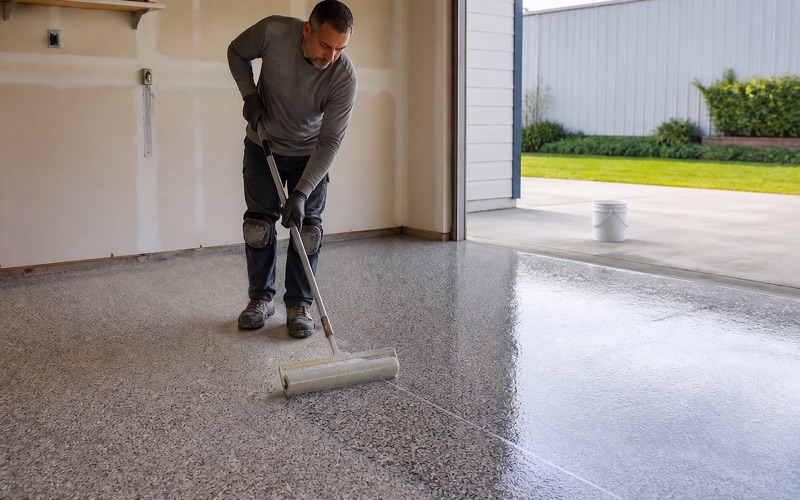
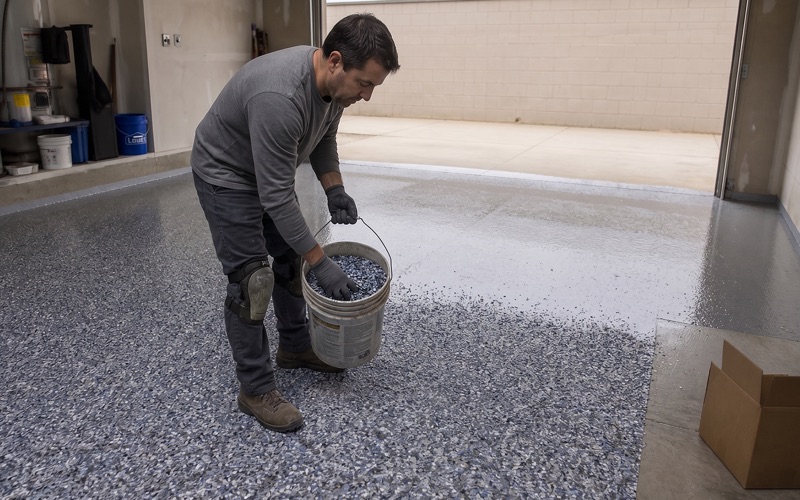
The right finish is partly a function of what the slab needs concealed. On a repaired older floor a full flake broadcast throws chip to refusal until no base color shows, which hides joint fills and patches that a light scatter would leave visible.
On a sound 2000s slab there is nothing to conceal, so a lighter scatter or a plain solid color becomes genuinely viable and cheaper. Choosing a light scatter on an older repaired floor to save money is usually a false economy, and we will say so.
Mechanical Preparation Throughout
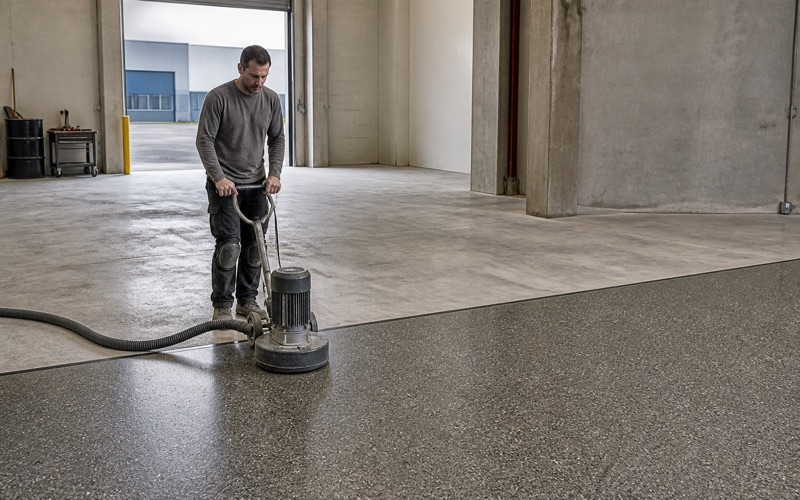
Every floor is opened with diamond grinding to a measured ICRI concrete surface profile, with the diamond segment bond chosen against the hardness of the slab and continuous HEPA dust extraction running. Hard concrete takes a soft bond and soft concrete takes a hard one, which reads backwards until you have watched it work.
We never acid etch. It softens the surface, leaves residue behind and cannot produce a consistent profile on a hard-troweled floor, so the coating bonds to a weakened layer rather than to sound concrete.
Elevation, Heat and the Working Window
Yucaipa sits high enough to be cooler than the valley floor and low enough that summer heat still governs the working day. Pot life on a common system runs about 60 minutes at 55 degrees and collapses toward 20 minutes at 95 degrees, with the recoat minimum shortening alongside it.
We read the actual surface temperature and dew point rather than the air temperature, since a coating needs to go down at least 5 degrees above the dew point and a garage slab can differ considerably from the air above it. Those are measurements rather than judgment calls.
What Else We Do in Yucaipa
Concrete Resurfacing on Worn Exterior Slabs
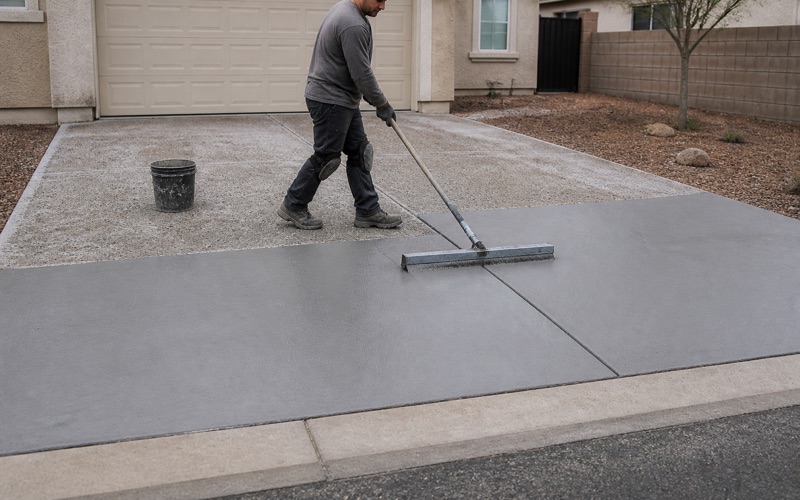
A city with this much older housing has a great deal of tired exterior concrete — driveways, walks and patios worn at the surface rather than structurally failed. A polymer-modified cementitious overlay rebuilds that surface in thin lifts over properly profiled concrete, at a fraction of the cost and disruption of replacement.
The judgment is whether the slab beneath is worth building on. Scaling, spalling and crazing resurface well; widespread structural cracking, settlement or a slab that moves under load is a replacement problem, and an overlay over any of those fails visibly within a season rather than lasting a decade.
Polished Concrete on a Sound Slab
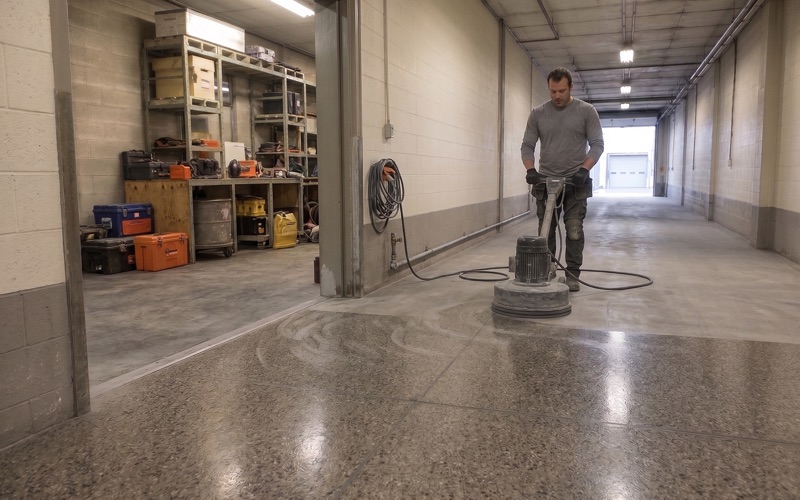
Where a slab is sound and flat, polished concrete is worth considering as an alternative to a coating, and it is particularly worth considering where a moisture reading has come back high. The floor is ground through progressive grits, densified with a chemical hardener and polished to a chosen gloss level.
Nothing is bonded on top, so there is no film for vapor pressure to lift. What it cannot do is hide a patched or contaminated slab, which on an older Yucaipa floor is a real limitation, so we grind a test area and let the concrete itself decide whether it is a candidate.
Doing Several Slabs at Once
Older properties here frequently need more than one thing — a garage floor, a driveway, sometimes a patio or a detached structure as well. Doing them in a single mobilization is meaningfully cheaper per square foot than returning for each, because the equipment and setup are shared across all of it.
It also means the junctions come out right. Where a garage floor meets a driveway, planning both sides as one job produces a transition that looks intentional rather than two finishes that happen to meet at a threshold.
- 20+ Years Experience
- Free Estimates
- Every Slab Moisture Tested