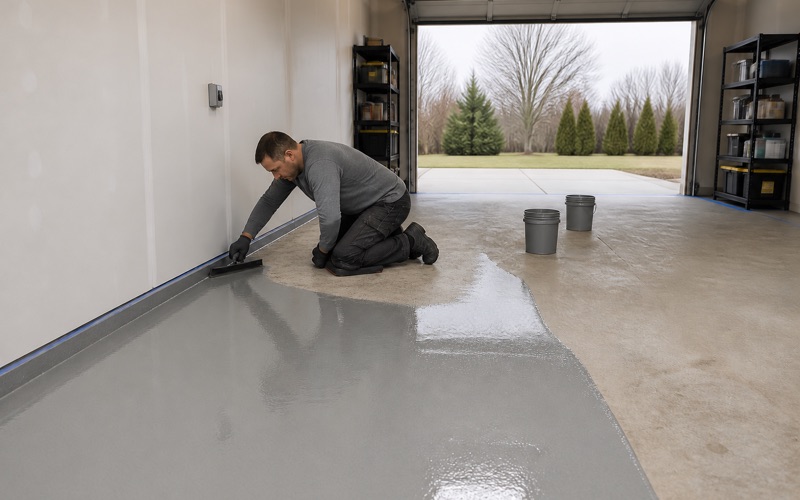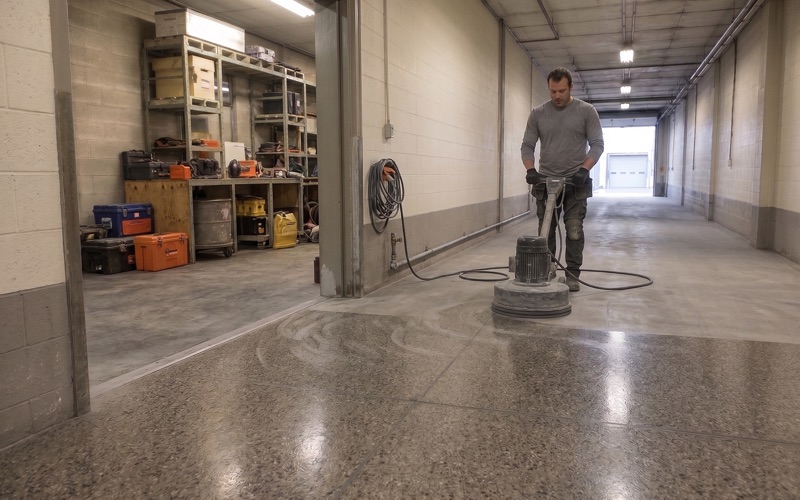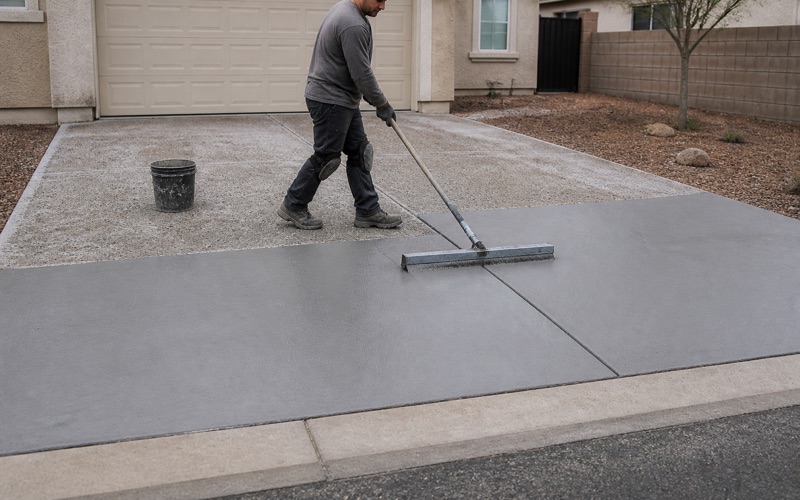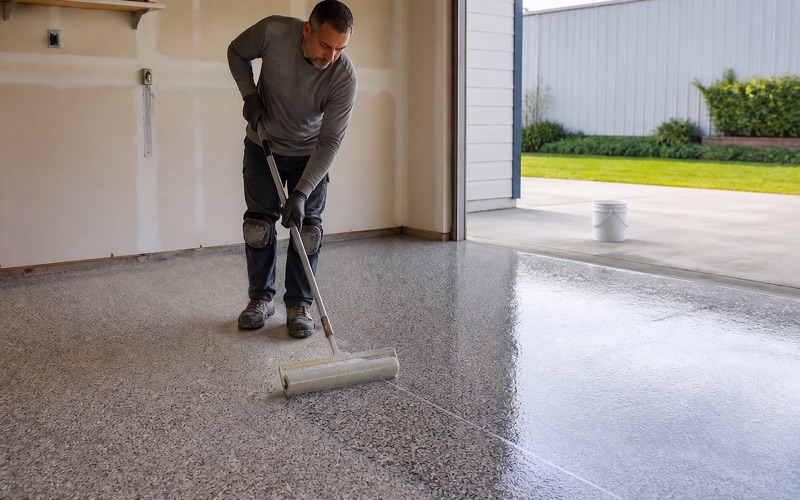
Colton Epoxy Flooring installs polished concrete flooring and resinous coatings in San Bernardino, CA, and this city asks more range of a flooring contractor than any other we serve. We have spent more than twenty years on slabs in this valley, and San Bernardino is where that experience earns its keep, because no single approach covers what is here.
The reason is the spread of construction eras inside one set of city limits. 34.0% of the housing stock predates 1960 and 8.8% predates 1940, while a large logistics build-out on former Norton Air Force Base land has been pouring new industrial slabs for two decades, including a 658,500-square-foot air hub building completed in the 2020s.
That is eighty years of concrete practice in one service area, and a crew that treats it as one substrate will be wrong most of the time. It is also why we quote from a site visit here rather than from an address, because two houses a mile apart can present completely different problems.
One City, Eighty Years of Slabs
The Pre-War Tier Is Real, Not Token
8.8% of housing here predates 1940 and 22,838 units were built before 1960. That is not a scattering of old houses; it is a substantial body of concrete placed before under-slab vapor retarders were routine construction practice, sitting in neighborhoods that were largely built out before the postwar tract wave began.
On those slabs the coating decision is genuinely a testing decision. A floor placed with nothing beneath it can carry vapor drive that will push any impermeable film off the concrete regardless of how well the surface was prepared, and no amount of grinding changes that. Recognizing which slabs are in that category before ordering material is most of what experience in this city is actually worth.
Postwar and Later Stock
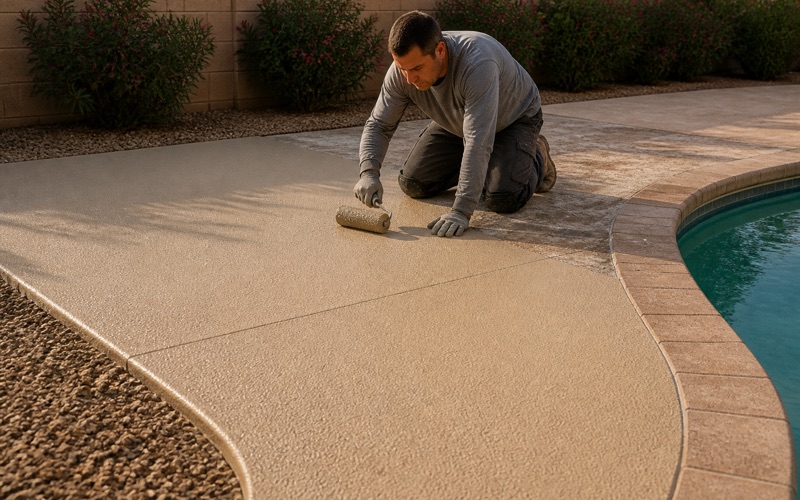
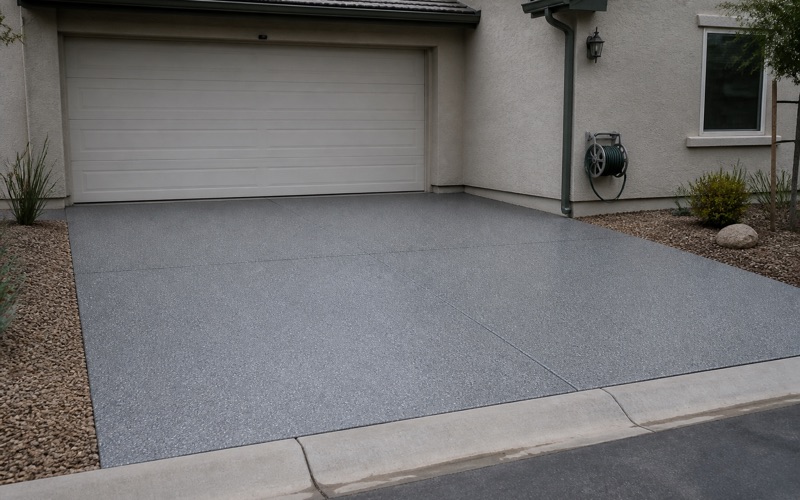
The middle of the city’s housing history behaves like the rest of the valley — postwar tract building, then the 1970s and 1980s expansion, then a slower period. Those slabs are ordinary work: grind to an ICRI concrete surface profile, fill joints, repair spalls and oil-contaminated areas, then build the system.
The useful thing about a mixed-era city is that we do not have to guess which kind we are looking at. The build date narrows it, and the test settles it. Between those two we can usually tell a homeowner what their floor is likely to need before we have taken a single reading, and then confirm it rather than discover it.
New Industrial Concrete on the Norton Land
At the other end of the range, two decades of logistics development on former Norton Air Force Base land have produced some of the newest large-area industrial slabs in the region. Those are power-troweled, tight and low-porosity, and the preparation problem there is the reverse of the one an old house presents.
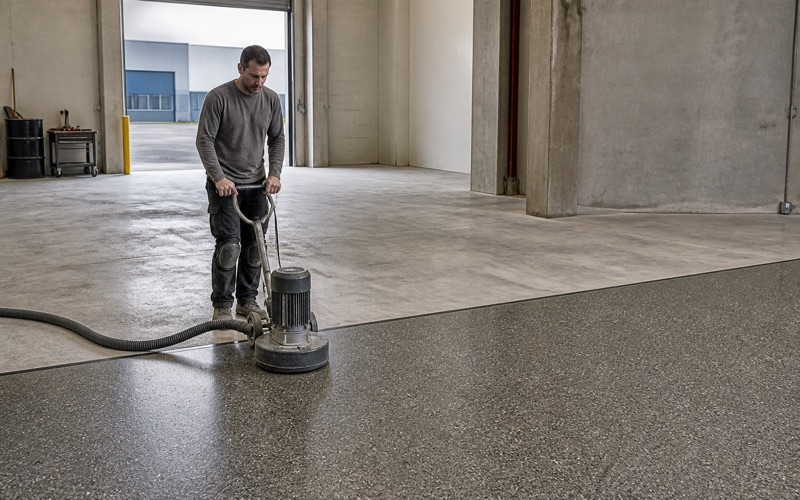
A burnished modern slab has to be opened mechanically to a specified profile or a coating is bonded to a surface film rather than to concrete. That is a shot-blasting job at scale, with hand grinding at every edge and around every fixed obstruction. The contrast is worth appreciating: on the same day a crew can be opening a burnished new slab in one building and dealing with a porous eighty-year-old one in another.
Looking for epoxy flooring closer to Muscoy? See Epoxy Flooring in Muscoy.
Moisture Testing as Scope, Not Upsell
Why It Belongs in the Price
Across roughly a third of the residential work in this city, moisture testing is part of the job rather than an addition to it. With 22,838 units built before 1960, the probability that a given older slab was placed without a vapor retarder is high enough that testing is the default rather than a precaution.
We put it in the scope and in the price for that reason. A contractor who lists it as an optional extra is inviting the customer to decline the one thing most likely to determine whether the floor survives. It is a small line on a quote and it carries more weight than any other decision on the page.
The Three Tests and What Each Answers
The ASTM F1869 calcium chloride test measures a moisture vapor emission rate at the surface. The ASTM F2170 in-situ relative humidity probe measures the state of the slab at depth. They answer different questions and the threshold numbers for both live in ASTM F710 rather than in the test methods themselves.
The ASTM D4263 plastic sheet test is the one homeowners have usually heard of, and it is asymmetric: a positive result fails a slab while a negative one proves nothing. It is a useful screen and it is not a measurement. We run the measured tests regardless of what a sheet test suggests, because the cost of being wrong is the whole floor.
What Happens When a Slab Reads High
A high reading is not the end of the job. The usual answer is a moisture vapor barrier primer sized to the number, which is a real product decision rather than a heavier coat of the same thing. Occasionally the honest answer is that the floor should not be coated until the source is dealt with.
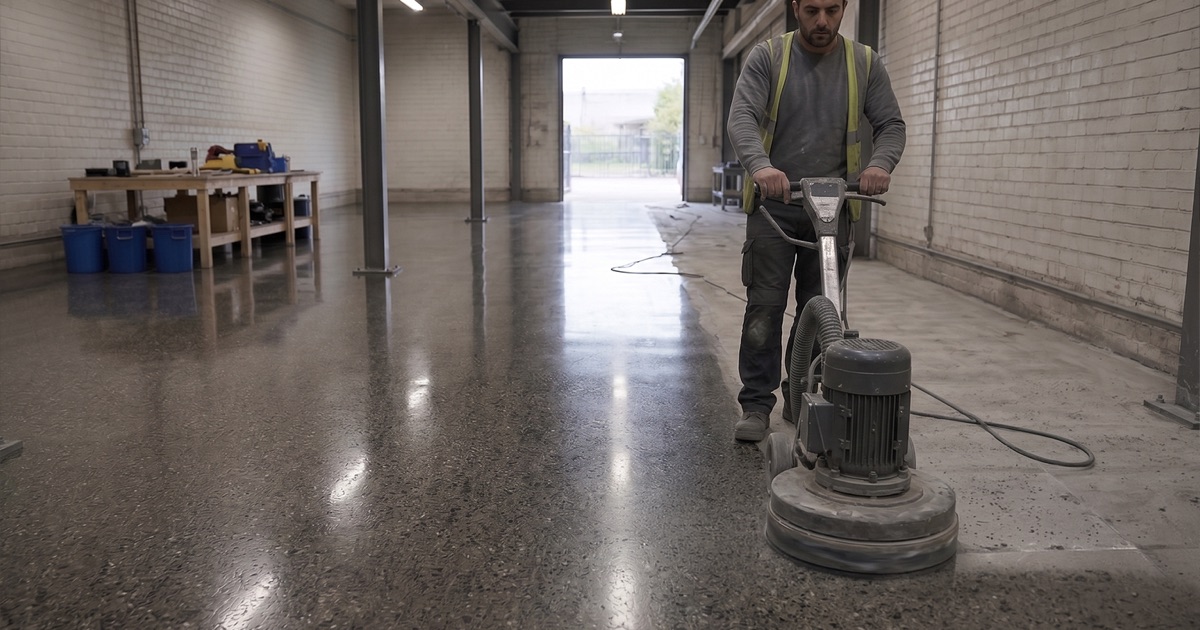
Polished concrete is worth mentioning here too, because it sidesteps the problem entirely. With nothing bonded on top, there is no film for vapor pressure to push off, which makes it a genuine option on a slab that a coating cannot survive. It is not the answer everywhere, since polishing cannot hide a patched or contaminated slab, but on a sound old floor with a moisture problem it is frequently the best one available.
Sizing This Market Honestly
225,000 Residents, About 20,000 Addressable Houses
San Bernardino’s population figure overstates the residential garage market substantially. Its 224,775 residents live in 67,108 housing units, of which only 40,615 are single-family detached, and citywide ownership sits at exactly 50.0%.
That puts the realistic owner-occupied detached pool at roughly 20,000 houses. It is still the largest residential market on our service area by a wide margin, and it is a fifth of what the population number would suggest. Being clear about that is more useful than an inflated figure, because it sets a realistic expectation for how much work is genuinely reachable here.
An Exact Fifty-Fifty Tenure Split
Tenure here divides almost precisely in half — 32,092 owner-occupied against 32,107 renter-occupied — which is the lowest ownership rate among the cities immediately around it. Practically that means about half the detached housing decisions are made by landlords rather than by the people living in the house.
That changes the conversation rather than reducing it. A landlord buys durability and ease of cleaning between tenants, cares less about flake blend selection, and is often a better customer for a hard-wearing specification than an owner-occupier weighing appearance. It also tends to mean faster decisions, since the question is a maintenance one rather than a design one.
Commercial Floors Across the Same Range
The commercial stock mirrors the residential spread. New distribution buildings on the Norton land sit alongside older commercial and institutional buildings downtown, and the two need different preparation, different products and different sequencing. A downtown building from the 1930s and a distribution box from 2019 have almost nothing in common as substrates, and quoting them from the same template would be a mistake.
We phase work in occupied buildings by zone or by shift, with containment and HEPA extraction running throughout, and reserve full shutdowns for the areas where nothing smaller will do. That plan is written into the proposal, because on a commercial floor the disruption is usually worth more than the materials.
Working Across the City
Neighborhood by Neighborhood, Not Citywide
Because the construction eras here are geographically distinct rather than mixed street by street, where a property sits tells us a good deal before we arrive. The older neighborhoods carry the pre-war and pre-1960 stock; the outer areas carry the postwar and later tract building; the industrial land carries the new large-area slabs.
That does not replace testing, and it does shape what we expect. It also means a route through this city can move between three quite different kinds of work in a single day, which is unusual and is part of why we like working here.
Access, Staging and Dust
Access varies with the era as well. Older neighborhoods have narrower driveways, shallower garages and less room to stage a trailer, while the newer tract areas and the industrial land present no difficulty at all.
Wherever we are, grinding runs under continuous HEPA dust extraction, and in occupied buildings containment goes up and access routes are protected. Dust is the part of this trade a neighbor notices, and controlling it properly is not an upgrade.
Heat and the Cure Calendar
Slab temperature governs the working day here as it does across the valley. Pot life on a common system runs roughly 60 minutes at 55 degrees and collapses toward 20 minutes at 95 degrees, and the recoat window shortens with it.
Summer work therefore means early starts and small batches, and every return-to-service date we quote is read against the actual surface temperature and dew point rather than a label average. We give the date you can use the floor before the work begins rather than afterwards.
- 20+ Years Experience
- Free Estimates
- Every Slab Moisture Tested