Colton Epoxy Flooring installs epoxy flooring in Running Springs, CA, and there are two unusual things about this community worth stating plainly before anything else. One is how uniformly residential it is. The other is that nobody has actually measured its climate. Both of those shape how we work here more than any decision about products does.
On the first point, 96.1% of housing here is single-family detached, and the housing survey records zero units in every multifamily category and zero mobile homes. There is genuinely no property-management, apartment or common-area half to this market — every job is a private house. That is genuinely unusual across the communities we serve and it makes the work here straightforward to organize.
On the second, no published climate normals exist for Running Springs itself. That was checked rather than assumed, and it matters because cold is the governing constraint on any coating job at this elevation, so how confidently we can describe that cold determines how confidently we can schedule. Being honest about that is more useful than a precise-sounding number nobody can support.
A Community of Detached Houses
No Shared Housing At All
The absence of any multifamily stock is genuinely unusual. Most communities we serve have at least some apartments, condominiums or mobile homes, and with them a property-management side to the work — parking areas, laundry rooms, stairwells and corridors bought on a maintenance cycle.
Here there is none of that. Every conversation is with an owner about their own building, which makes the work simpler to organize and means the questions are practical rather than procedural. Nobody here is waiting on an association or a manager to approve a finish. Decisions get made on site by the person who owns the building, which usually shortens the whole process considerably.
What That Means for the Work
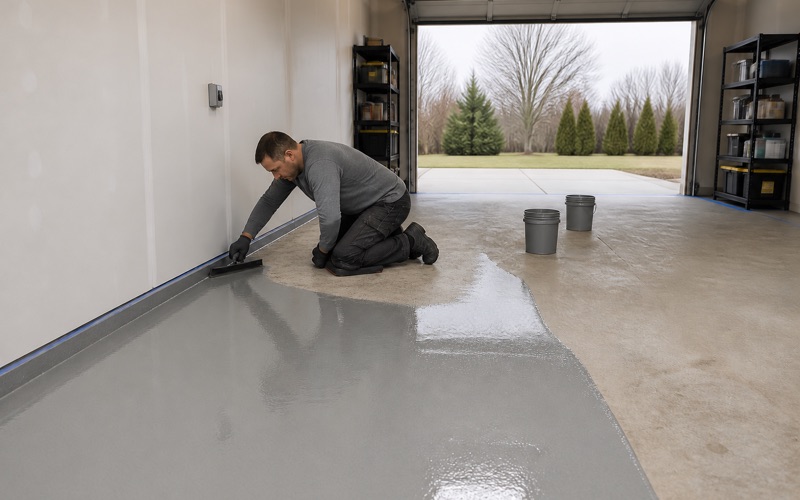
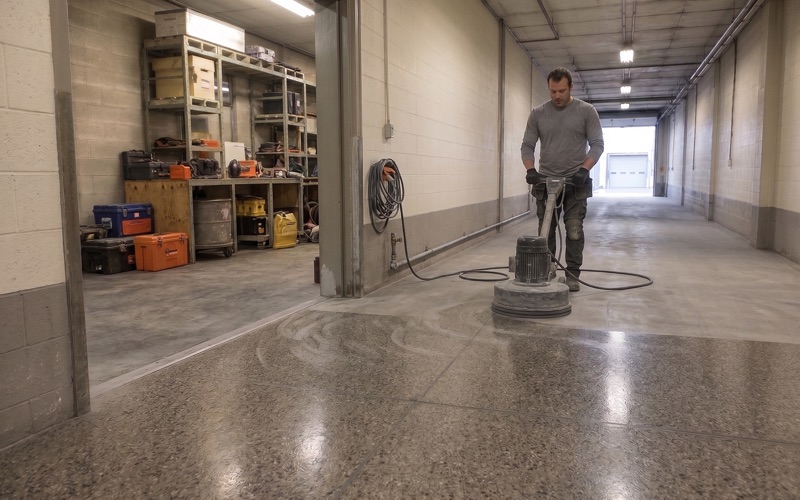
The jobs are garages, workshops and occasionally a detached outbuilding. Those run as residential work does anywhere: assess the slab, test it, grind to a measured ICRI concrete surface profile, repair joints and spalls, treat contamination, then prime, build and topcoat.
What varies most is the building rather than the owner. A mountain garage takes wet boots, grit, snow melt and firewood, which argues for a broadcast finish with genuine texture rather than a smooth decorative floor. Texture also hides what a mountain garage actually does to a floor between one winter and the next. That matters more here than gloss or color, and it is the choice owners most often thank us for later.
Older Mountain Concrete
The housing here carries a real older tier, and older mountain slabs frequently carry both moisture and movement. Concrete placed before under-slab vapor retarders were routine can hold seasonal moisture, and settlement or seasonal shifting can leave cracking that is still active rather than dormant.
An active crack telegraphs through any coating placed over it, so it is either addressed structurally or carried through the finished surface as a deliberate joint. Telling an active crack from a dormant one comes from its edges and how it runs, and where it is genuinely ambiguous we say so rather than guessing. Guessing here produces a floor that cracks in the same place within a year, which helps nobody.
Looking for epoxy flooring closer to Lytle Creek? See Lytle Creek Epoxy Flooring.
A Climate Nobody Has Measured
Why We Say That Out Loud
There are no published climate normals for Running Springs itself. That is not an admission of ignorance; it is the honest state of the available data, and it is more useful to a customer than a confident figure no station supports.
What we can do is bound the problem with proxies, and be clear about which proxy answers which question. The severity of the cold here is inferred rather than measured, and any contractor quoting precise local normals is over-claiming. It is the sort of detail that separates a considered answer from a confident one.
The Proxy Trap Worth Avoiding
The nearest obvious comparison is not the right one for every number. A nearby high-desert basin station is reasonable for daytime highs and badly wrong for overnight lows, because a closed basin pools cold air in a way a ridge town does not.
Using the wrong proxy for lows would substantially overstate how cold it gets here overnight. The defensible figures for a ridge town at this elevation are roughly 97 freeze days a year and six months with a mean below 50 degrees, and we treat those as a bound rather than a measurement. Bounding a problem honestly is a perfectly good basis for planning; pretending to precision is not.
What That Means for Scheduling
Fifty degrees is a hard published minimum on common epoxy floor coatings, applying to air, surface and material alike, with a requirement to be at least 5 degrees above the dew point. Six months below that mean means a real seasonal window rather than a year-round service.
So mountain work here is planned around conditions rather than a fixed date, with a target window agreed and working days confirmed closer to the time. We would far rather move a date than apply a coating outside its specification, because a floor that cures wrong looks finished and cannot be recovered. There is no way to rescue material that cured outside its specification; it is on the slab and removing it is a fresh job.
Working at This Elevation
Getting Equipment Up and In
Access is a real planning question rather than a formality. Getting a planetary grinder, a dust extraction rig and material up to the community and then onto a specific property takes thought, and driveways here are frequently steep, narrow or unpaved.
We confirm the last hundred feet before committing to a date — grade, surface, turnaround room and whether a heavy machine can be walked to the slab. A few minutes at the survey prevents a wasted trip that costs a full day. It is the single most useful question we ask on a mountain property.
Heating a Space to Extend the Window
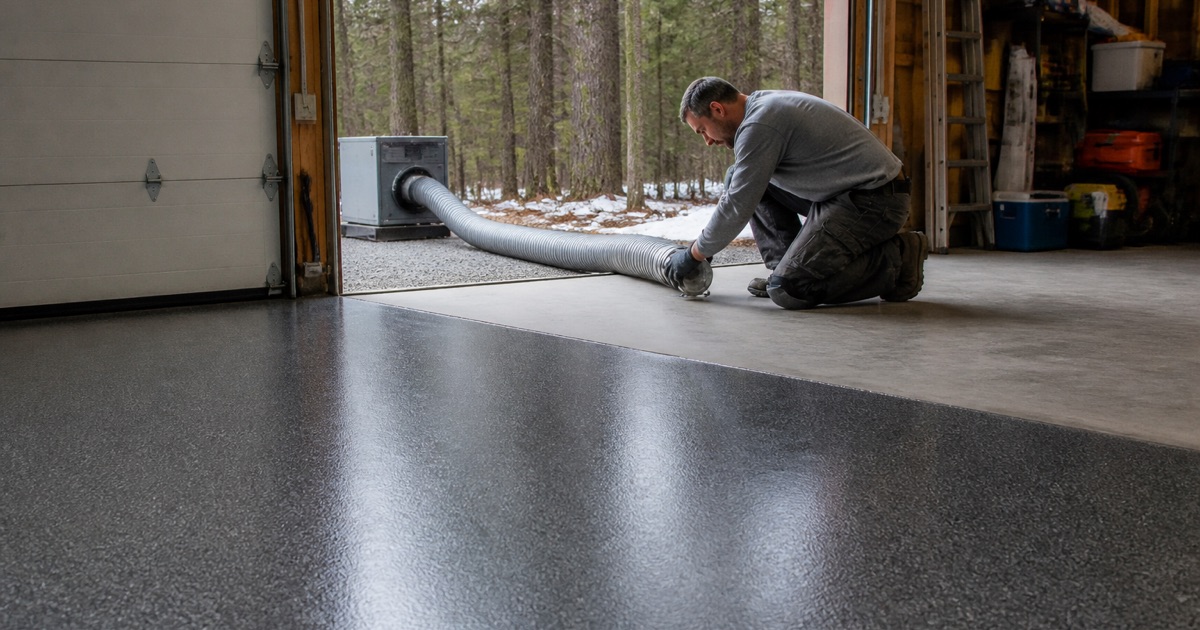
Where a job genuinely has to happen outside the comfortable season, heating and controlling the space is a real option rather than a fudge. In an enclosed garage that can work well, and it carries requirements of its own around ventilation, even heat distribution and holding temperature through cure rather than only during application.
It also costs money, and we set that out honestly as an option rather than either refusing the work or taking it and hoping for a warm week. Once the trade-off is clear the decision belongs to the owner.
Testing on Mountain Slabs
We moisture test every slab before ordering, using the ASTM F1869 calcium chloride test for a vapor emission rate at the surface and the ASTM F2170 in-situ relative humidity probe for the state of the slab at depth, with thresholds read from ASTM F710.
On a building that sits unheated through a cold season, a single reading taken on one dry afternoon is not the whole picture, and we say so rather than over-claiming. The ASTM D4263 plastic sheet test is a screen only — asymmetric, so a positive fails a slab while a negative proves nothing. We run the measured tests regardless of what it suggests, because on an unheated mountain building the margin for error is smaller.
Finishes and Practical Choices
What Suits a Mountain Garage
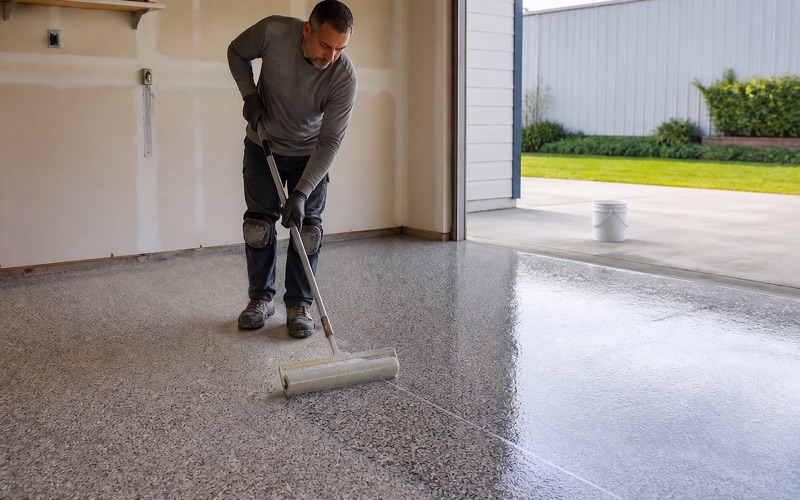
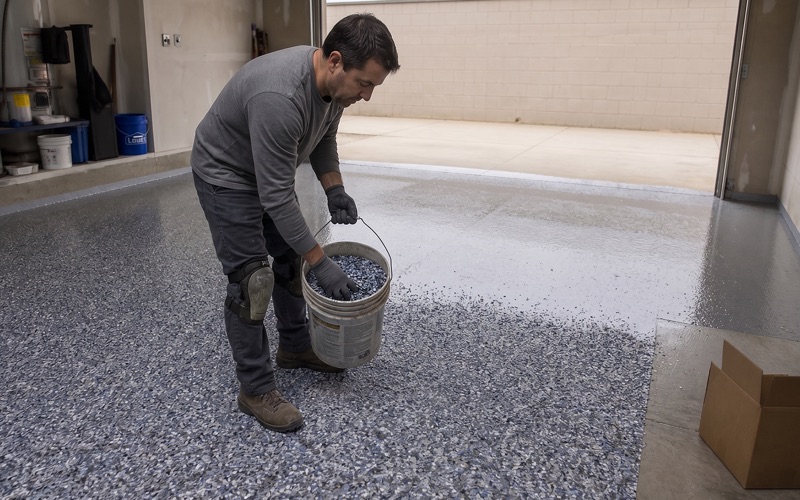
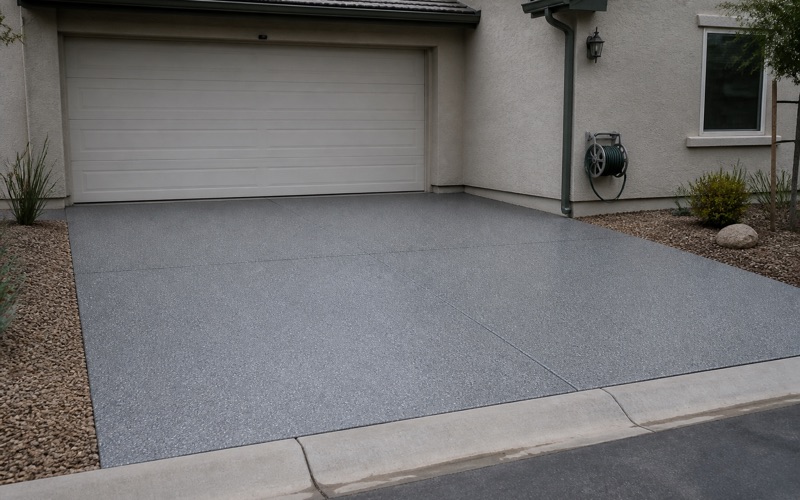
A building that takes wet boots, grit, snow melt and firewood wants texture and forgiveness rather than depth and gloss. A full flake or quartz broadcast gives genuine grip underfoot and hides the marks a mountain garage collects between seasons.
Gloss level deserves a deliberate decision too. High gloss shows every scratch and every piece of tracked-in grit, while satin hides a great deal and is usually what people are happiest with a year later in a building used hard and cleaned rarely.
Repair Is Usually Part of the Job
On older mountain concrete, grinding exposes work rather than simply preparing a surface. Control joints need filling with a semi-rigid material so they keep moving without cracking the coating above them, spalls and broken edges need cutting back and patching, and contaminated areas need treating before priming.
All of that is scoped and priced with the floor rather than raised once work has started. On a slab that has been through decades of freeze cycles it is frequently a larger share of the job than the coating itself, and a quote that does not mention it is not describing the same work.
Planning Ahead Rather Than Reacting
The most useful thing an owner here can do is identify a floor in spring and book into the window rather than discovering a problem in November. A job identified early can be scheduled comfortably; the same job found in mid-winter waits until conditions allow, whatever anybody would prefer.
We are happy to survey out of season and hold a scope ready for the right month. That costs nothing and it means the work happens under conditions that let the material do what it is designed to do rather than under pressure. That is worth more to the finished floor than any difference between one product range and another.
- 20+ Years Experience
- Free Estimates
- Every Slab Moisture Tested