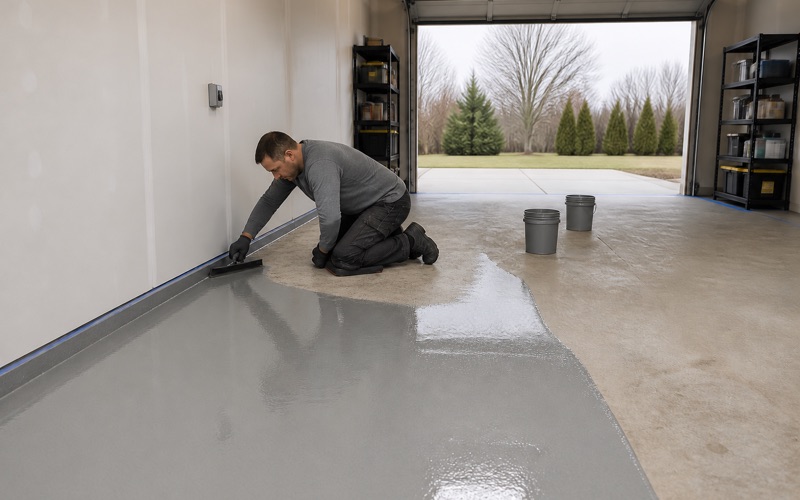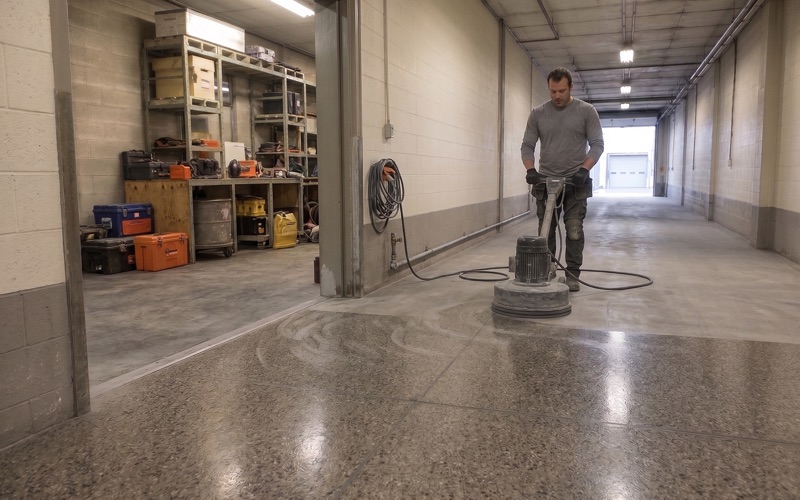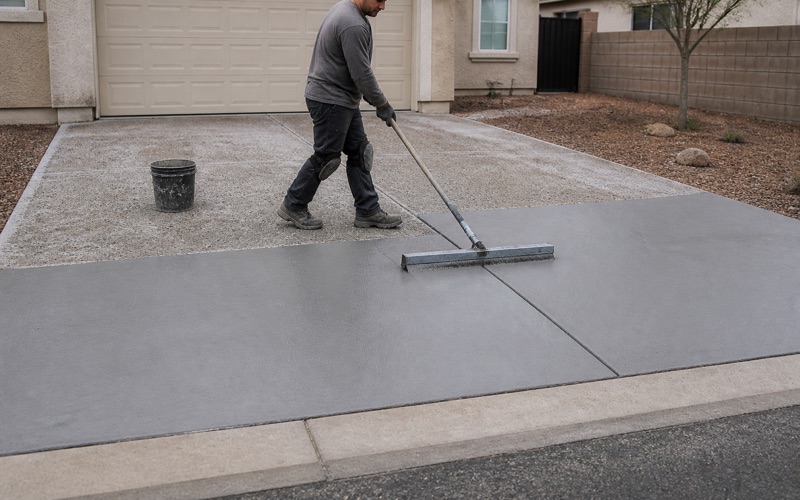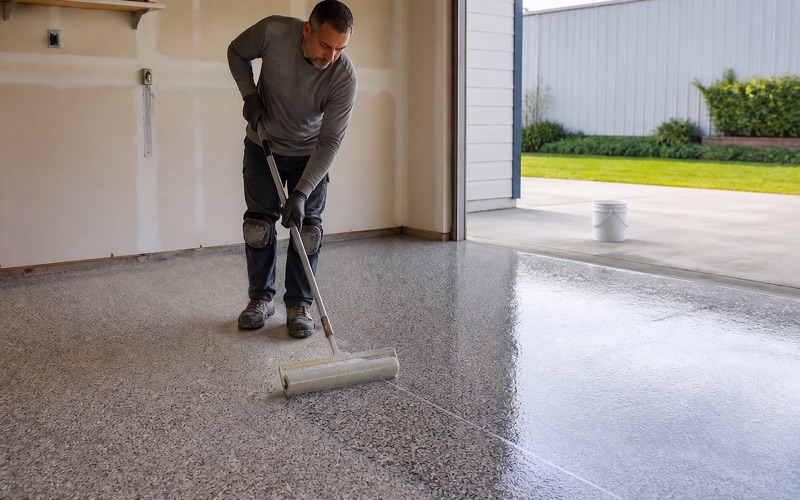
Colton Epoxy Flooring installs commercial epoxy flooring in Riverside, CA, along with residential garage systems, polished concrete and concrete resurfacing across the city. We have more than twenty years of resinous flooring behind us in this valley, and Riverside asks for most of that range, because it holds both the largest housing stock we work in and the deepest historic one.
The thing that governs how we work here is slab age. A substantial share of this city was built before 1960 and a real slice of that predates the war, which leaves a very large body of concrete placed before under-slab vapor retarders became routine construction practice. On a great deal of the residential work here, testing is the job rather than a preliminary to it.
There is also something in Riverside that exists nowhere else on our service area, and it can reach into a garage floor. The city operates a Cultural Resources Ordinance under Municipal Code Title 20, with a Cultural Heritage Board, four levels of local designation and a Certificate of Appropriateness required for alteration of a designated or eligible resource.
When Design Review Reaches a Garage Floor
What the Ordinance Actually Covers
Riverside’s Cultural Resources Ordinance is a genuine, confirmable constraint rather than a piece of local color. It establishes levels of designation, a Cultural Heritage Board to administer them, and a requirement for a Certificate of Appropriateness before a designated or eligible resource is altered. That is a real approval step with a real timeline attached to it.
What it does not do is apply across the board, and we would not tell a general reader that their garage floor needs one. The requirement attaches to designated and eligible resources rather than to the city at large, so the honest advice is to establish which category a property is in before work is scheduled rather than after.
Why It Is Worth Asking Before You Start
An interior floor coating is frequently outside the scope of exterior design review, and frequently is not the same as always. The cost of asking is a phone call; the cost of guessing wrong falls on the owner rather than on us, which is an asymmetry worth respecting on a property carrying a designation.
We raise it at quoting on any property that looks like it might be affected, because it changes the schedule rather than the work. Where a Certificate is needed, factoring it in from the beginning turns an approval into a step rather than into a delay discovered halfway through.
The Historic Garage Is a Different Building
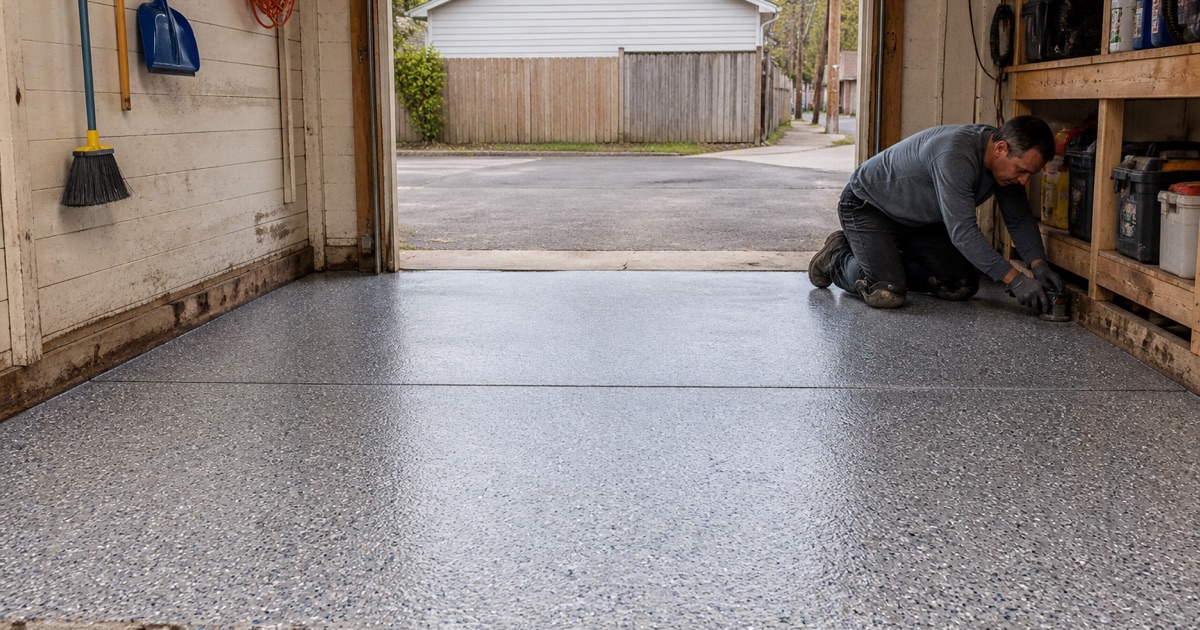
The city’s own design guidelines describe historic garages as generally accommodating only one small car, predominantly detached, sited at the rear of the lot and mostly accessed by alleys. That is not a stylistic observation; it is a description of a completely different working environment from a modern attached bay.
An alley-accessed detached garage means a longer equipment run, a tighter approach, no direct route from a driveway, and often no power in the building itself. All of that is worth establishing on the site visit, because it changes the day rather than the specification.
Looking for epoxy flooring closer to Highland? See Highland Epoxy Flooring.
The Largest Pre-1960 Slab Stock We Work On
What 26,722 Units Actually Means
More than a quarter of Riverside’s housing predates 1960 and 6,284 units predate 1940. In a city with 99,910 total housing units — the largest stock on our service area by a wide margin — even a modest percentage is a very large absolute number of old slabs, and it is the reason moisture testing here is scope rather than an upsell.
Under-slab vapor retarders were not routine practice before roughly the 1960s, so on that tier the working assumption is that there is nothing beneath the slab. Vapor moving up through unprotected concrete does not damage the concrete at all; it pushes whatever is bonded on top of it off, which is why a perfectly prepared floor can still fail.
The Three Tests and What Each One Answers
We read a moisture vapor emission rate at the surface with the ASTM F1869 calcium chloride test, and the state of the slab at depth with the ASTM F2170 in-situ relative humidity probe. Those measure genuinely different things, and the threshold numbers for both live in ASTM F710 rather than in the test methods themselves.
The ASTM D4263 plastic sheet test is the one most homeowners have heard of, and it is worth understanding properly: it is asymmetric, so a positive result fails a slab while a negative one proves nothing at all. We use it as a quick screen and never as the basis for ordering material on pre-war concrete.
When Polished Concrete Is the Better Answer
On an old slab that reads high for moisture, polished concrete deserves serious consideration, because the failure mode that defeats a coating does not exist for it. With nothing bonded on top, there is no film for vapor pressure to lift, and the finished floor is the concrete itself rather than something applied to it.
It is not universally the answer, since polishing cannot conceal a patched, contaminated or badly placed slab and it exposes whatever the concrete contains permanently. On sound old concrete with a moisture problem, though, it is frequently the best option available and we would rather recommend it than sell a coating that will not survive.
Commercial Floors Across a Large City
Buildings That Cannot Close
Most commercial work here happens in occupied buildings, so it is phased rather than simply scheduled. We break a floor into bays, zones or rooms that can be prepared, coated and cured while the rest of the space keeps operating, and agree that sequence with whoever runs the building before quoting rather than improvising it on the first morning.
Containment and HEPA dust extraction run continuously and access routes are protected for the duration, because the dust that causes a complaint is almost always the dust that travelled rather than the dust in the work area. Where a full shutdown is unavoidable it is normally a weekend rather than a week.
Kitchens, Labs and Back-of-House
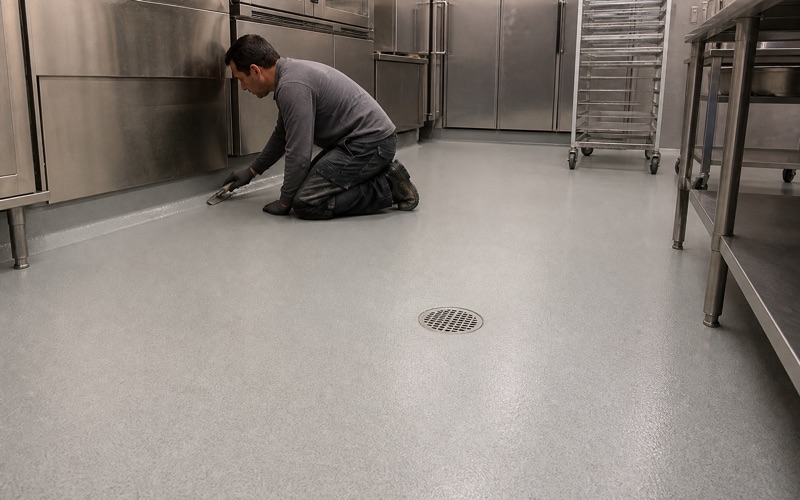
Commercial kitchens, laboratories and food-handling areas are specified around cleanability rather than appearance: a seamless, coved, chemically resistant surface with no junction at the wall for water to get behind. In the hottest and wettest of those rooms urethane cement outperforms epoxy substantially, because its thermal expansion behaves much more like the concrete under it.
We will say that rather than sell an epoxy into a room that will delaminate it the first time boiling water hits the floor. That conversation is far better had at quoting than as a warranty argument two years later.
The Category Question
Riverside sits inside the South Coast Air Quality Management District, where Rule 1113 caps floor coatings at 50 grams per liter of volatile organic compounds and industrial maintenance coatings at 100, and treats the two categories as mutually exclusive rather than as a range.
Subsection (c)(6) prohibits applying, or soliciting the application of, industrial maintenance coatings for residential use, so which category a building falls into is a legal determination rather than a preference. We settle it before quoting rather than inferring it from what a building looks like from the street.
Practicalities
Access Varies With the Era
Riverside presents almost every access condition we deal with, and it maps closely to construction era. The historic neighborhoods have alley-accessed detached garages, narrow driveways and limited staging room; the postwar and later tract areas are straightforward; the commercial and industrial buildings offer dock-height access and hardstanding.
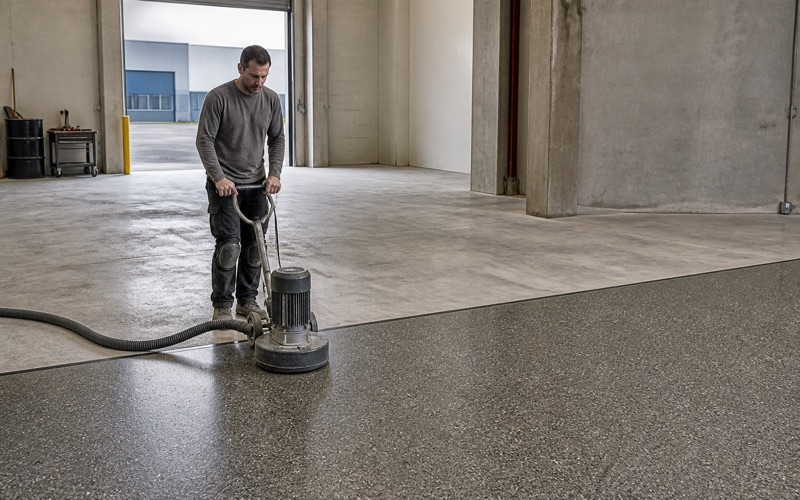
We settle staging on the site visit rather than the morning of the job, because on an older property whether a planetary grinder can physically reach the slab is a genuine question rather than a formality. It rarely stops a job and it frequently changes how long one takes.
Heat, Pot Life and the Calendar
Temperature at the slab, not in the air, decides the working day. Pot life on a common system drops from about 60 minutes at 55 degrees to something nearer 20 at 95, and the recoat window closes faster alongside it.
Summer work therefore means early starts, smaller batches and a sequence planned across the floor before anything is mixed. Every return-to-service date we quote is read against the actual surface temperature and dew point on the day, and we give you the date before the work starts rather than after it.
What Else We Do Here
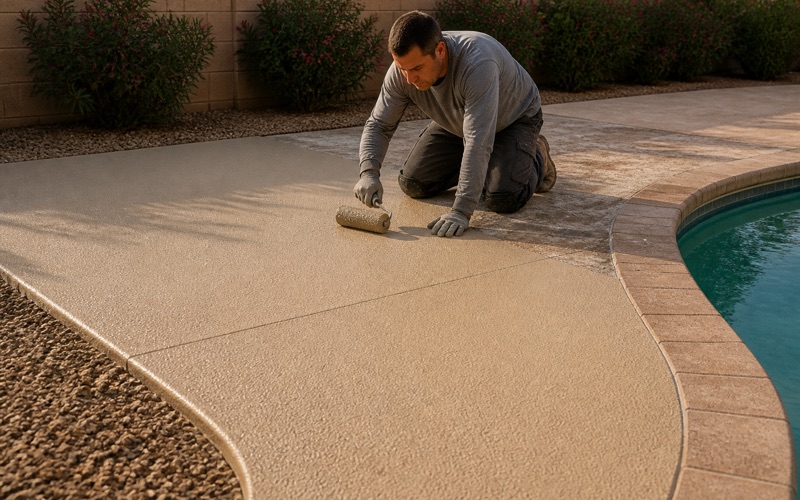
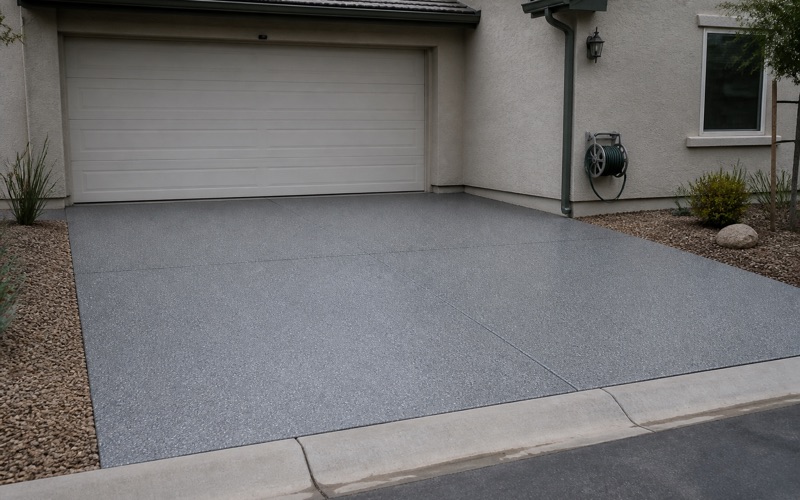
Beyond garages and commercial floors, the same crew installs polished concrete, resurfaces driveways, patios and pool decks, and prepares slabs for other trades. Exterior work needs a genuinely different specification — ultraviolet-stable polyaspartic or polyurea rather than an epoxy topcoat, texture broadcast in for slip resistance, and color chosen with surface temperature in mind.
On a large old lot with a detached garage, a driveway and a patio, doing them together usually makes sense. The mobilization and much of the preparation equipment is shared, and the transitions between slabs look far better when all of them were planned as one job.
- 20+ Years Experience
- Free Estimates
- Every Slab Moisture Tested