Colton Epoxy Flooring installs epoxy flooring in Redlands, CA, covering residential garages, polished concrete and the commercial floors in and around the city. We have spent more than twenty years working concrete in this valley, and Redlands is a short enough drive that a site visit costs nothing but the time. That proximity matters more on commercial work than residential, because phased jobs need someone who can be on site at the start and end of a shift without a long drive at either end.
There is one local fact here that almost never gets written down and that changes how a commercial job proceeds. Redlands completely surrounds an unincorporated San Bernardino County enclave of roughly a thousand acres, known locally as the Donut Hole, which holds Citrus Plaza, the Mountain Grove center and a dense cluster of distribution buildings.
Everything inside it carries a Redlands mailing address and none of it is permitted by the City of Redlands. That distinction is worth understanding before anyone writes a schedule. It is not obscure trivia; it is the difference between a permit that arrives on time and one that arrives from the wrong department.
A Redlands Address the City Does Not Permit
What the Donut Hole Actually Is
The enclave is unincorporated county land entirely enclosed by the city. Buildings there have Redlands addresses, Redlands postcodes and, to anyone driving past, every appearance of being in the city — but their building permits come from San Bernardino County Land Use Services rather than from the city’s own department. There is no signage, no change in road surface and nothing else to indicate the boundary, which is precisely why it catches people out.
For a floor coating job the technical work is identical either side of that line. What differs is the plan-check route, the counter you deal with and the timeline attached to it, and none of those are things to discover once a tenant improvement is already on a critical path. A week lost to filing with the wrong department is a week the tenant is paying rent on a building they cannot occupy.
Why It Matters Commercially
The enclave is not a residential curiosity. It holds a substantial retail and distribution concentration, and the city’s own principal-employers schedule lists those employers in a separate block from the city ones — a block that is almost entirely distribution. That the city itself lists them separately is a useful confirmation that the distinction is real and recognized rather than a technicality we are inventing.
So the buildings most likely to need a large-area industrial floor in this area are disproportionately the ones sitting under county rather than city jurisdiction. That makes the question a practical one for exactly the jobs where getting it wrong costs the most. A homeowner filing late loses a weekend; a distribution tenant filing late loses a lease start date.
Checking Before You Commit
The practical advice is simple: on a commercial job anywhere near that boundary, confirm which building department the parcel actually belongs to before the schedule is written. A mailing address does not settle it, and the boundary is not visible from the street. The parcel record settles it in a couple of minutes, which is a reasonable investment against the alternative.
We check as a matter of course, because we work both sides of it regularly. It takes one look at a parcel and it removes the single most likely source of delay on a commercial floor here. We would rather do that at quoting than explain a delay afterwards, and it costs the client nothing either way.
Looking for concrete floor coating closer to Jurupa Valley? See Concrete Floor Coating in Jurupa Valley.
The Residential Side and Its Pre-War Tier
A Genuine Pre-War Stock
Redlands carries a real pre-war residential tier rather than a token one. 2,342 units were built in 1939 or earlier and another 1,017 in the 1940s, inside a housing stock where 26.3% predates 1960 — which is a substantial body of concrete placed before under-slab vapor retarders were routine practice. Redlands has more genuinely pre-war housing than almost anywhere else on our service area, and it is concentrated rather than scattered.
On that tier the coating question is genuinely a testing question. Vapor moving up through an unprotected slab pushes whatever is bonded to it off, and that happens regardless of how carefully the surface was prepared or how good the product is. That is the hardest thing to explain to somebody who has just paid for a floor that lifted, and it is why we would rather test first and be sure.
Testing Before Anything Is Ordered
We moisture test every slab before product is ordered, using the ASTM F1869 calcium chloride test for a surface emission rate and the ASTM F2170 in-situ relative humidity probe for the state of the slab at depth, with the threshold numbers taken from ASTM F710. Running both matters because they measure different things — a rate at the surface and a state at depth — and a slab can look acceptable on one while failing the other.
The ASTM D4263 plastic sheet test is the one most homeowners have heard of and it is worth understanding correctly: it is asymmetric, so a positive result fails a slab while a negative one proves nothing at all. We treat it as a screen rather than as a measurement. It costs nothing to run and it should never be the basis for ordering material on a pre-war slab.
The Larger Modern Stock
Most of the city is not pre-war, and the addressable residential pool here is 12,499 owner-occupied single-family detached houses — the largest of any city we cover apart from San Bernardino itself. The bulk of that is ordinary postwar and later tract housing with straightforward slabs. For most homeowners here the job is the predictable one rather than the complicated one, and the price reflects that.
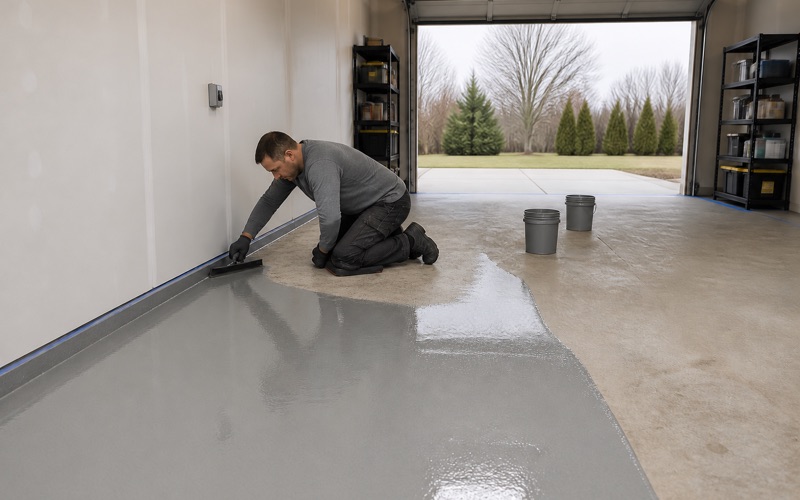
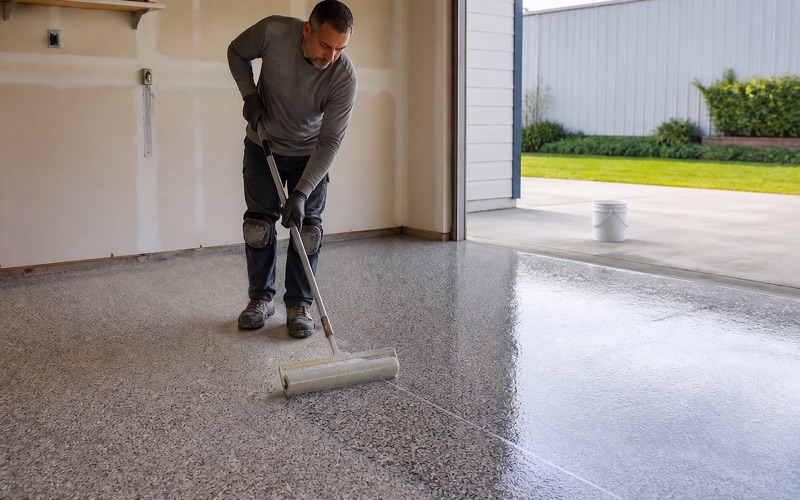
Those jobs run predictably: grind to an ICRI concrete surface profile, fill the control joints with a semi-rigid material, patch spalls, treat oil contamination, then prime, build and topcoat. The variation in price comes almost entirely from what is already on the floor. A slab that has never been coated is a materially cheaper job than one carrying a failed kit that has to be sheared off first, and that difference is visible on the site visit rather than over the phone.
Commercial Work On Both Sides of the Line
Distribution and Retail Floors
The distribution cluster in and around the enclave is the heaviest floor stock in this area, and it needs what large-area industrial floors always need: joint filling to protect edges from hard-wheeled traffic, crack repair, a coating or hardener chosen on abrasion and impact, and striping laid out to the racking plan. We ask about wheel material and pallet-jack routes before proposing a product, because those answers narrow the options faster than the square footage does.
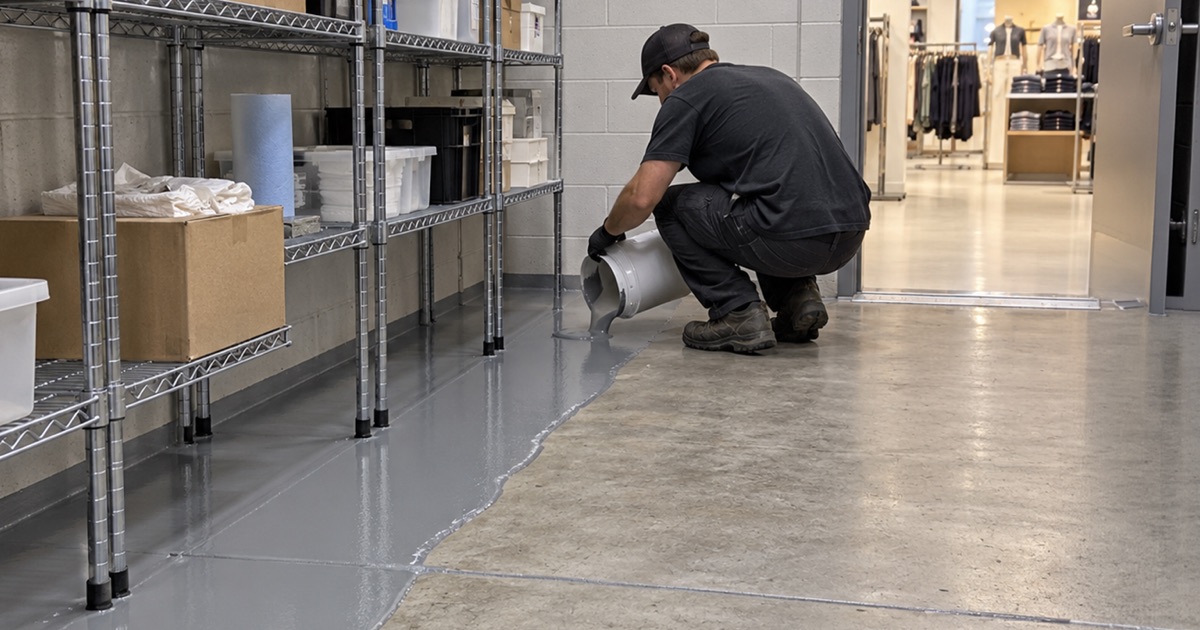
Retail back-of-house is its own category again — stockrooms, receiving areas and food-handling spaces in a retail center each want cleanability and durability rather than appearance, and they are usually coated in phases around trading hours. A stockroom floor that fails is a trading problem rather than an aesthetic one, which tends to make retail clients unusually clear about what they need.
Working in Buildings That Stay Open
Very little commercial floor work here happens in an empty building. We phase by zone, bay or room so the rest of the space keeps operating, run containment and HEPA extraction continuously, and protect access routes for the duration of the work. Dust that escapes a contained area is the thing a building’s occupants actually notice, so protecting the route matters as much as containing the room.
Where a full shutdown is unavoidable it is normally a weekend rather than a week, and a fast-cure polyaspartic or polyurea topcoat is what makes that possible. We quote the return-to-service dates against the actual slab temperature and dew point rather than a label average. Releasing a commercial floor early damages it before it has been paid for, and there is no way to recover that without redoing the area.
The Category Question
Redlands sits inside the South Coast Air Quality Management District, where Rule 1113 caps floor coatings at 50 grams per liter of volatile organic compounds and industrial maintenance coatings at 100, and treats the two as mutually exclusive. Which side of that line a building falls on is a legal determination rather than a marketing one, and it decides which products are even available for the job.
Subsection (c)(6) prohibits applying, or soliciting the application of, industrial maintenance coatings for residential use, which is worth settling explicitly on any mixed-use property. We confirm the category before quoting rather than inferring it from what a building looks like. A workshop on a residentially zoned parcel is a residential property however industrial the wear it takes, and that case arises here more often than people expect.
Practical Notes for Working Here
Access Across a Mixed City
Redlands presents almost every kind of access we deal with. The older neighborhoods have narrow driveways, shallow detached garages and limited room to stage a trailer; the newer tract areas are straightforward; and the commercial and distribution buildings offer dock-height access and hardstanding.
We work out the staging on the site visit rather than on the morning of the job, because on an older property the question of whether a planetary grinder can physically reach the slab is a real one rather than a formality.
Heat, Pot Life and Scheduling
Slab temperature governs the working day here as everywhere in this valley. Pot life on a common system runs about 60 minutes at 55 degrees and drops toward 20 minutes at 95 degrees, and the recoat minimum shortens alongside it.
Summer work therefore means early starts, smaller batches and a sequence planned across the floor before anything is mixed. We give the date you can use the floor before the work begins, read against actual conditions rather than a label figure.
What Else We Do Here
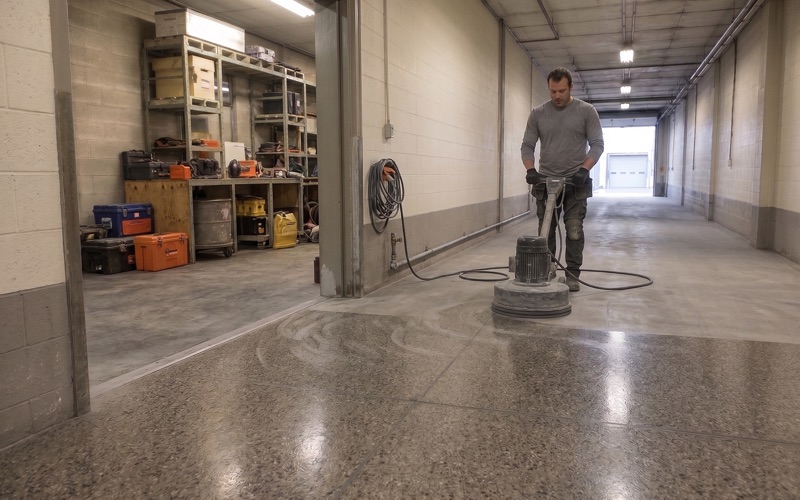
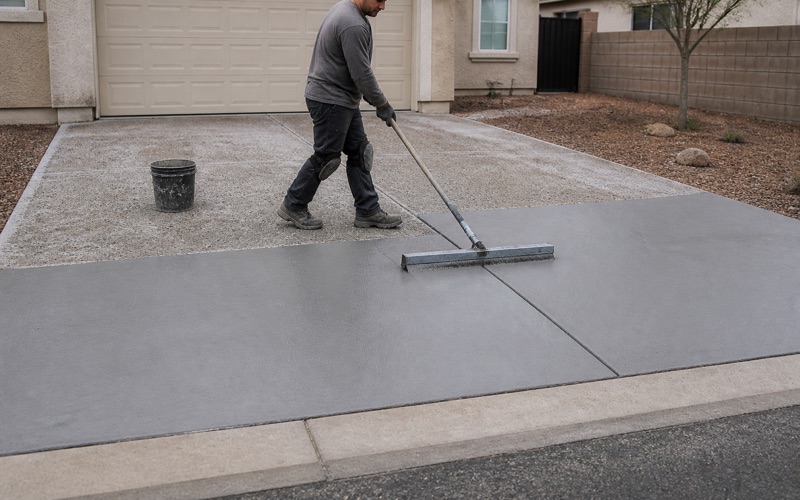
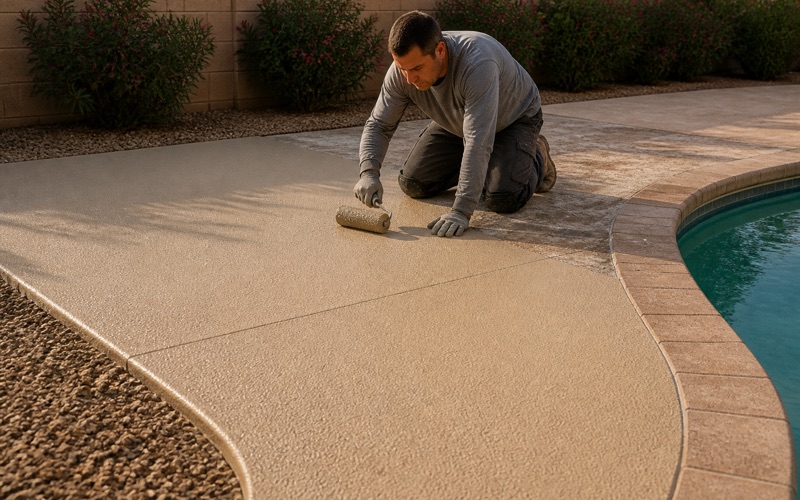
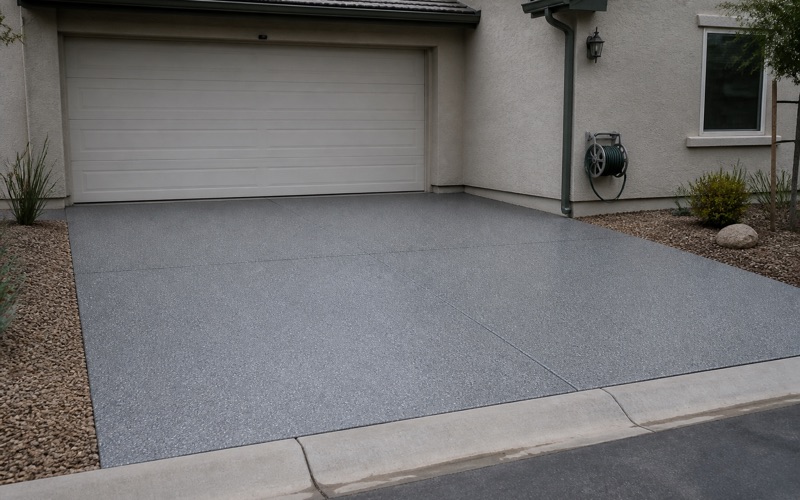
Garage floors are the bulk of the residential work, but the same crew installs polished concrete, resurfaces driveways, patios and pool decks, and coats the commercial and industrial floors in and around the city.
Exterior slabs need a different specification from anything indoors — ultraviolet-stable chemistry rather than an epoxy topcoat, texture broadcast in for slip resistance, and color chosen with surface temperature in mind, because a dark slab in full inland sun gets too hot to walk on barefoot.
- 20+ Years Experience
- Free Estimates
- Every Slab Moisture Tested