Colton Epoxy Flooring installs garage floor coating systems in Rancho Cucamonga, CA, along with polished concrete, resurfacing and commercial work. We have more than twenty years of concrete coating behind us in this region, and Rancho Cucamonga is a city where two things shape almost every residential job: who has to approve the finish, and who is going to see it. Neither of those questions comes up in most of the cities we serve, and both matter here more than any technical decision about the slab.
The city is substantially master-planned. Victoria, Terra Vista, Day Creek and The Resort are planned areas with homeowners associations maintaining common landscaping, parks and pools, and individual sub-associations operating within them. That governance layer is a real consideration rather than a background detail. It is also verifiable rather than assumed, which is why we raise it as a question instead of a warning.
The slab story is straightforward by comparison. 71.0% of the housing here was built in 1980 or later and only 4.5% predates 1960, so the typical garage has a modern slab with a vapor retarder beneath it, and a failed moisture test is the exception rather than the expectation. That makes this one of the more predictable residential markets on our service area.
Who Approves a Finish Before You Choose It
Associations and Sub-Associations
Master-planned areas here frequently have more than one layer of governance — a master association covering common areas and a sub-association covering a particular tract or product type. Which of those has a view on a given change is not always obvious from inside the house. Owners frequently know one association exists and not the other, which is exactly how an approval gets missed.
We raise the question at quoting on any property in a planned area. In many cases an interior garage floor is entirely outside what an association reviews, and confirming that costs a phone call while assuming it costs a floor if the assumption turns out wrong. We would rather ask a question that turns out unnecessary than skip one that turns out to have mattered.
Why a Garage Floor Can Read as Exterior
The complication is that a garage with the door open is visible from the street, which is why some associations take an interest in a finish that is technically interior. A bright metallic pour visible from the sidewalk is a different proposition from a neutral flake floor nobody notices. That is not a rule anywhere we have seen written down, and it is a pattern worth anticipating.
That is worth knowing before choosing a color rather than after. It rarely blocks a project and it occasionally changes which finish is the sensible one, and either way it is better established early. Choosing a finish twice is considerably more expensive than asking a question once.
What We Need From You
If a property is in an association, the useful things to establish before ordering material are whether an approval is needed at all, what it covers, and how long it takes. We can work to whatever the answer is; what we cannot do is unwind a floor that has already gone down. A coating is not reversible in any practical sense, which is why the approval question belongs before the order rather than after it.
Where an approval is needed we build the timeline into the schedule rather than treating it as a delay. It is the same principle as any other lead item on a job. Material lead times, cure windows and approvals all belong on the same schedule rather than being tracked separately.
Looking for epoxy flooring closer to El Sobrante? See Epoxy Flooring in El Sobrante.
A Consistent Post-1980 Slab
Predictable Bays, Predictable Prices
With 71.0% of housing built since 1980, the garages here are dimensionally consistent in a way that older cities are not. Two-car and three-car tract bays built to similar specifications mean quoting is more reliable and scheduling is more accurate, because there are fewer surprises waiting under a coating.
That consistency is worth something concrete to a homeowner. A quote given after a site visit here rarely moves, whereas in a mixed-era city the price genuinely depends on what grinding exposes. For a homeowner comparing two contractors, that predictability is worth understanding, because a low quote that moves is not a low quote.
Moisture Is the Exception, Not the Rule
Modern construction means an under-slab vapor retarder is likely present, so a failed moisture test here is unusual rather than expected. That said, likely is not certain, and the California Residential Code exempts garages from the vapor retarder requirement in the first place.
So we test every slab regardless, using the ASTM F1869 calcium chloride test for a surface emission rate and the ASTM F2170 in-situ relative humidity probe for the state of the slab at depth, with thresholds read from ASTM F710. The test is quick and it removes the one variable capable of destroying an otherwise perfect floor.
A Tight, Burnished Surface
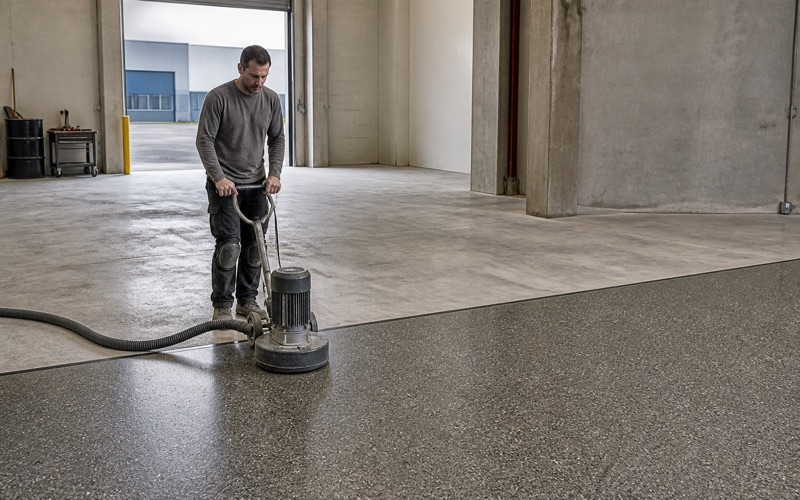
The preparation problem on a modern slab is the opposite of an old one. A power-troweled garage floor is dense and low-porosity, and it gives a resin very little to key into until it is opened mechanically to a specified concrete surface profile.
That is a grinding job with a diamond segment bond chosen against the hardness of the slab, run under continuous HEPA dust extraction. An acid etch cannot produce a consistent profile on concrete like this at all, which is why we do not use one.
When the Neighbors Can See Both Floors
Color and Flake Consistency Matters More Here
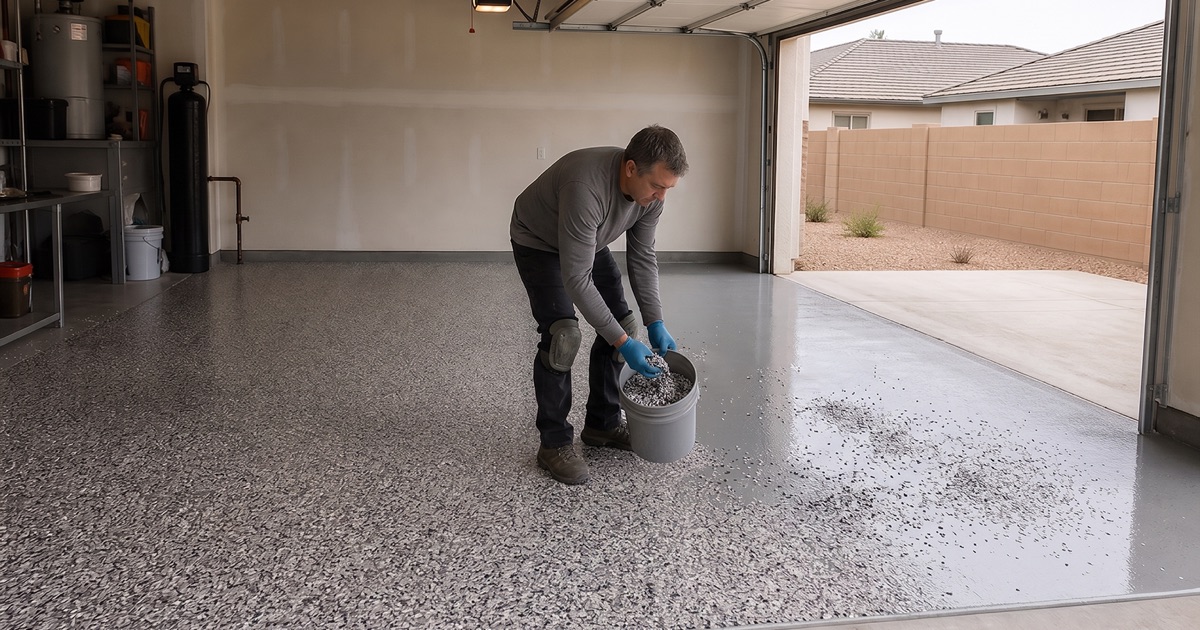
In a tract where houses are similar and garages face the street, finishes get compared directly in a way they never are in a mixed neighborhood. A flake blend that reads slightly differently from one two doors down is noticed, and it matters to people.
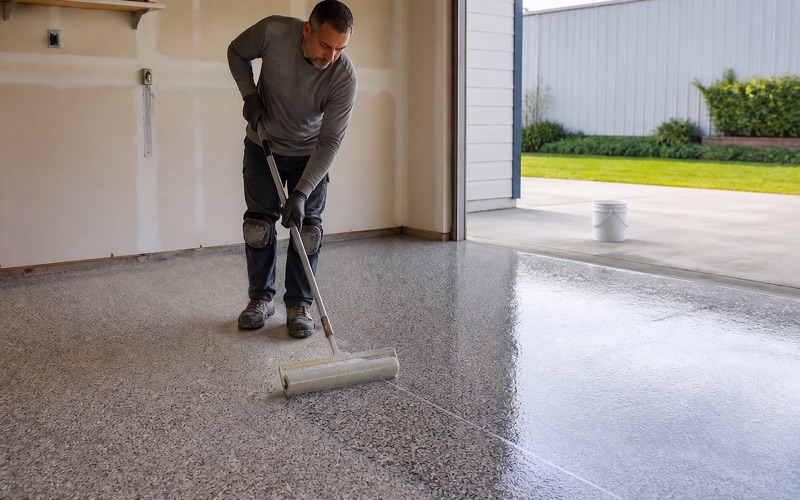
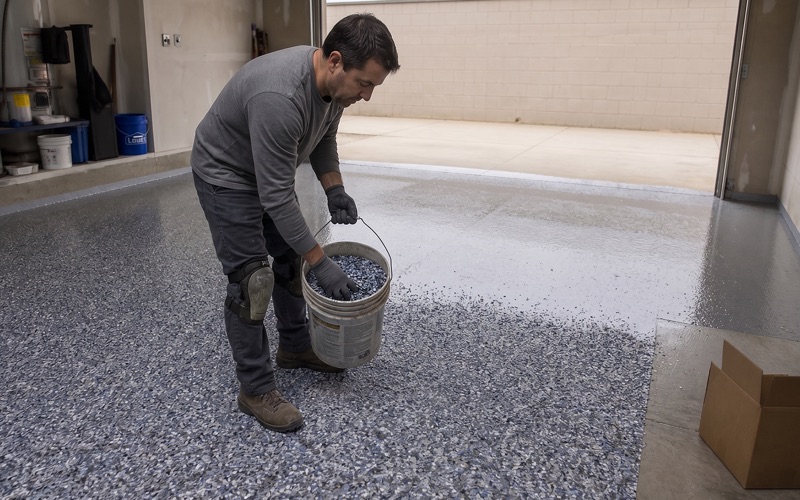
We put the blend name, the chip size and the broadcast rate in pounds per square foot into the written scope for exactly that reason. If you want to match a neighbor’s floor, those three numbers are what make it possible, and without them two quotes for a gray flake floor may be quoting genuinely different products.
Metallic Floors and Repeatability
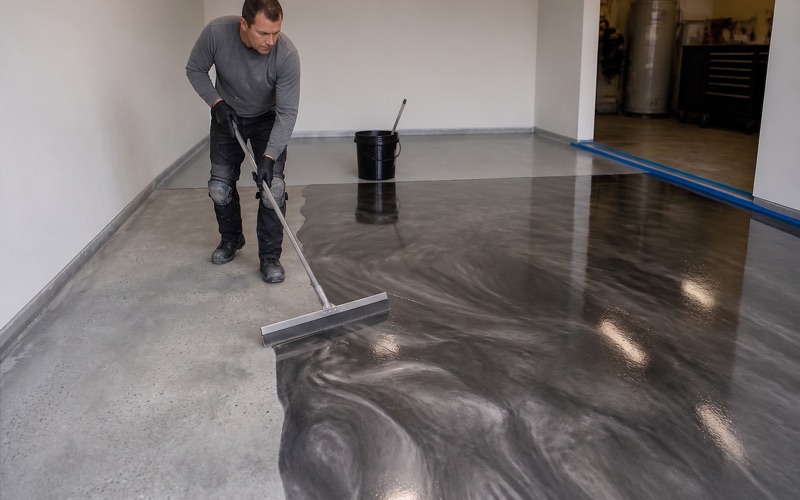
Where a metallic finish is wanted, the honest position is that the pattern is directed rather than controlled. Pigment is dispersed through clear resin and then moved, and the marbling that results depends on flow, temperature, film thickness and hand movement.
That means we can match a character and a color family but not an exact pattern, and anyone promising otherwise is overselling. On a street where floors get compared, being clear about that in advance avoids a disappointment that cannot be corrected afterwards.
Finish Choice in a Working Garage
Sheen is a practical decision. High gloss photographs best and shows dust, tire marks and every scratch afterwards; satin gives up a little depth and hides a great deal; matte hides the most. In a garage genuinely used for vehicles and storage, satin is usually what people are happiest with a year on.
Where a floor is mostly display — an enthusiast garage with the door open at weekends — the calculation changes and gloss may well be right. It is worth deciding deliberately rather than defaulting.
Beyond the Garage Floor
Driveways, Patios and Pool Decks
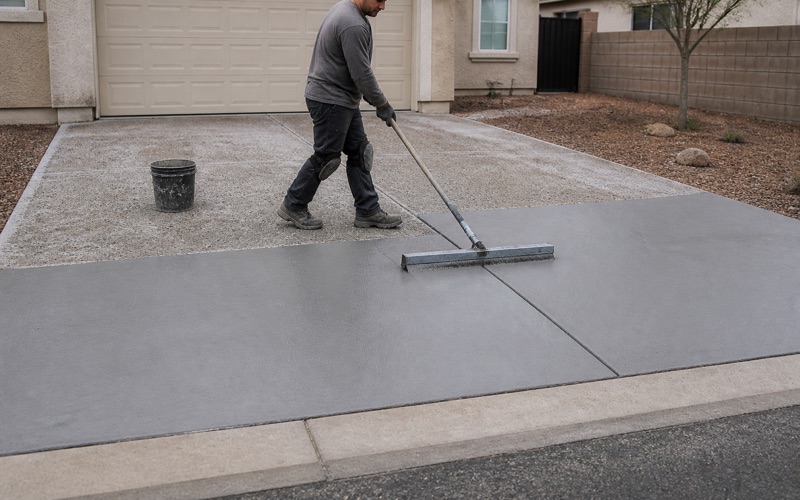
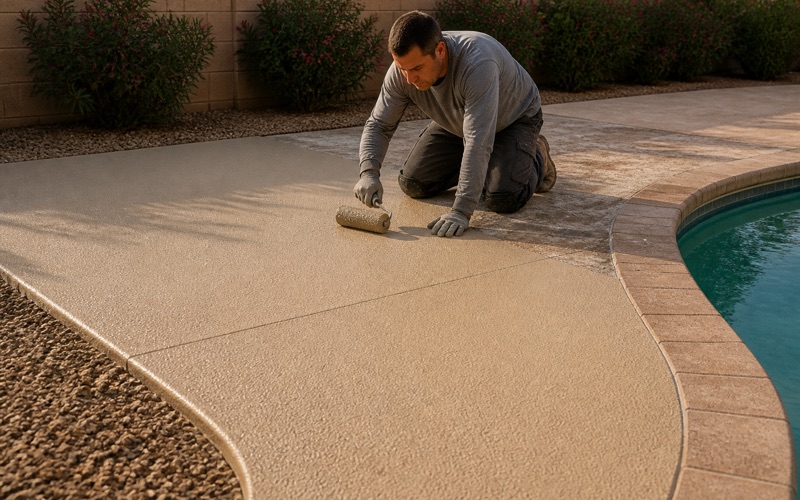
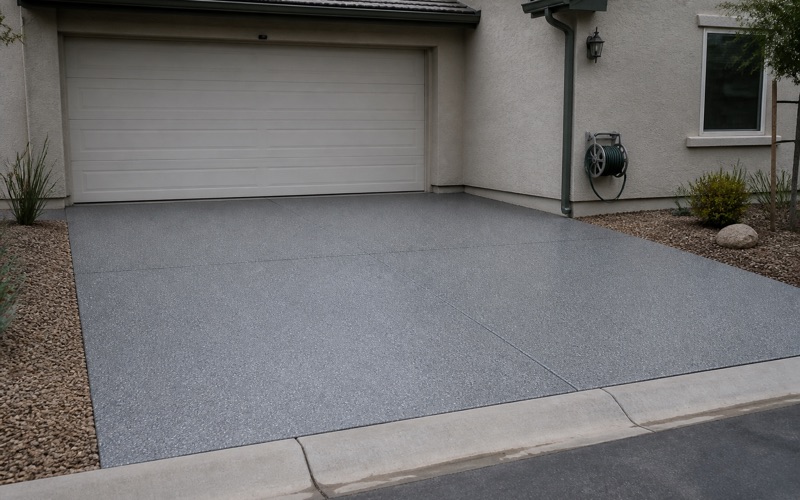
The same planned tracts that make the garages consistent also come with driveways, patios and frequently a pool surround, and those need a different specification rather than the same system applied outdoors. Ultraviolet exposure, thermal cycling, standing water and bare feet all change what the finish has to do.
Exterior work therefore uses aliphatic polyaspartic or polyurea chemistry, or a polymer-modified cementitious overlay where the surface is worn rather than failing, with texture broadcast in for slip resistance. Color matters for comfort as well as appearance, because a dark slab in full inland sun becomes too hot to walk on barefoot.
Polished Concrete Indoors
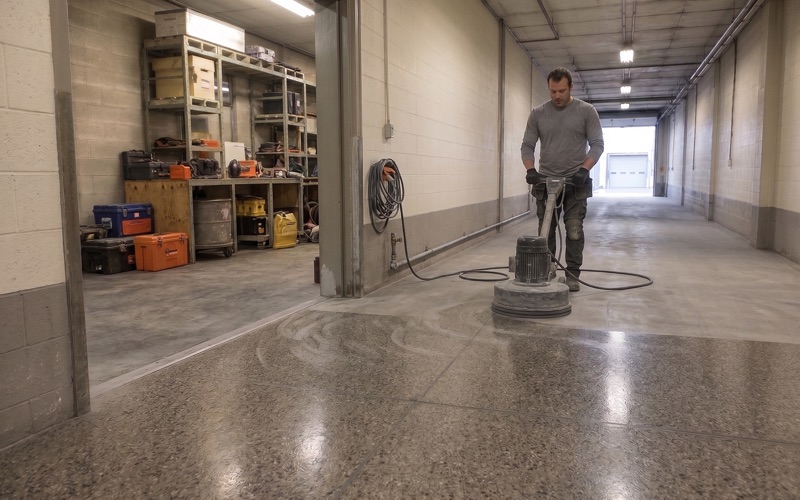
Where a slab is sound, flat and clean, polished concrete is a genuine alternative to a coating. The floor is ground through progressive grits, densified with a chemical hardener that reacts inside the concrete, and polished to a chosen gloss level, so what you walk on is the slab itself rather than something applied to it.
Nothing is bonded on top, so nothing can delaminate. The limitation is that polishing exposes whatever the concrete contains permanently, which is why we grind a test area first and let you judge against your own floor rather than a photograph.
Commercial and Retail Floors
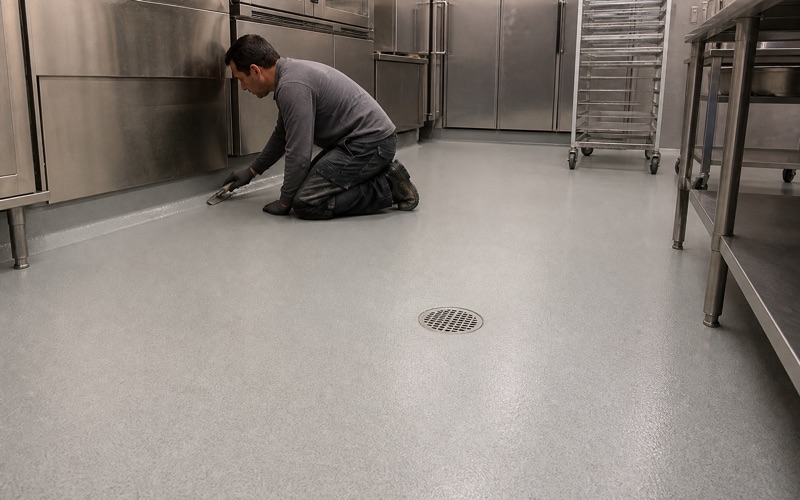
Alongside the residential work we coat commercial floors across the city — retail back-of-house, restaurant kitchens, medical and dental suites, workshops and light industrial space. Those are specified on cleanability, chemical exposure and traffic rather than on appearance.
Nearly all of them are phased, because the buildings stay open. We break a floor into zones, run containment and HEPA extraction throughout, and agree the sequence with whoever runs the space before quoting rather than settling it on the first morning.
- 20+ Years Experience
- Free Estimates
- Every Slab Moisture Tested