
Colton Epoxy Flooring installs polished concrete flooring throughout Colton, CA, and the surrounding cities including Grand Terrace, Bloomington, Rialto, Loma Linda and San Bernardino, drawing on more than twenty years of grinding and finishing concrete in this valley. Polished concrete is the one finish on our list that is not a coating at all, and that difference is the reason people choose it.
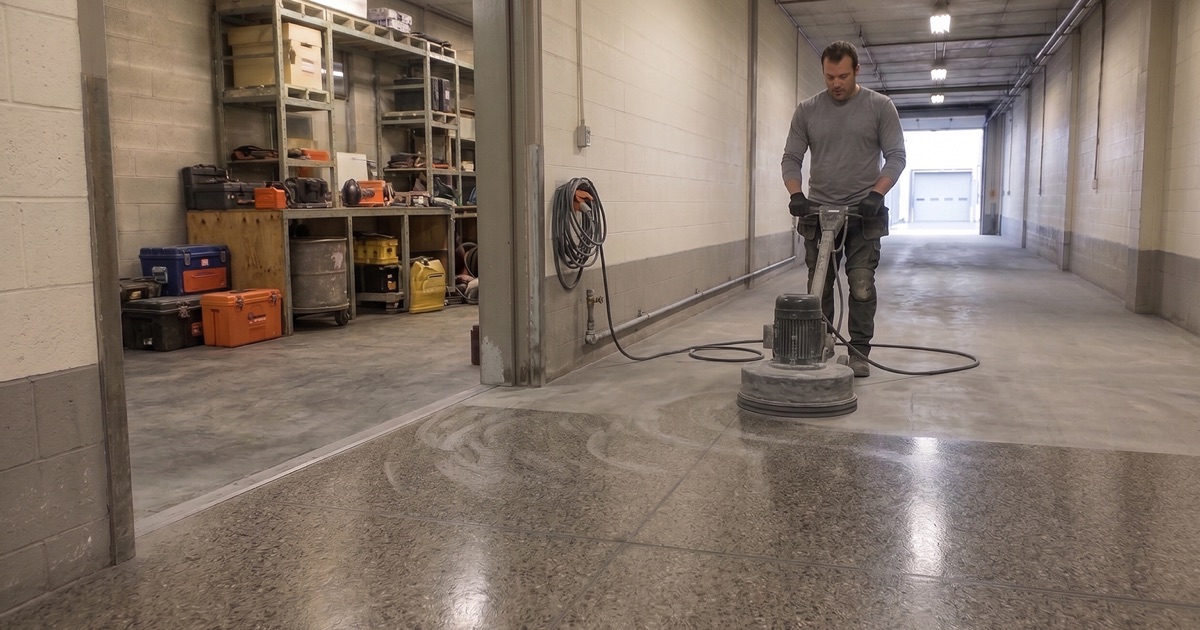
Instead of bonding a resin film to the slab, we refine the slab. The floor is ground through progressively finer diamond grits, densified with a chemical hardener that reacts inside the concrete, then polished to whatever gloss level suits the room. What you walk on afterwards is the concrete that was always there.
Because nothing is bonded on top, nothing can delaminate. The trade-off is that polishing cannot hide a poor slab, so the assessment at the start matters more here than on any coated floor.
Why Polished Concrete Behaves Differently
Nothing on Top Means Nothing to Let Go
Every failure mode we deal with on coated floors — blistering, peeling, hot-tire pickup, delamination — depends on there being a film bonded to concrete. A polished floor has no film. Moisture moving up through the slab passes through a polished surface rather than pushing it off, which is why polished concrete is often the right answer on a slab that failed a moisture test. That single property makes it worth considering on any floor where a coating has already failed once and nobody is certain why.
The Densifier Is Doing Chemistry, Not Sealing
A lithium silicate densifier is not a surface sealer. It penetrates and reacts with free lime inside the concrete to form additional binder, hardening the matrix from within so it takes a finer polish and resists abrasion. That reaction is what separates a genuinely polished floor from a slab that has simply been ground flat and waxed. It is also why the densifier has to go on at the right point in the grit sequence: applied too early it is ground straight back off, and applied too late it cannot penetrate.
Gloss Is a Specified Level, Not a Preference
Polished concrete is finished to a defined gloss level rather than a vague description, and the level is reached by how far up the grit sequence the work is taken. Deciding it in advance matters, because you cannot add gloss later without going back through the grits, and the specification affects both cost and maintenance. A higher gloss means more passes through finer resin-bond grits, so it costs more up front and shows scuffing a little more readily in a high-traffic corridor.
Which Colton Floors Suit Polishing
Commercial and Institutional Floors
Polished concrete earns its keep in buildings with heavy foot traffic and long maintenance horizons — retail, institutional corridors, school and campus buildings, offices and showrooms. There is nothing to recoat on a cycle, cleaning is a routine rather than a chemical program, and the finish gets better under traffic rather than worse. Over a ten or fifteen year horizon that absence of a recoat cycle is usually the number that decides the specification.
Warehouse and Industrial Slabs
On distribution and manufacturing floors, polishing plus densification hardens the wear surface and cuts dusting without adding a film that forklift traffic can chip off. It pairs naturally with joint filling, since a semi-rigid filler protects the joint edges that hard wheels would otherwise break down. On a distribution floor the joints are where damage concentrates, so filling them properly matters more to the life of the floor than the polish level does.
Residential Interiors and Garages
In houses, polished concrete works where the slab is sound and the look is wanted — open living areas, sunrooms and the occasional garage. It is unforgiving of a patched or badly placed slab, so we assess honestly before recommending it, and sometimes the right advice is a coated system instead. A garage slab is the most common residential case, and the deciding factors there are usually how much oil has soaked in and whether the original finish was troweled flat enough to polish evenly.
Assessing the Slab Before Committing
What Grinding Will Expose
Polishing removes the top layer of the slab, which means whatever the concrete contains becomes the floor’s appearance. Aggregate exposure, color variation, old patches, saw cuts and previous repairs all become visible and permanent. We grind a test area first so you can see what your particular slab is going to look like rather than a photograph of somebody else’s. That test patch takes an hour or two and it is the only part of this process that cannot be undone later, which is why we insist on it.
Hardness, Flatness and Existing Coatings
We check hardness, because that decides the diamond bond, and flatness, because polishing follows the slab rather than levelling it. Any existing coating or sealer has to come off completely first, which on a previously coated floor makes removal a real part of the scope rather than a formality. Removing an old coating ahead of polishing usually means PCD tooling first and then a conventional grit sequence, and it can add a day to the program on its own.
Aggregate Exposure Levels
How deep we grind decides whether you get a cream finish with almost no stone showing, a salt-and-pepper look with fine aggregate visible, or full aggregate exposure. That is a decision made against your slab’s actual placement depth, since grinding for full exposure on a slab whose aggregate sits low simply will not reach it. Pushing for exposure the slab cannot deliver removes more concrete than it should and leaves an uneven result, so the exposure level gets set by what the test patch shows rather than by preference.
Our Polished Concrete Process
Test Grind and Specification
We start with a test area, agree an aggregate exposure and gloss level from what it reveals, then write the specification. That document names the grit sequence, the densifier, the target gloss and the joint treatment, so the finished floor is measured against something rather than described afterwards. Having the target written down also settles what happens if a patch of slab behaves differently from the test area, which on older concrete does occasionally happen.
Repair, Joint Fill and Grinding
Cracks and spalls are repaired with materials chosen to take a polish alongside the surrounding slab, and control joints are filled where traffic requires it. Then the floor goes through the grit sequence in order, each pass removing the scratch pattern of the one before it, under continuous dust extraction. Skipping a grit to save time is the most common shortcut in this trade and it shows permanently, because the coarser scratch pattern never comes out.
Densifying and Polishing to Gloss
The densifier is applied at the right point in the sequence to react properly rather than sit on the surface, and the floor is then polished up through the finer resin-bond grits to the agreed gloss. A guard or protective treatment goes on at the end to make routine cleaning easier.
Living With a Polished Floor
Maintenance Is Cleaning, Not Recoating
A polished floor is maintained by dust mopping and neutral-pH damp cleaning rather than stripping and resealing. There is no recoat cycle to budget for, which is a large part of why it makes sense on a commercial floor with a long horizon.
Where Polishing Is the Wrong Answer
Polished concrete is not the right choice everywhere and we will say so. A slab with widespread patching, heavy contamination or serious surface damage will show all of it. Kitchens, wash-down rooms and areas needing chemical resistance or a coved detail are better served by a resinous system built for that duty.
- 20+ Years Experience
- Free Estimates
- Every Slab Moisture Tested