Colton Epoxy Flooring installs epoxy flooring in Norco, CA, and this is the one city on our service area where the biggest coating opportunity is usually not a garage. We have more than twenty years of concrete work behind us in this region, and Norco asks for a specification most flooring contractors never write. It is also the reason a generic garage-floor quote is close to useless on a property here.
Roughly 6,000 residential properties here — every parcel in the city’s animal-keeping zones — sit inside the Equestrian Historic District, and those parcels carry barns, stables, tack rooms and wash racks. Those are all concrete floors, they all wear out, and almost none of them should be specified the way a domestic garage is. Treating them as garages is the single most common mistake made on properties in this city.
The city’s protection of that character is unusually durable, too. Title 18 of the Norco Municipal Code, which carries the animal-keeping and zoning rights, cannot be changed, amended or repealed without a four-fifths supermajority vote of the City Council under the City Charter. This is not soft branding. The zoning that produces this work is protected well enough that it is worth building a specialty around rather than treating as a niche.
Barn, Stable and Wash-Rack Floors
Why a Stable Floor Is Not a Garage Floor
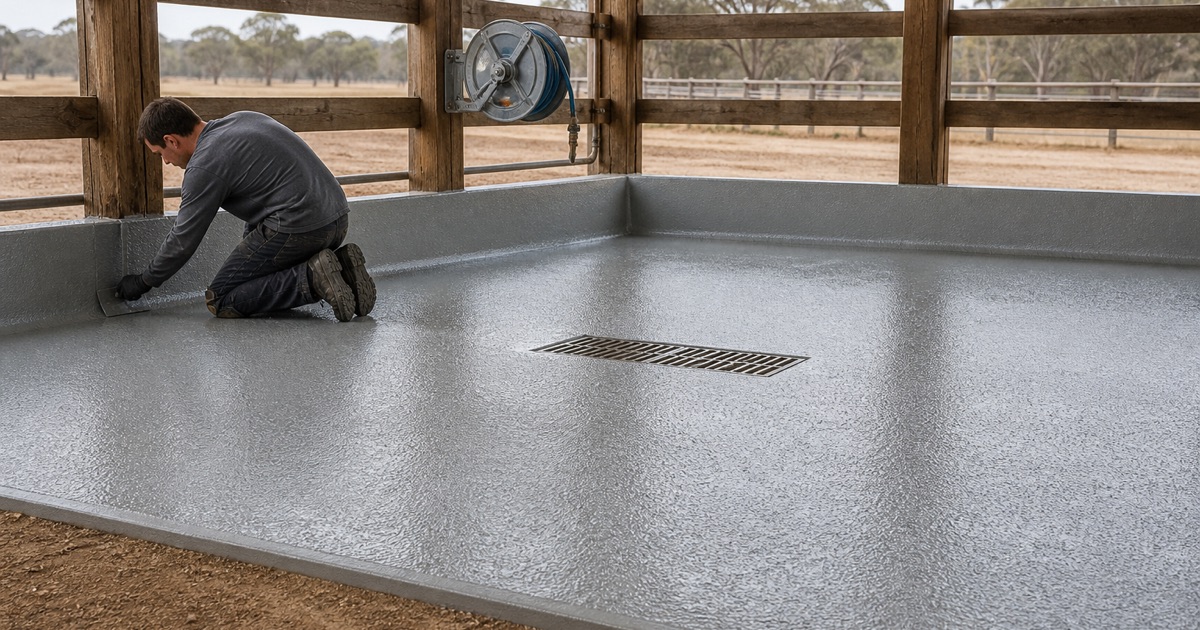
A wash rack and a stall floor face constant water, urine and manure ammonia, hoof impact and abrasion, and cleaning cycles that a garage never sees. Ammonia in particular is chemically aggressive in a way that motor oil is not, and it attacks both the coating and the concrete beneath it over time. That is why chemical resistance rather than abrasion resistance is the first question in a stall specification.
A system specified for a domestic garage put into a stall will fail, and it will fail in a way that is unpleasant rather than merely disappointing. The right answer is a chemically resistant, seamless system with a coved detail where the floor meets the wall so nothing gets behind it. A seam at floor level in a wash-down environment is the defect that ends a floor, and coving is what removes it.
Slip Resistance When the Animal Weighs Half a Ton
A horse on a wet smooth coating is a genuine safety problem rather than a theoretical one, and it is the single most important design consideration in this work. Texture has to be built into the finish rather than added at the end, because a broadcast grit applied over the top wears off separately from the coating underneath. Texture that is part of the system wears at the same rate as the system, which is the whole point.
That means aggregate broadcast into the system at a specified rate, with a slip resistance figure that can be quoted rather than described in adjectives. We would far rather commit to a number in the scope than tell an owner a floor is “non-slip” and leave it there. A number in a scope is something you can hold a contractor to; an adjective is not.
Tack Rooms, Feed Rooms and Aisles
The rest of an equestrian building has its own requirements. A tack room takes leather dressing, oils and foot traffic; a feed room needs to be cleanable and sealed against pests and spillage; a barn aisle takes hoof traffic, wheelbarrows and constant sweeping.
Those are three different duties and they are frequently quoted as one. We specify them separately where it matters and say plainly where a single system genuinely does cover all three, because over-specifying is as unhelpful as under-specifying. An owner paying for chemical resistance a tack room will never need is money that would be better spent on the wash rack.
Looking for epoxy flooring closer to Eastvale? See Epoxy Flooring in Eastvale.
Drainage, Substrate and Detailing
The Floor Is Half of a Drainage System
In a wash rack the coating and the drainage are one problem rather than two. Falls have to actually move water to the drain, the coating has to be continuous through the fall, and the junction at the drain itself is where a poorly detailed floor lets go first.
We look at the existing drainage before quoting a coating, because resurfacing a wash rack that ponds simply produces a smoother place for water to sit. Where fall needs correcting, that is a design decision made at quoting rather than a discovery afterwards. Correcting fall costs more than coating over it and it is the only version that actually solves the complaint.
Testing Older Agricultural Slabs
Barn and stable slabs are frequently older than the house and were often placed with less care, sometimes with no vapor retarder and occasionally over uncontrolled fill. We test every one before ordering, using the ASTM F1869 calcium chloride test and the ASTM F2170 in-situ relative humidity probe, with thresholds read from ASTM F710.
Contamination is the other question on an agricultural floor. Years of organic matter, ammonia and cleaning chemistry leave a slab that needs genuine remediation rather than a wash, and grinding is what reveals how deep that goes. We confirm the remediation scope after the first pass rather than promising it beforehand, because a swept slab hides most of it.
Preparation on a Working Property
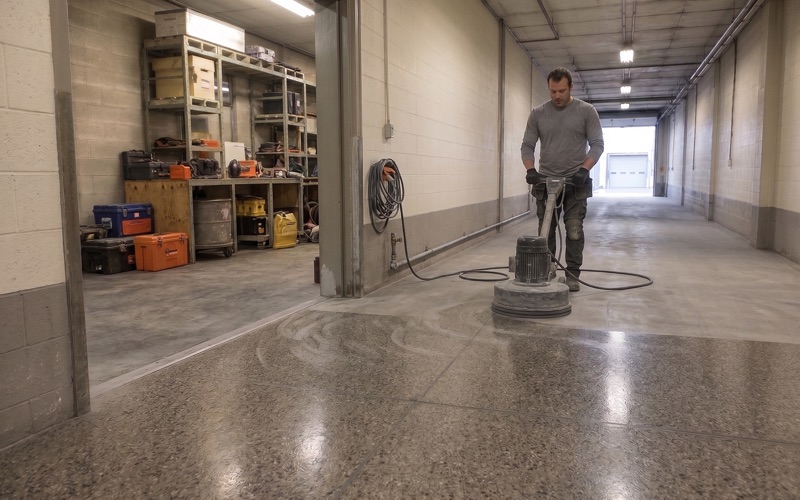
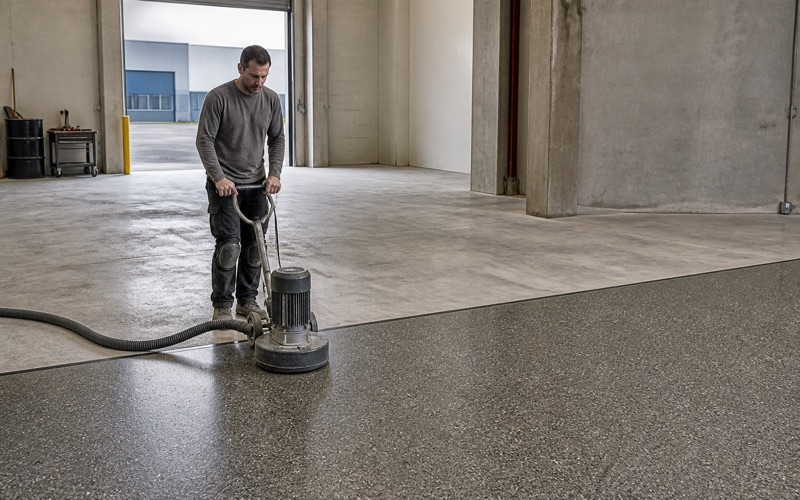
Every floor is opened mechanically — diamond grinding or shot blasting to the profile the system requires, with dust extraction running and the diamond bond chosen against the hardness of the slab. An acid etch has no place on any of it.
The practical complication is that these are working buildings with animals in them. Clearing a barn aisle or a stall block for grinding, cure and return to service takes planning and cooperation, and we agree that sequence in writing before the day rather than assuming somewhere else exists to put a horse.
The Rest of the Work in Norco
The Garage Is Usually There Too
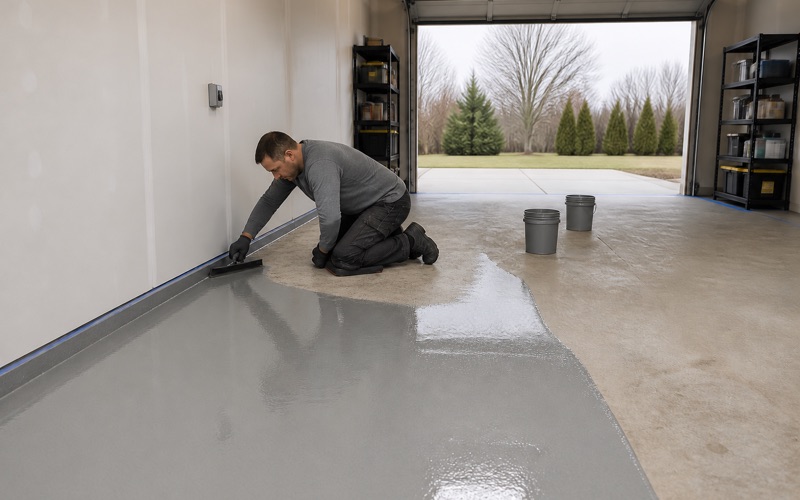
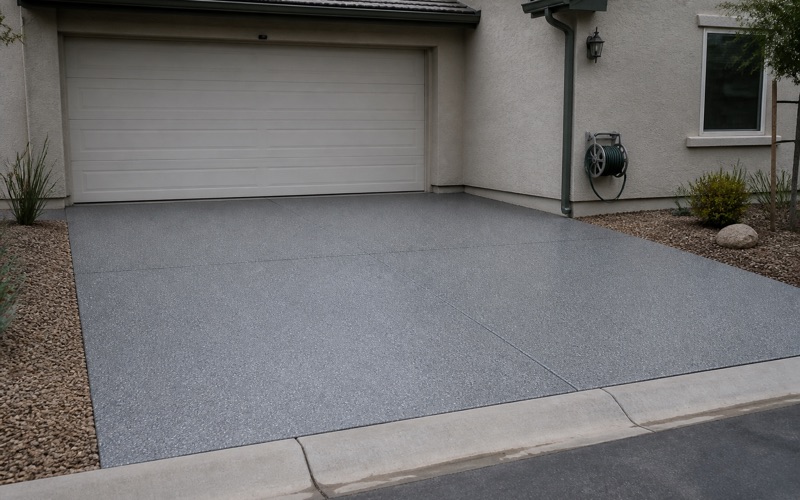
Almost every one of these properties also has a conventional garage, and doing both in one visit makes obvious sense. The mobilization and much of the preparation equipment is shared, so the second slab costs meaningfully less per square foot than it would as a separate job.
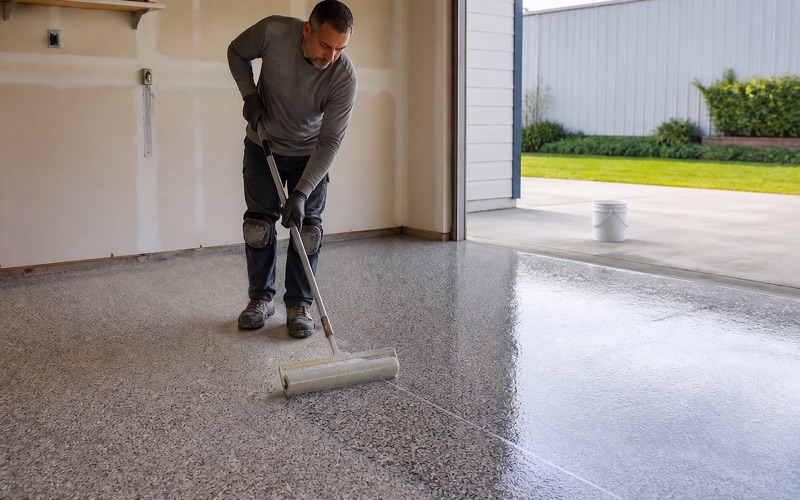
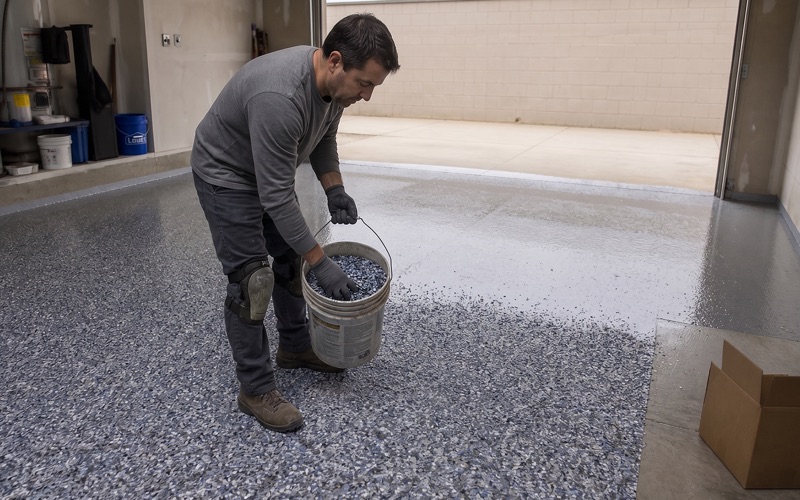
The specifications stay different even when the visit is the same. A garage takes an epoxy body coat with a flake or quartz broadcast and a polyaspartic topcoat; a stall floor takes a chemically resistant seamless system with aggressive texture designed in.
Exterior Slabs and Sun
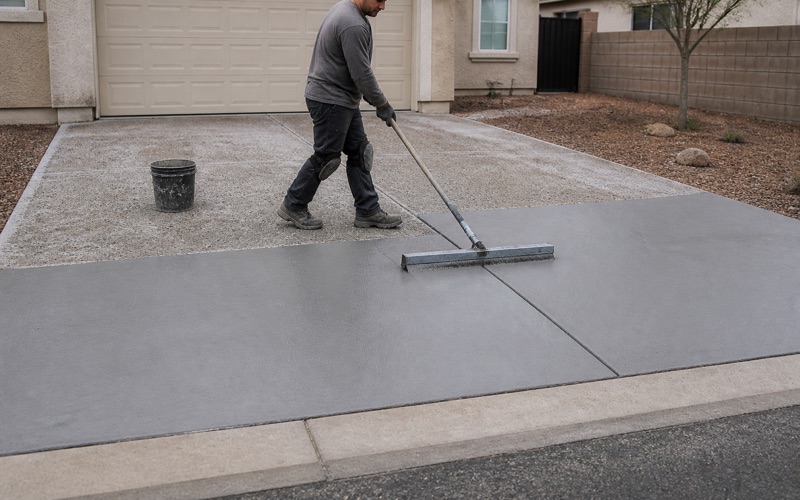
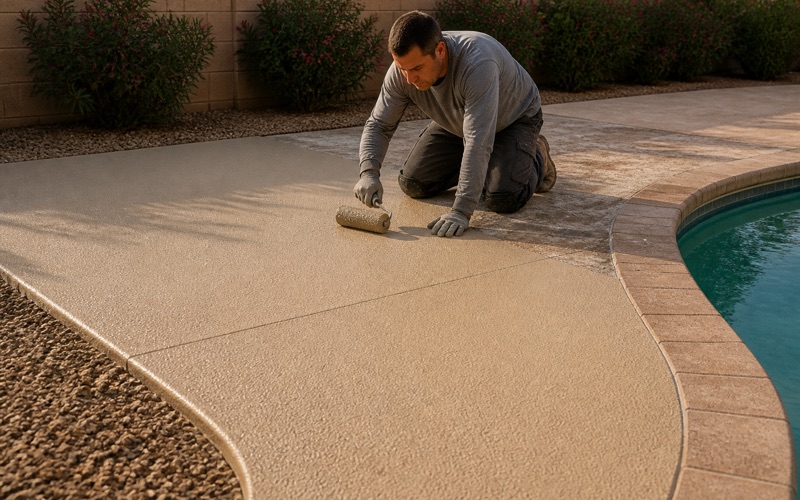
Driveways, patios, walkways and covered exterior areas all take direct inland sun, which rules out an epoxy topcoat because epoxy ambers under ultraviolet light. Exterior work gets aliphatic polyaspartic or polyurea chemistry, or a cementitious overlay where the surface is worn rather than failing.
Surface temperature matters for comfort as well as for application, since a dark exterior slab in full sun gets too hot to walk on barefoot. Infrared-reflective pigment reduces heat absorption for a given color and widens what is usable.
Category Rules on an Animal-Keeping Parcel
Norco sits inside the South Coast Air Quality Management District, where Rule 1113 caps floor coatings at 50 grams per liter of volatile organic compounds and industrial maintenance coatings at 100, treating the two as mutually exclusive categories.
Subsection (c)(6) prohibits applying, or soliciting the application of, industrial maintenance coatings for residential use, and this is exactly the kind of property where that needs thinking about. A barn on a residentially zoned parcel is a residential property however industrial the wear it takes, so the product decision is deliberate rather than automatic.
Scheduling Around a Working Property
Animals, Access and Cure Time
The hardest part of an equestrian job is rarely the floor. It is arranging for a barn aisle, a stall block or a wash rack to be genuinely out of use for preparation, application and cure, on a property where the animals still need somewhere to be for the whole of that period.
We work that out in writing before the date, section by section where the building allows it, so the property keeps functioning. Phasing a barn in halves usually costs a little more in mobilization and it is almost always the right answer on a working yard.
Dust Control Around Animals
Grinding produces a great deal of dust, and a barn is not a place to be casual about it. Our machines run under continuous HEPA extraction as standard, and we contain the work area and protect routes through the building for the duration.
That matters more here than in an empty garage, because respiratory sensitivity and feed contamination are both real concerns on a yard. It is worth agreeing beforehand where feed and bedding will be kept while the work runs.
What a Realistic Program Looks Like
A wash rack alone is usually a short job; a barn aisle with stalls either side is a program. Each area needs its own preparation, repair, application and cure, and cure windows are set by the material and the slab temperature rather than by how many people are on site.
We set out the sequence and the dates in writing before starting, including which areas are usable when. On a working property that schedule is frequently more important to the owner than the price, and it deserves the same care.
- 20+ Years Experience
- Free Estimates
- Every Slab Moisture Tested