Colton Epoxy Flooring installs epoxy flooring in Muscoy, CA, and the concrete here is the oldest we work on anywhere close to our base. We have spent more than twenty years coating slabs across this valley, which matters more in Muscoy than it does in most places, because a large majority of these floors were poured before the practices that make a modern coating straightforward existed.
The numbers are unusually clear-cut. 54.8% of Muscoy’s housing predates 1960, and 50.4% was built in the 1940s and 1950s alone. That is not a tail of older homes beneath a newer city; it is the city. Any page about coating floors here that leads with modern slab practice is describing somewhere else, and any quote built on that assumption will be wrong.
There is a second fact that shapes the work here just as much, and it is one people get wrong. Muscoy is 82.3% single-family detached and simultaneously renter-majority. Those two figures rarely appear together, and between them they explain most of what makes working here different from the cities around it.
Half These Houses Went Up in the Forties and Fifties
What a Pre-1960 Slab Usually Means
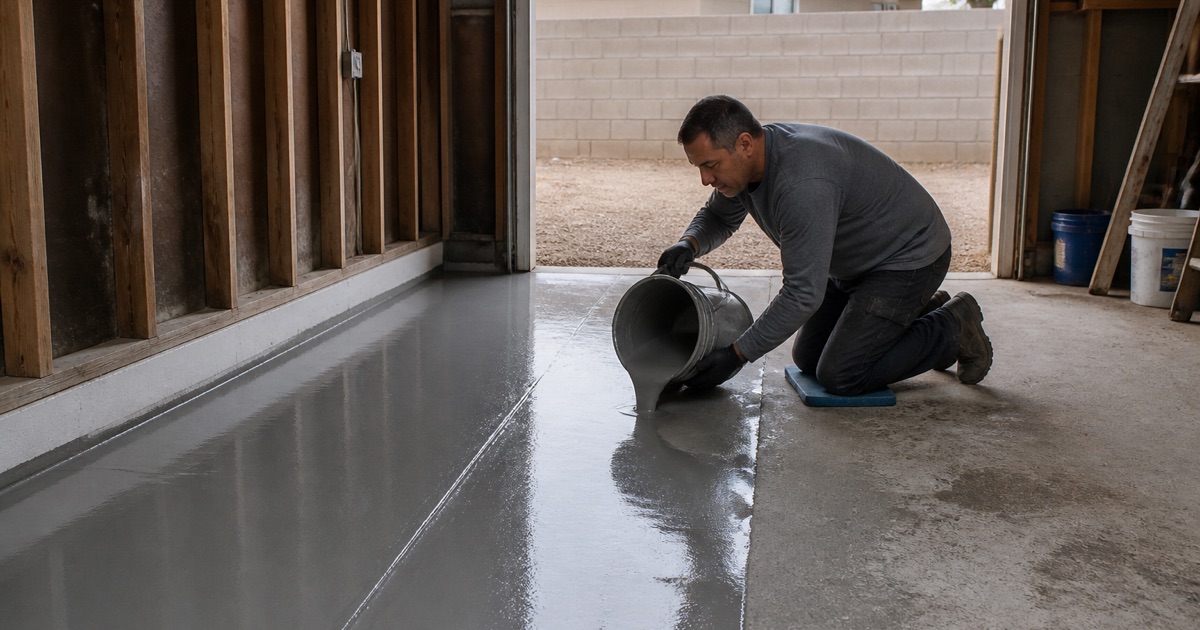
Under-slab vapor retarders were not routine practice before roughly the 1960s, so on the majority of jobs here the slab was almost certainly placed without one. That single fact governs the whole specification, because vapor moving up through unprotected concrete does not damage the concrete at all — it pushes whatever is bonded on top of it off.
That is why a floor here can be prepared perfectly and still fail. The bond was never the problem; the slab was, and no amount of grinding addresses it. That is why we would rather spend an hour testing than a day grinding a floor that was never going to hold a coating.
Testing Is Where Every Muscoy Job Starts
We moisture test before a single product is ordered, using the ASTM F1869 calcium chloride test to read a vapor emission rate at the surface and the ASTM F2170 in-situ relative humidity probe to read the state of the slab at depth. The threshold numbers for both live in ASTM F710 rather than in the test methods.
On a slab this age we also treat the ASTM D4263 plastic sheet test as a screen rather than a measurement, because it is asymmetric — a positive result fails a slab while a negative one tells you nothing you can rely on. It is a useful five-minute screen and it is not a substitute for a measured reading, particularly on concrete of this age.
What We Do About a High Reading
A high reading changes the system rather than ending the job. The usual answer is a moisture vapor barrier primer sized to the measured number, applied before the build coats go on, which is a specific product decision rather than an extra coat of the same material. Sizing it to the actual reading matters, because a barrier primer chosen by guesswork is an expensive layer that may not do the job it was bought for.
Where a reading is high enough that no primer is a sensible answer, we say so. Polished concrete is often the right recommendation there, because nothing is bonded on top for vapor pressure to lift. It also removes the recoat cycle entirely, which on a rental property is worth real money over a decade.
Looking for concrete resurfacing closer to Fontana? See Concrete Resurfacing Services in Fontana.
Half the Detached Houses Here Are Rentals
1,002 of 2,049 Detached Houses Are Rented
Muscoy is 82.3% single-family detached and 52.1% renter-occupied at the same time, which is an unusual combination. Of 2,049 detached houses, 1,002 are rentals and the owner-occupied pool is 1,047 houses. Sizing this market as though every detached house had an owner living in it would be wrong by half. We would rather work from the real figure, because it changes both how much work is here and what kind of work it is.
That is worth stating plainly rather than quietly, because it changes who we expect to be talking to on any given job here and what that person actually wants from a floor. A page written purely for owner-occupiers would speak to under half this community, which is not a useful way to describe a place.
What a Landlord Buys
A rental property owner buys a floor for different reasons than a homeowner does. Turnover damage, cleaning between tenants and the cost of repeat maintenance are the recurring expenses, so durability and cleanability outrank flake blend selection and gloss level almost every time.
That frequently makes a coated garage floor a better argument on a rental than on an owner-occupied house, not a worse one. A sealed, hard-wearing slab is quicker to clean between tenants and does not absorb the oil that a bare floor does. Over two or three tenancies that difference usually pays for the floor, which is the argument we actually make to an owner rather than a decorative one.
Scheduling Around a Tenant
The practical complication is access. Work on an occupied rental has to be arranged around the people living there, and clearing a garage wall to wall requires their cooperation rather than the owner’s alone.
We would rather sort that out in writing before the day than arrive to a half-full garage. Where it helps, the moving can be part of the job, quoted as its own line so everyone can see what it costs. Being explicit about it avoids the most common source of friction on a rental job, which is nobody having agreed whose responsibility the contents were.
Permits, Practicalities and Heat
There Is No Muscoy City Hall
Muscoy is unincorporated San Bernardino County. There is no city hall, no city building department and no city website, and the permit authority is County Land Use Services, Building and Safety, at 268 W. Hospitality Lane in San Bernardino.
That is simply what unincorporated means, and it catches out contractors from outside the area as often as it catches out homeowners. Knowing where a permit comes from before quoting is part of the job. It is also the sort of thing that quietly adds a week to a schedule when a contractor assumes there is a city counter to walk into.
Reading Older Local Figures Carefully
Some published figures for Muscoy derive from surveys around a decade older than current estimates, and the two should not be blended. Where they disagree, the current data governs, and we would rather characterize the community accurately than quote a number that has aged.
What is not in dispute is the age profile of the housing, which is consistent across sources and is the fact that actually drives the specification here. Whatever else is uncertain about the numbers, the age of this housing stock is not, and that is what the whole approach rests on.
Inland Heat and the Working Day
Heat governs the calendar as it does everywhere on the valley floor. Pot life on a common system runs about 60 minutes at 55 degrees and collapses toward 20 minutes at 95 degrees, with the recoat minimum shortening alongside it.
On an older slab that already needs a barrier primer and repair work, a compressed summer working window makes sequencing the day matter even more. We start early, batch small, and plan the run across the floor before anything is mixed.
What the Work Usually Looks Like
Smaller, Older Garages
A garage built in the 1940s or 1950s is typically narrower and shallower than a modern bay, and frequently detached on a slab of its own. That changes the practical side of the job more than the technical side: less room to work, a tighter turn for equipment, and a slab whose edges have often broken down where the door has always sat.
It also changes the finish conversation. A smaller floor takes less material and less time, which puts a properly specified system within reach on a budget that would not stretch to a modern three-car bay.
Repair Is Usually Part of the Scope
On concrete this age, grinding exposes work rather than simply preparing a surface. Control joints need filling with a semi-rigid material so they can keep moving without the coating cracking above them, spalls and broken edges need cutting back and patching, and oil that has soaked into the slab has to be treated before priming.
We scope and price all of that with the floor rather than raising it once the grinder is already running. On an older slab it is the difference between a quote that holds and one that moves halfway through the job.
Honest Answers About What Is Worth Doing
Not every seventy-five-year-old slab is worth coating, and we say so when it is not. A floor with widespread structural cracking, significant settlement or deterioration through its depth needs replacement or a different approach, and putting a resinous system over it buys a season rather than a decade.
Where the slab is sound and simply old, the opposite is true: it will take a coating perfectly well provided the moisture question is answered honestly first. Telling those two cases apart is most of what we are doing on the first visit.
- 20+ Years Experience
- Free Estimates
- Every Slab Moisture Tested