Colton Epoxy Flooring installs polyaspartic floor coating systems in Moreno Valley, CA, along with epoxy garage floors, polished concrete and commercial work. We have more than twenty years of resinous flooring behind us in this valley, and Moreno Valley is one of the more predictable cities we work in, for a reason that shows up clearly in the housing data.
This is a young-slab market. The overwhelming majority of the housing stock went up in 1980 or later and very little of it predates 1960, which means under-slab vapor retarders were normal practice on almost all of these garage floors. Moisture is a test-and-confirm exception here rather than the expected finding, which is the reverse of the situation a few miles away. That single difference is why we do not carry assumptions between neighboring cities here, and why the build era matters more than the address.
It is also remarkably concentrated in era, with one decade accounting for the largest single block of housing and a second wave filling in much of the rest. A crew working residential here is working essentially two slab generations, and that makes the preparation specification unusually repeatable. It is one of the few places where experience genuinely translates into a faster, cheaper job rather than just a better-informed one.
Two Slab Generations and Almost Nothing Else
Why Consistency Is Worth Something
In a mixed-era city, two houses on the same street can present completely different problems, and a quote given without seeing the slab is close to worthless. Here the variation is much narrower, which means we can tell a homeowner what their floor is likely to need before we have taken a reading and then confirm it rather than discover it.
That predictability shows up in the price too. Where most of the variability in a garage quote comes from what is already bonded to the floor and how the slab was placed, a city built in two waves produces quotes that hold rather than move. Nobody enjoys a price that changes halfway through a job, and the housing stock here makes that outcome much less likely.
What Actually Ages an Eighties Tract Garage
The wear on these floors comes from use rather than from how they were built. Expect control-joint and shrinkage cracking, settlement and lipping at the garage door threshold, edge curling, and three to four decades of motor oil and tire-plasticizer staining where the car has always been parked.
Very often there is also a failed one-part paint or a hot-tire-damaged consumer kit on top of it. That is the single most common condition we meet in this city, and dealing with it properly is most of what separates a floor that lasts from one that repeats the same failure. Removal gets priced as its own line so the difference between a bare slab and a previously coated one is visible rather than buried.
The 2000s Stock
The second wave behaves like modern construction anywhere: a sound, uncoated slab placed over a vapor retarder, where the job is a clean grind to profile, joint fill, prime, broadcast and topcoat. Those are the most straightforward floors we install and they price accordingly. They also cure more predictably, because a sound modern slab holds a consistent profile across its whole area.
The finish conversation is also freer on that stock, because there is no repaired or patched slab to conceal. A lighter flake scatter or even a plain solid color is genuinely viable where an older floor would want a full broadcast doing concealment work as well as decoration. That is a genuine saving rather than a downgrade, and it is worth knowing before choosing a finish from a sample board.
Looking for epoxy flooring closer to March ARB? See Epoxy Flooring Services in March ARB.
Why Polyaspartic Suits This City
Fast Return to Service
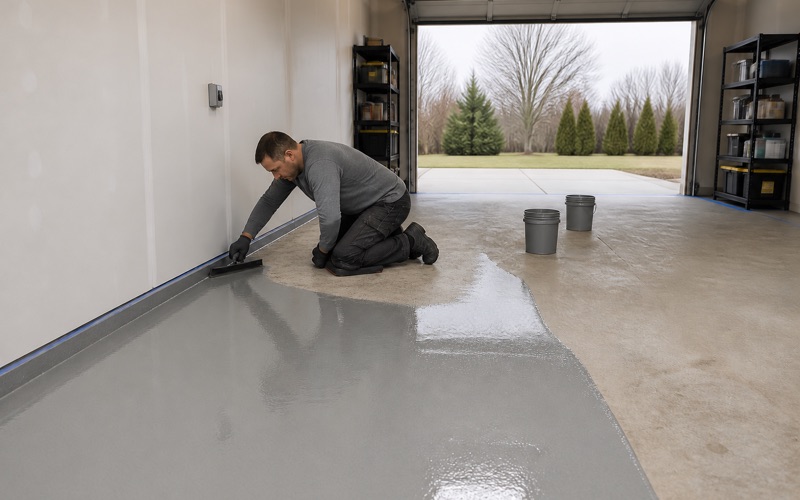
A polyaspartic or polyurea topcoat cures far faster than epoxy and holds its color in sunlight, which is why it goes over the epoxy rather than under it. For a household with one garage and nowhere else to put a car, the shortened wait before the floor takes vehicles is frequently the deciding factor rather than a technical preference.
It also shortens the window during which a half-finished floor sits exposed to dust and weather, which on a residential job usually means one disruption instead of several. For a household that uses the garage daily, the number of days it is unusable often matters more than the specification on the quote.
What the Speed Costs
Fast chemistry has a short working window, and on a hot slab that window shortens further — pot life on a common system runs about 60 minutes at 55 degrees and collapses toward 20 minutes at 95 degrees, with the recoat minimum falling alongside it. It is a material that punishes a crew working beyond its pace.
So we batch small, plan the run across the slab before anything is mixed, and size the crew to the floor rather than to habit. Where an area is too large to hold a wet edge in one pass, we plan a deliberate break at a joint rather than letting one appear at random. A planned break at a construction joint is invisible in the finished floor; an unplanned one across an open bay is not.
Why Most Systems Use Both
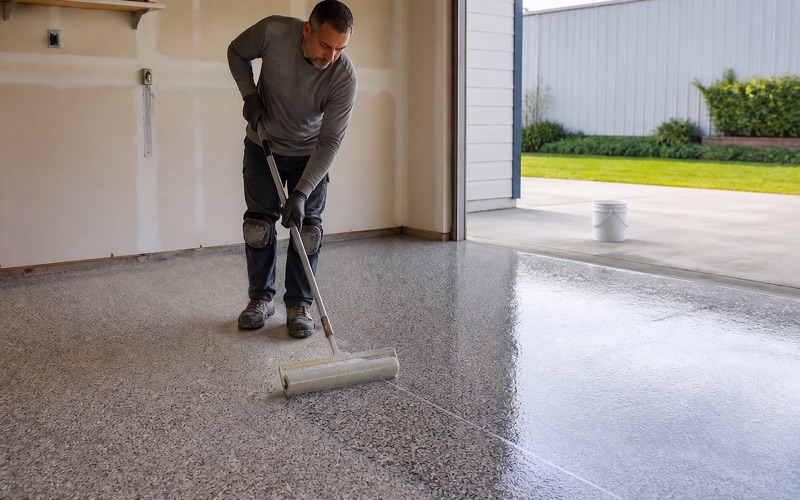
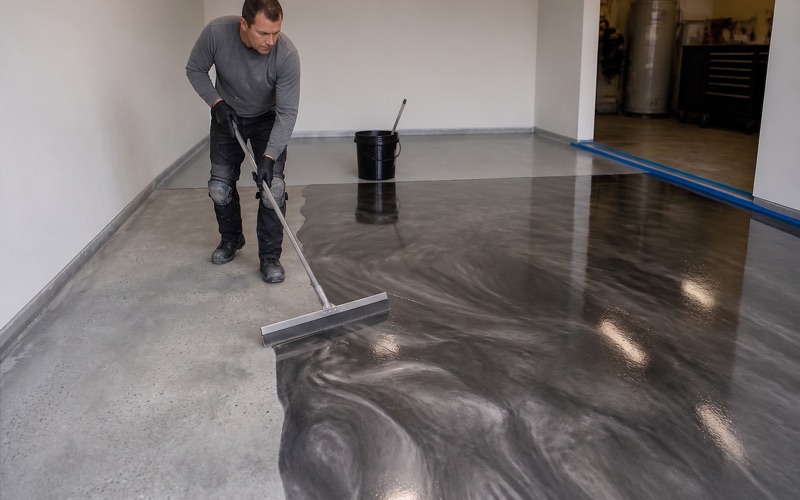
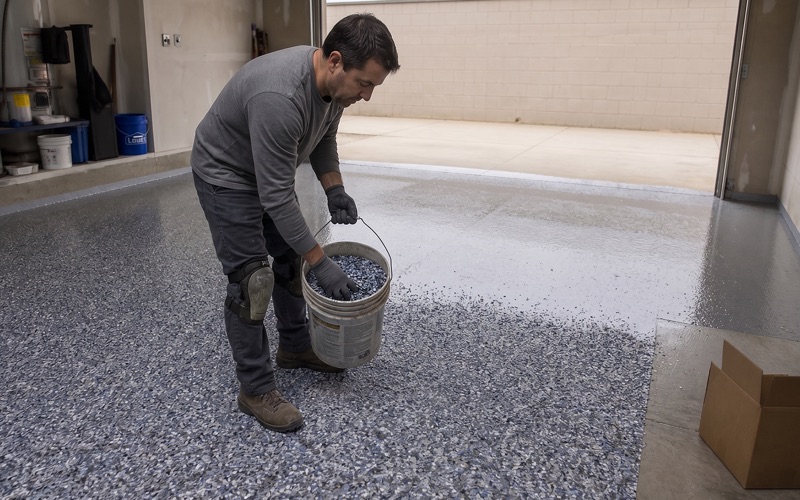
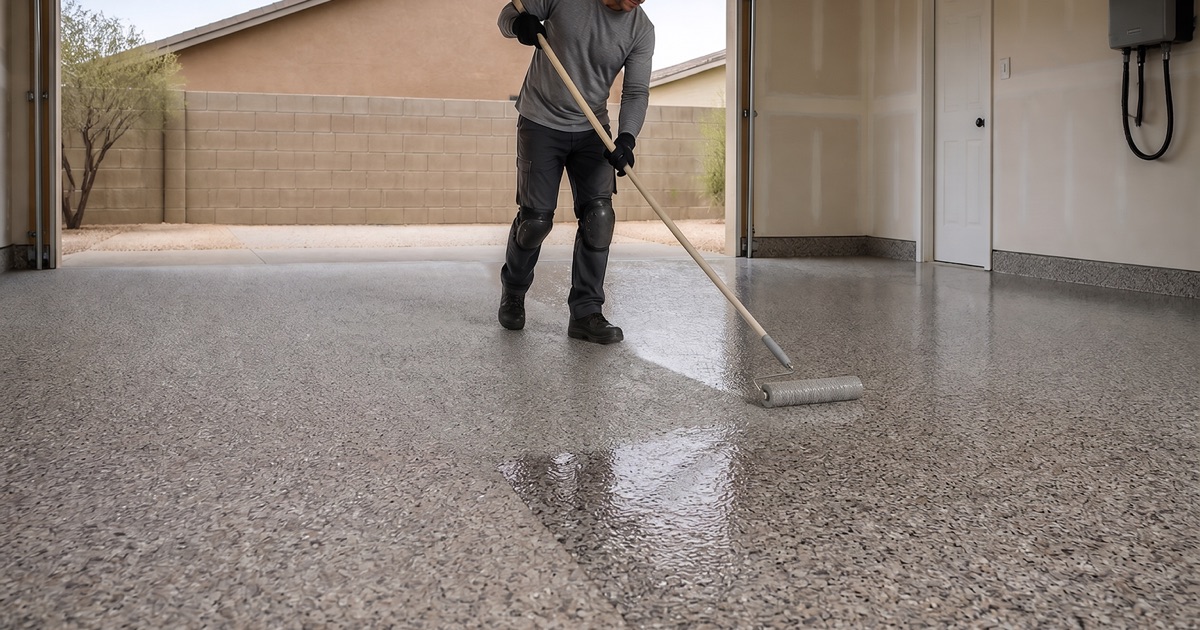
Polyaspartic is generally applied at a lower film build than a 100% solids epoxy body coat, so asking it to be both the build and the wear surface produces a thinner floor than a customer expects. The practical answer on most floors is a hybrid: epoxy primer and body coat to grip the concrete and build the film, flake or quartz broadcast into that, then a polyaspartic clear coat over the top.
That is what we install on the large majority of garages here, and our written scope names each layer with its film build so a quote can be compared against another one line by line rather than on a total. Two quotes that name different numbers of layers are not quoting the same floor, however similar the headline figures look.
Preparation, Testing and Practicalities
Mechanical Prep, Never an Acid Etch
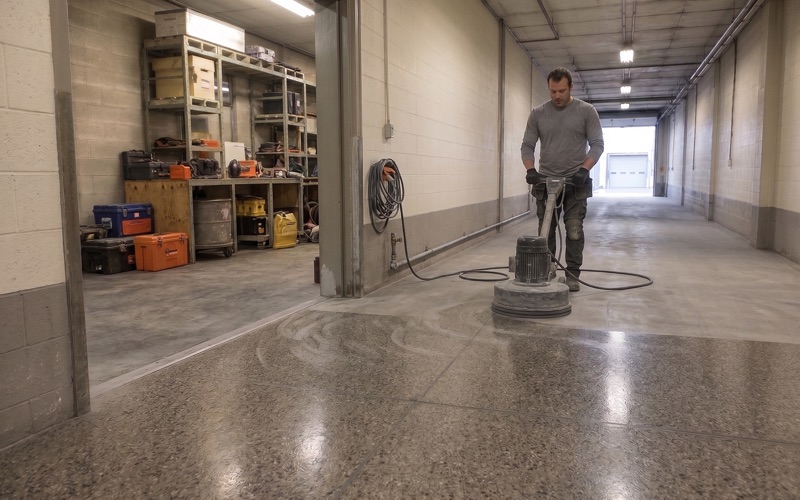
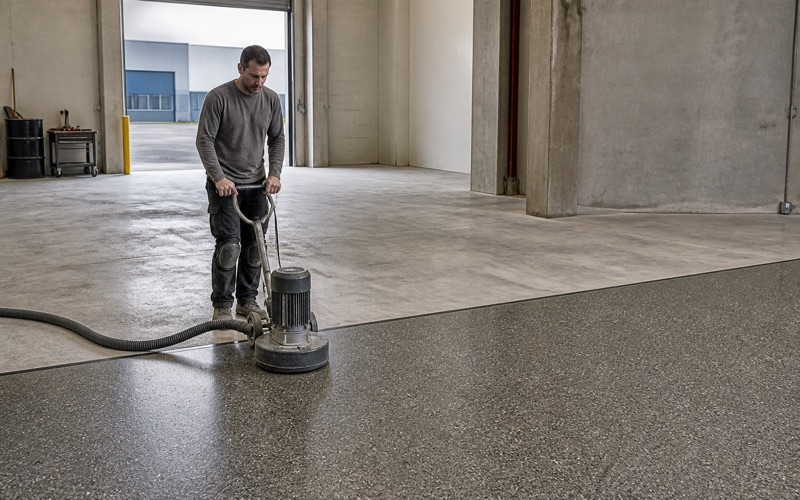
Concrete leaves the trowel closed, and on a 2000s slab it is closed tighter than most. We open every floor with diamond grinding to a measured ICRI concrete surface profile, choosing the diamond segment bond against the hardness of the slab, under continuous HEPA dust extraction.
We do not acid etch. Acid softens the surface and leaves residue behind, so the coating ends up bonded to a weak layer rather than to sound concrete, and on a hard-troweled modern slab it cannot produce a consistent profile in the first place.
Testing Even Where Moisture Is Unlikely
A young slab is not an exempt slab. The California Residential Code exempts garages from the under-slab vapor retarder requirement, so a garage floor may have nothing beneath it however recent the house is, and the only way to know is to measure.
We use the ASTM F1869 calcium chloride test and the ASTM F2170 in-situ relative humidity probe, with thresholds read from ASTM F710. The test costs very little against the price of a floor that has to come off, which makes it an easy decision even in a city where most slabs pass.
Access, Scheduling and Category Rules
Access here is straightforward: modern tract streets, standard driveways and a consistent housing layout mean staging a grinder and extraction rig is rarely a constraint, and the uniformity of the stock keeps drive time and setup time predictable across a route.
Moreno Valley sits inside the South Coast Air Quality Management District, where Rule 1113 caps floor coatings at 50 grams per liter of volatile organic compounds and industrial maintenance coatings at 100, treating the two as mutually exclusive categories. Subsection (c)(6) prohibits applying or soliciting industrial maintenance coatings for residential use, and we confirm which applies before quoting.
Beyond the Garage
Driveways, Patios and Pool Decks
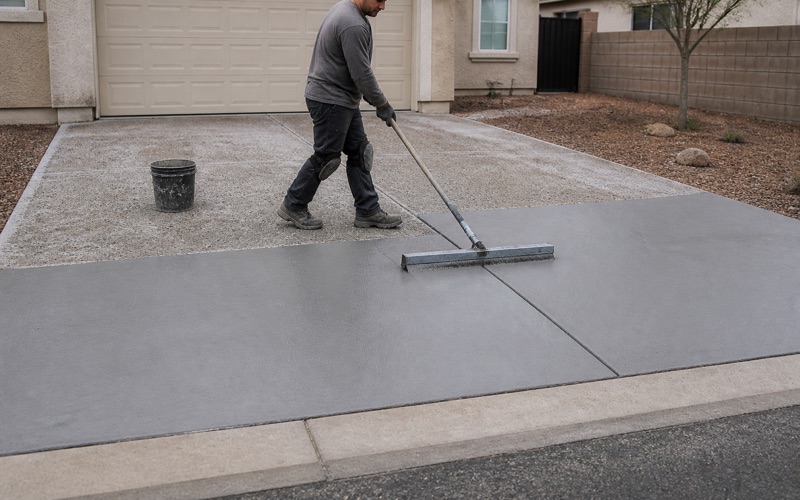
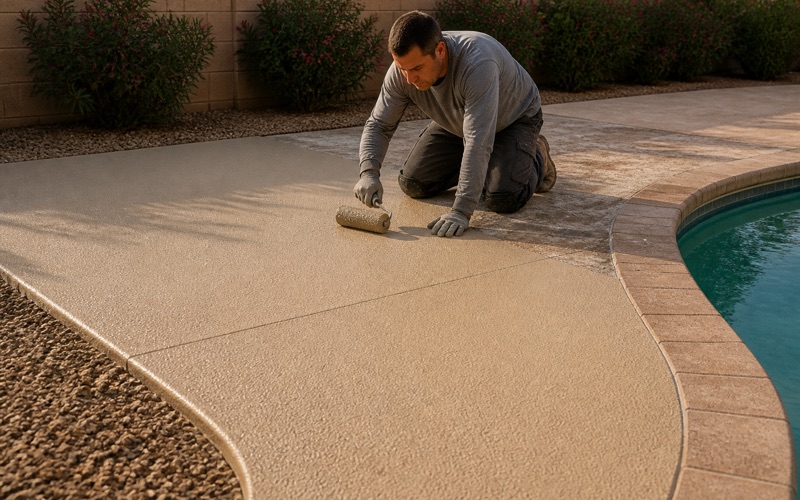
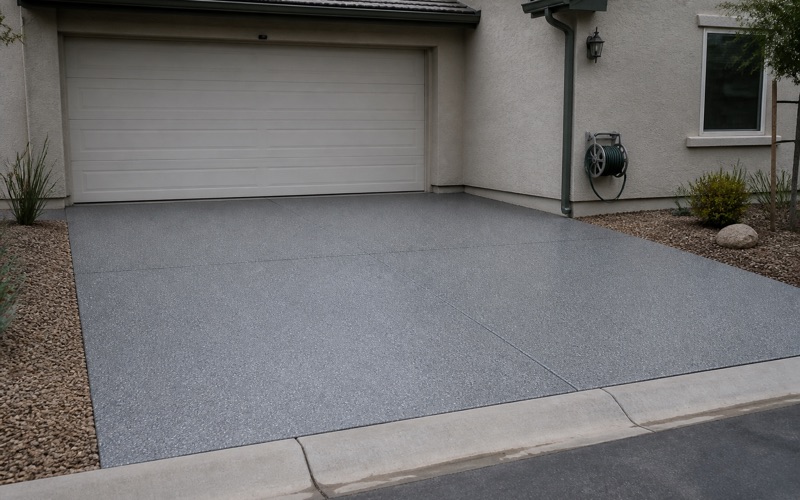
The same tract housing that makes garages predictable here also comes with a driveway, and frequently a patio or a pool surround. Those are a genuinely different specification rather than the same system used outdoors, because ultraviolet exposure, thermal cycling and bare feet all change what the finish has to do.
Exterior slabs get aliphatic polyaspartic or polyurea chemistry, or a polymer-modified cementitious overlay where the surface is worn rather than merely tired. Texture is broadcast in for slip resistance, and on a slab in full inland sun we think about color and surface temperature together rather than separately.
Polished Concrete Where the Slab Deserves It
Where a slab is sound, flat and reasonably clean, polished concrete is worth considering as an alternative to a coating. The floor is ground through progressive grits, densified with a chemical hardener that reacts inside the concrete, and polished to a chosen gloss level, so what you walk on is the slab itself.
Nothing is bonded on top, so nothing can delaminate. The trade-off is that polishing exposes whatever the concrete contains permanently, which is why we grind a test area and let you see your own floor before deciding rather than showing a photograph of somebody else’s.
Commercial and Light Industrial Floors
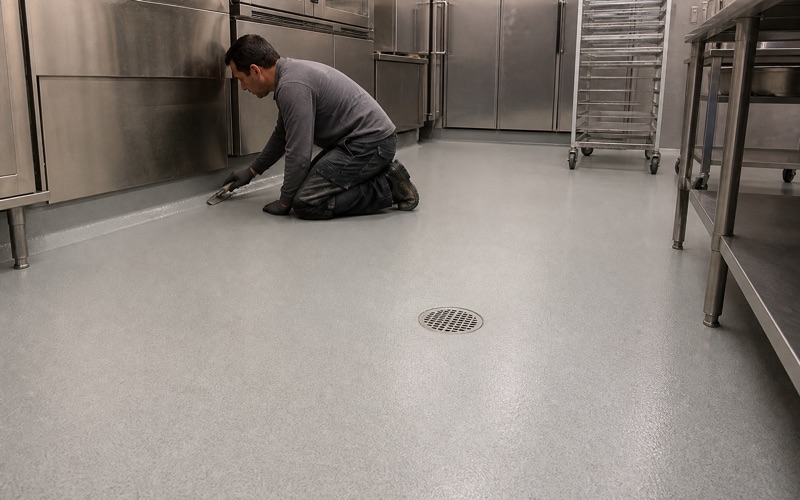
Alongside the residential work we coat commercial and light industrial floors across the city — retail back-of-house, kitchens, workshops, warehouse and distribution space. Those are specified on traffic and cleanability rather than appearance, and they are almost always phased so the building keeps operating.
We break a floor into bays or zones, run containment and HEPA extraction throughout, and agree the sequence with whoever runs the space before quoting. On a commercial floor the disruption is usually worth more than the materials, so the sequencing plan is the part of a proposal most worth reading closely.
- 20+ Years Experience
- Free Estimates
- Every Slab Moisture Tested