Colton Epoxy Flooring installs epoxy flooring in Mentone, CA, covering garage floors, concrete resurfacing and polished concrete. We have spent more than twenty years working concrete across this valley, and Mentone is a community where the single most important scheduling fact is one that most contractors treat as a footnote. It decides how a day is run here, and getting it wrong costs a batch of material rather than a minor inconvenience.
Mentone sits at roughly 1,650 feet, which puts it well below the foothill communities to its east. That elevation difference matters because it flips which end of the temperature range causes problems. In the mountain communities the constraint is cold closing the application window for months at a time; here the constraint is heat, and it bites in the middle of a summer working day rather than across a season.
Alongside that is an old townsite. Mentone was laid out in 1887 for citrus, and 914 of its housing units predate 1960 with 515 predating 1950 — concrete placed long before under-slab vapor retarders were routine practice. Between the heat and the age of the housing, Mentone asks two quite specific things of a contractor at once.
Heat Governs the Working Day Here
Twenty Minutes of Pot Life
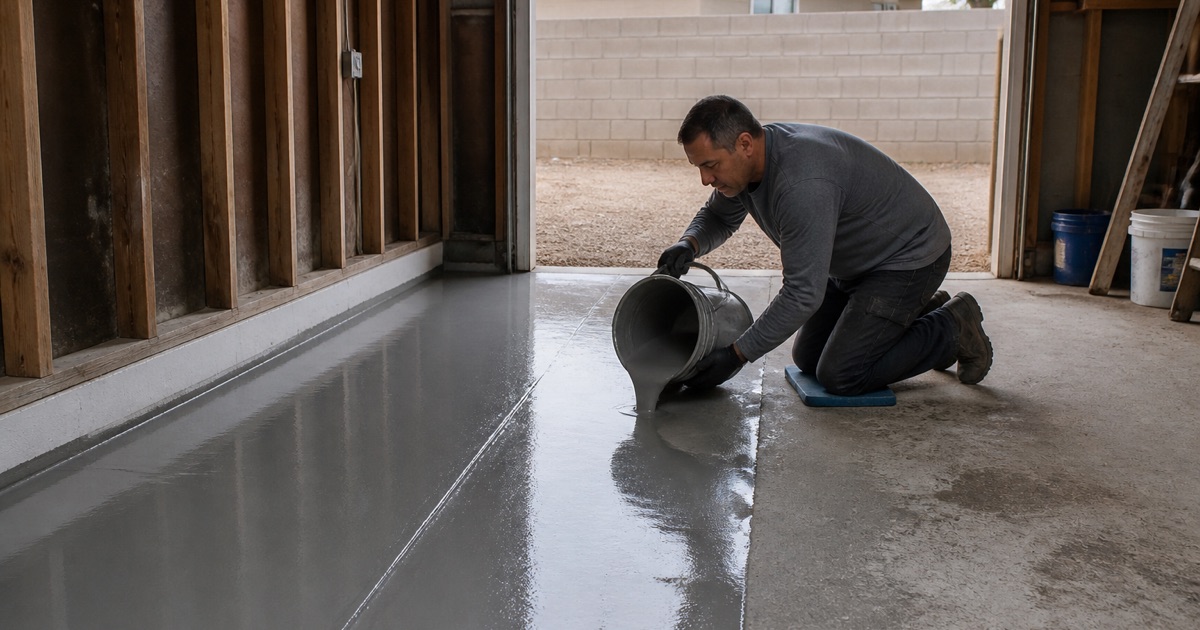
Pot life is a curve against temperature rather than a number on a label, and the curve is steep. On one published system it runs roughly 60 minutes at 55 degrees, 40 minutes at 72 degrees and about 20 minutes at 95 degrees, with the recoat minimum collapsing from 24 hours to 6 across the same range.
That is not a caveat, it is the governing constraint on how a job here is run. Twenty minutes is enough time to mix, spread with a gauge rake, back-roll and broadcast a modest area, and it is not enough time to do a whole garage from one batch. Anyone who tells you otherwise has either never worked here in August or is planning to leave a set edge in the middle of your floor.
What We Do About It
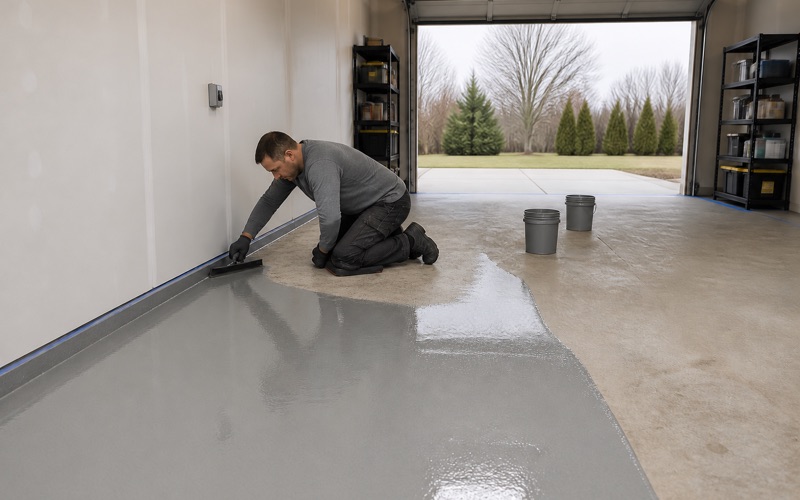
The answers are operational rather than chemical. We start early, work the shaded half of a slab first, mix in small batches sized to what can genuinely be laid inside the working window, and put enough hands on site to keep a wet edge moving across the area rather than chasing it. Crew size here is set by the slab and the season rather than by habit, and in summer that usually means more people for a shorter day.
We also read the actual surface temperature and dew point rather than the air temperature, because an uninsulated garage slab can be considerably hotter than the air above it and can approach a 160 degree surface maximum on a bad afternoon. A coating needs to go down at least 5 degrees above the dew point, and both numbers are measured rather than assumed. Those two readings take a few minutes and they decide whether the day proceeds as planned or gets moved.
Why the Mountain Rules Do Not Apply
It is worth being explicit that the constraints governing the higher communities nearby do not govern Mentone. There is no closed winter application window here, no freeze-day count deciding a booking calendar, and no months where the average high sits below the minimum application temperature for common floor coatings.
Someone applying mountain scheduling logic to a Mentone job would turn away work that is perfectly viable, and someone applying valley-floor summer logic without measuring would ruin a batch. The elevation is the thing that decides which set of rules applies. It is the sort of local knowledge that does not appear on any product datasheet and only comes from working both.
Looking for epoxy flooring closer to Woodcrest? See Epoxy Flooring in Woodcrest.
An 1887 Citrus Townsite and Its Slabs
What Pre-1950 Concrete Means
515 Mentone units predate 1950 and 914 predate 1960, which is a substantial older tier for a community this size. Under-slab vapor retarders were not routine practice that early, so on any pre-1950 garage here the moisture question is scope rather than an add-on somebody can decline.
Vapor moving up through unprotected concrete does not harm the concrete; it pushes whatever is bonded on top of it off. That is why a floor here can be prepared impeccably and still fail, and it is why we test before ordering rather than after a coating lifts. On a pre-1950 slab that test is the most valuable few minutes in the whole job.
The Tests and What They Answer
We use the ASTM F2170 in-situ relative humidity probe to read the state of the slab at depth and the ASTM F1869 calcium chloride test to read a vapor emission rate at the surface, taking the threshold numbers from ASTM F710 rather than from the test methods themselves. They measure different things and both are worth running on concrete of this age.
The ASTM D4263 plastic sheet test is worth understanding correctly because it is the one homeowners have usually heard of: it is asymmetric, so a positive result fails a slab while a negative one proves nothing at all. It is a screen, not a measurement. We run the measured tests regardless of what a sheet test suggests, because the cost of being wrong is the entire floor.
Older Garages Are Physically Different
A garage from the citrus-era townsite is typically smaller, often detached, and sitting on a slab whose edges have broken down where a door has rested for seventy years. That changes the practical shape of the work more than the technical side — less room to maneuver, tighter turns for equipment and more hand grinding at the perimeter. None of that makes the job harder to do well; it makes it slower, and the quote should say so rather than discovering it on the day.
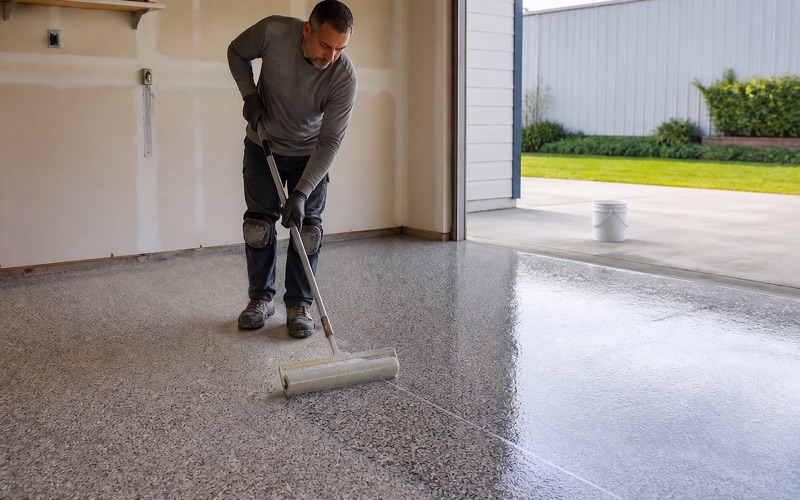
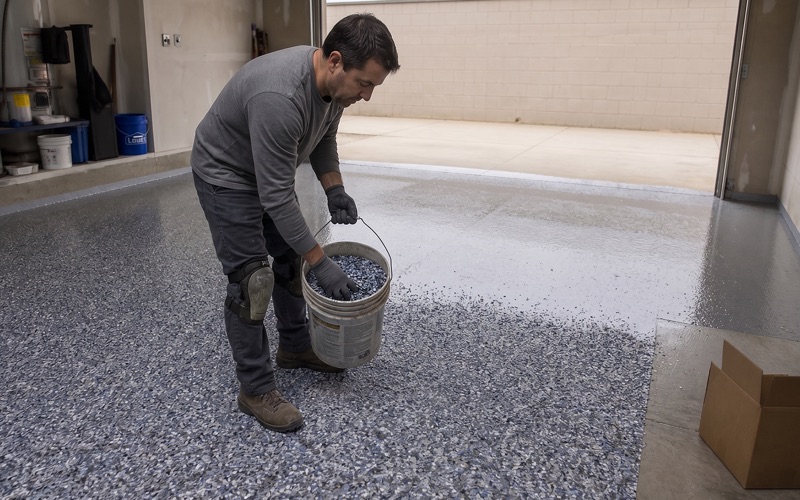
It also changes the finish conversation, because a repaired older slab benefits from a full flake broadcast that throws chip to refusal until no base color shows. That conceals joint fills and patches which a lighter scatter would leave visible. On an older floor the finish is doing concealment work as well as decoration, and choosing a light scatter there is usually a false economy.
Practical Notes
Repair Is Part of the Floor
On concrete this age, grinding exposes work rather than simply preparing a surface. Control joints get filled with a semi-rigid material so they can keep moving without the coating cracking above them, spalls and broken edges are cut back and patched, and oil that has soaked into a slab is treated before priming so it cannot bleed back through.
All of that is scoped and priced with the floor rather than raised once the grinder is already running. On an older slab that is the difference between a quote that holds and one that moves halfway through the work.
Mechanical Preparation Only
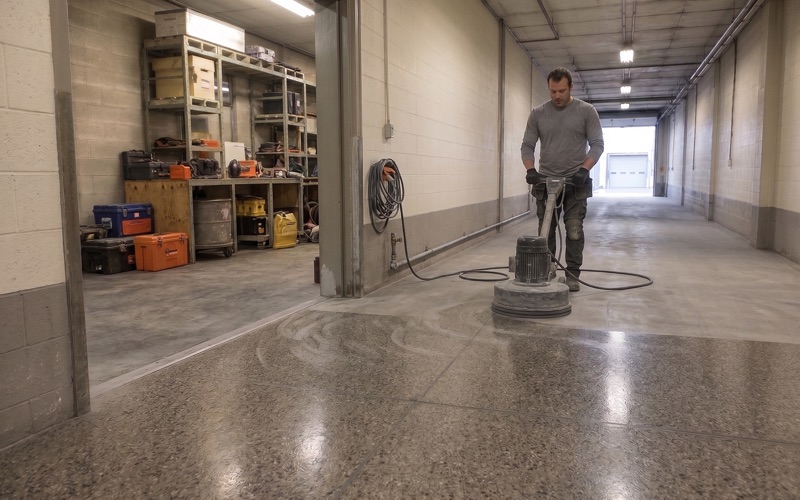
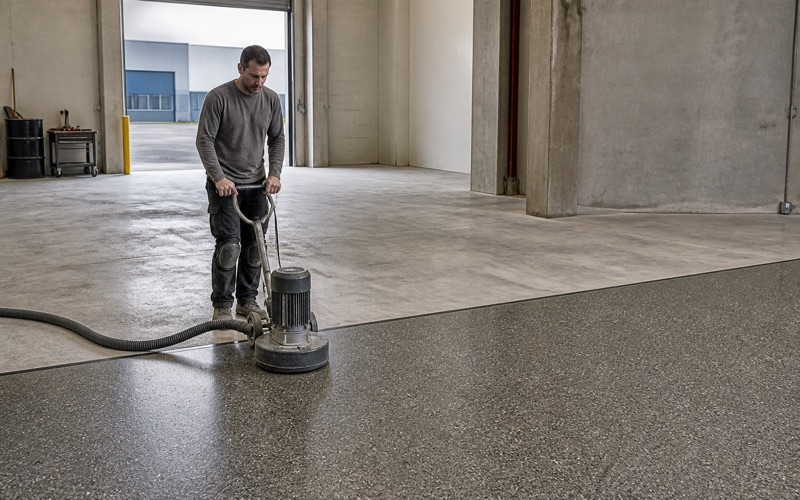
We open every floor with diamond grinding to a measured ICRI concrete surface profile, choosing the diamond segment bond against the hardness of the slab, under continuous HEPA dust extraction. On older, softer concrete that bond choice runs the opposite way to what people expect, because soft concrete takes a hard bond.
We never acid etch. Acid softens the surface and leaves residue behind, so the coating bonds to a weakened layer rather than to sound concrete, and on an old slab that already carries moisture risk it adds a second failure mode for no benefit.
Exterior Slabs and Category Rules
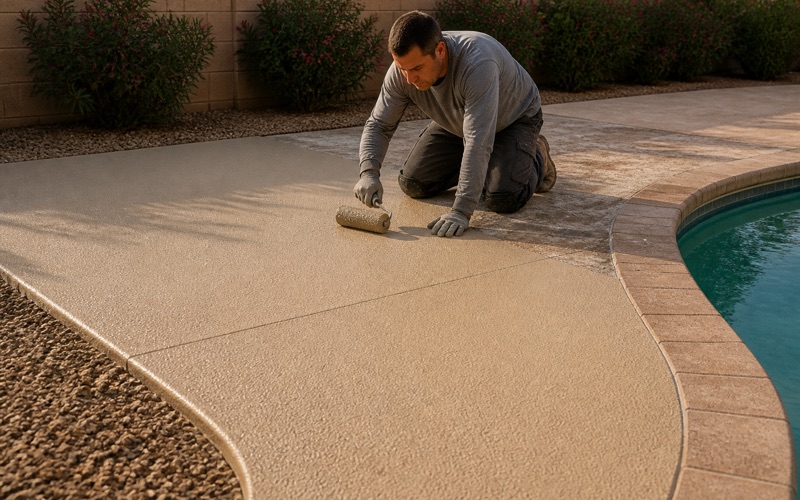
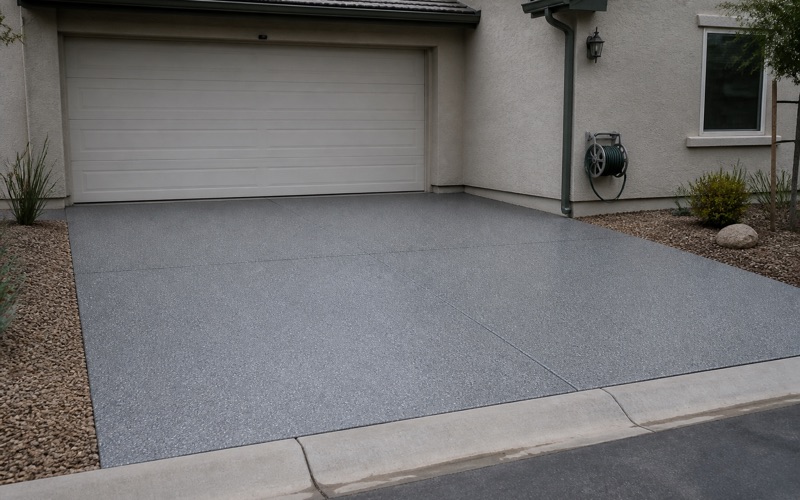
Driveways, patios and pool decks here take the same heat that governs the garages, and color becomes a comfort decision as much as a design one because a dark exterior slab in full sun gets too hot to walk on barefoot. Infrared-reflective pigment reduces how much heat a given color absorbs and widens what is genuinely usable.
Mentone sits inside the South Coast Air Quality Management District, where Rule 1113 caps floor coatings at 50 grams per liter of volatile organic compounds and industrial maintenance coatings at 100, treating the two as mutually exclusive. Subsection (c)(6) prohibits applying or soliciting industrial maintenance coatings for residential use, so we settle the category before quoting.
What Else We Do in Mentone
Concrete Resurfacing on Older Exterior Slabs
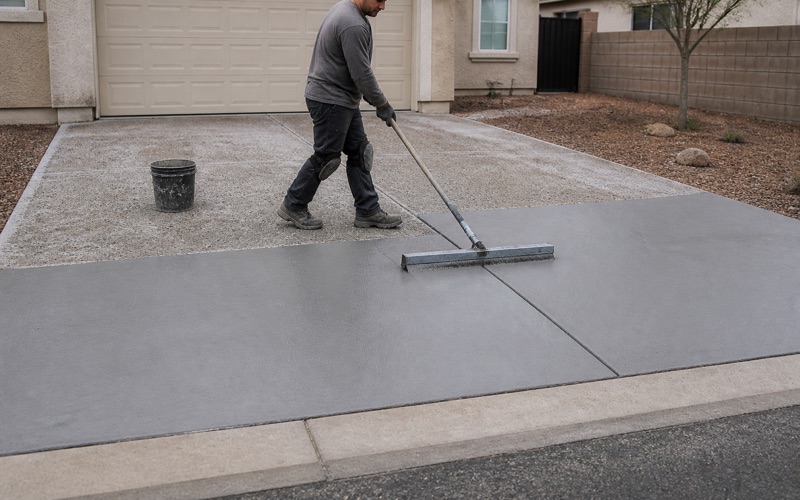
An 1887 townsite comes with a good deal of old exterior concrete — driveways, walks, patios and porches that are worn at the surface rather than structurally failed. A polymer-modified cementitious overlay rebuilds that surface in thin lifts over properly profiled concrete, at a fraction of the cost and disruption of replacement.
The judgment is whether the slab beneath is worth building on. Scaling, spalling and crazing resurface well; widespread structural cracking, settlement or a slab that moves under load is a replacement problem, and an overlay over any of those fails visibly within a season rather than lasting.
Polished Concrete as an Alternative
On an older slab that reads high for moisture, polished concrete is worth genuine consideration, because the failure mode that defeats a coating does not apply to it. The slab is ground through progressive grits, densified with a chemical hardener and polished to a chosen gloss, so nothing is bonded on top for vapor pressure to lift.
What it cannot do is hide a patched or contaminated floor, and on a seventy-year-old slab that is a real limitation. We grind a test area first so the decision is made against your own concrete rather than a photograph of somebody else’s.
Doing Several Slabs in One Visit
Older properties here frequently need more than one thing — a garage floor, a driveway and a patio, sometimes a detached structure as well. Doing them in a single mobilization is meaningfully cheaper per square foot than returning for each, because the equipment and the setup are shared across all of it.
It also produces better transitions. A garage threshold meeting a driveway looks considerably better when both sides were planned as one job rather than coated years apart in different systems, and on an older property those junctions are usually where the wear shows first.
- 20+ Years Experience
- Free Estimates
- Every Slab Moisture Tested