Colton Epoxy Flooring installs epoxy flooring in Mead Valley, CA, covering garage floors, carport and patio pads, and concrete resurfacing. We have more than twenty years of concrete work behind us in this region, and one of the things experience buys is the ability to tell a customer what a market actually is rather than what its population suggests. Getting that wrong wastes the customer’s time as much as ours, which is reason enough to be straight about it.
Mead Valley has more residents than several communities we cover and considerably fewer garages. More than a third of the housing here is manufactured — the highest share we encounter anywhere — and a manufactured home has a carport or a detached pad rather than an integral garage bay.
That leaves a real addressable pool roughly half what the resident count would suggest. Sizing this market off population overstates it substantially, and we would rather say that plainly than quote as though every household had a garage floor waiting. A page written on the population number would be describing a market roughly twice the size of the real one.
Why the Population Figure Is the Wrong Number
More Than a Third of Homes Have No Garage
At 37.7% of all housing, manufactured homes are not a footnote here; they are a defining feature of the community. Those units carry carports, awnings and detached pads rather than enclosed garages, which puts them outside the garage-coating trade as it is normally described. Any contractor quoting this community from housing-unit counts alone will be pricing work that is not there.
That does not make them outside our work. It makes them a different product with a different specification, and the honest thing is to name it correctly rather than quoting a patio as though it were a garage. The exposure, the traffic and the right system all differ, and calling it correctly keeps the price honest in both directions.
What We Actually Coat on a Manufactured-Home Property
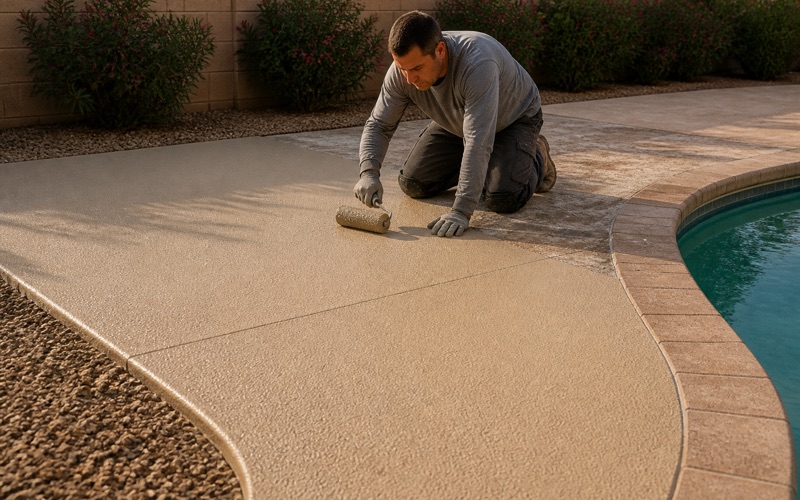
A carport pad is an exterior slab in full sun with vehicle traffic on it, which is a genuinely different brief from an enclosed bay. It needs ultraviolet-stable chemistry rather than an epoxy topcoat, because epoxy ambers in direct sunlight, and it needs texture broadcast in because it gets wet. Those two requirements alone rule out most of what would be specified for an enclosed bay.
Awning slabs, patios and walkways around those homes are the same category of work. They are worth doing well and they are usually a smaller job than a garage, which is worth being upfront about rather than inflating. A smaller job honestly quoted is better business than a larger one nobody proceeds with.
Sizing a Quote Honestly
The practical consequence is that we quote from what is on the property rather than from an assumption about the housing type. A site visit settles in a few minutes what a phone call would get wrong, and it costs nothing. It also lets us see the drainage, the sun exposure and the access, none of which come across on the phone. Those three between them decide most of what an exterior slab needs, and none of them is guessable from an address.
We would rather turn up, look, and give a number for the actual slab than describe a service that does not match what somebody has. That is a more useful conversation for both sides than a generic garage-floor quote.
Looking for epoxy flooring closer to Norco? See Norco Epoxy Flooring.
The Detached Houses That Do Have Garages
About 2,530 Detached Units
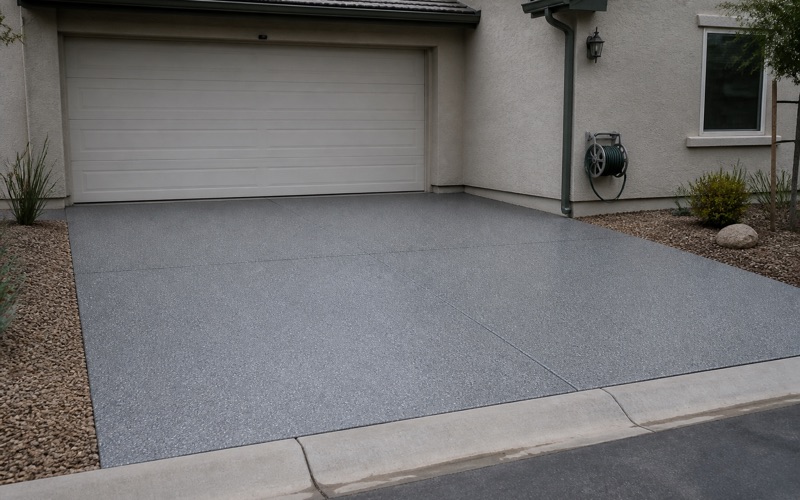
The detached housing here is a real market and we treat it as one. Those jobs run as garage work does anywhere: assess the slab, test it, grind to a measured ICRI concrete surface profile, repair joints and spalls, treat contamination, then prime, build and topcoat.
What varies is the age and condition of the concrete, which is why the site visit matters more than the address. Mead Valley’s housing is not uniform, and the difference between two properties can be substantial. Two addresses a street apart can present a modern attached bay and a sixty-year-old detached slab. That is why we do not quote this community from a template, and why the visit is not a formality.
Testing Before Ordering
Every slab is moisture tested before product is ordered, using the ASTM F1869 calcium chloride test to read a vapor emission rate at the surface and the ASTM F2170 in-situ relative humidity probe to read the state of the slab at depth, with the threshold numbers taken from ASTM F710.
The ASTM D4263 plastic sheet test is worth understanding as a screen rather than a measurement, because it is asymmetric: a positive result fails a slab while a negative one proves nothing at all. We run the measured tests regardless of what it suggests. The cost of the test is trivial against the cost of a floor that has to come off.
Mechanical Preparation Only
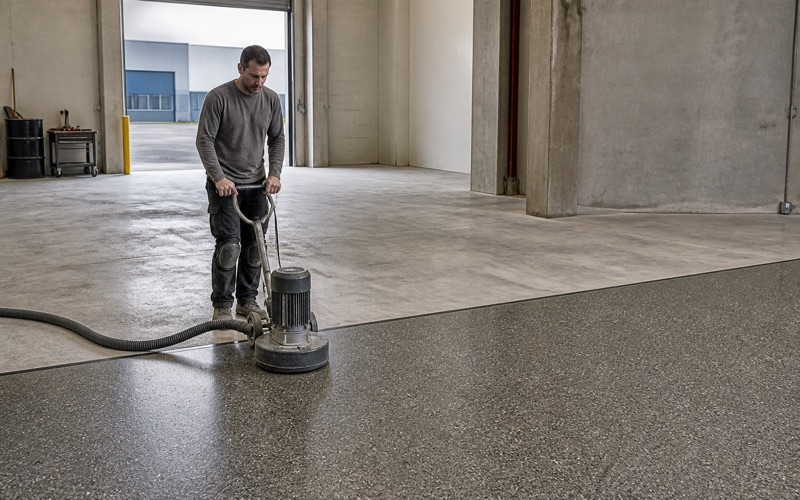
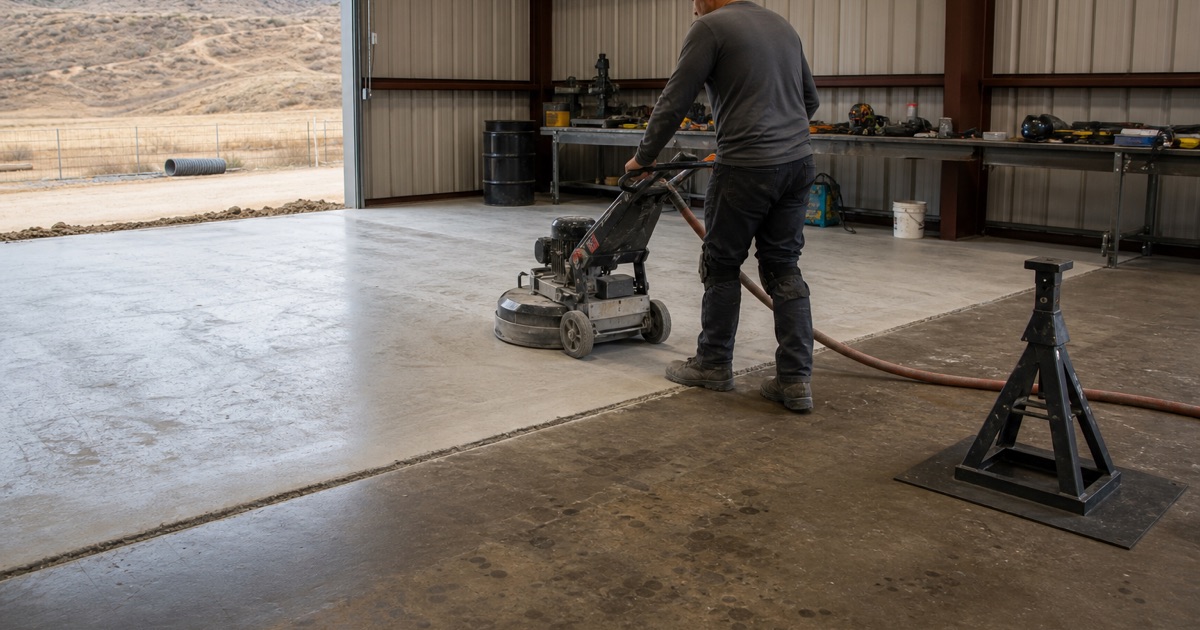
We open every floor with diamond grinding or shot blasting to the profile the coating system specifies, choosing the diamond segment bond against the hardness of the slab, under continuous HEPA dust extraction. We never acid etch.
Acid softens the surface, leaves residue behind and cannot produce a consistent profile on a hard-troweled floor, so the coating ends up bonded to a weakened layer rather than to sound concrete. It is cheap on day one and it is the most common reason a garage floor fails. On an exterior pad it is worse still, because the surface is already working harder than an interior one.
Working in Unincorporated Riverside County
There Is No City Hall Here
Mead Valley is unincorporated Riverside County. There is no city government, no city building department and no local counter to visit — permits come from Riverside County Building and Safety, filed through the county’s online portal.
That is simply what unincorporated means and it catches out contractors from outside the area as often as it catches out homeowners. Establishing where a permit comes from before quoting is part of doing the job properly.
Exterior Slabs and Inland Sun
A great deal of the work here is outdoors, which changes the specification rather than simplifying it. Exterior concrete takes ultraviolet exposure, larger thermal movement and standing water, and people walk on patios and carport pads with bare feet.
Surface temperature is a real consideration on a slab in full sun. Infrared-reflective pigment reduces how much heat a given color absorbs, which widens the range of colors that stay usable, and it matters during installation too because surface temperature drives pot life rather than air temperature.
Heat, Pot Life and Scheduling
Slab temperature governs the working day. Pot life on a common system runs about 60 minutes at 55 degrees and collapses toward 20 minutes at 95 degrees, with the recoat minimum shortening alongside it, which is published behavior rather than a rule of thumb.
Summer work therefore means early starts, smaller batches and a sequence planned across the slab before anything is mixed. On an exterior pad in direct sun that is not a refinement, it is the difference between a uniform floor and a set edge across the middle of it.
Practical Notes for This Community
Access and Staging on Large Lots
Parcels here are generally roomy, so positioning a trailer, turning a vehicle and working without blocking a road is rarely a problem. That is a genuine advantage over the tighter tract communities we serve and it keeps mobilization straightforward.
What is less predictable is power. A planetary grinder and a dust extraction rig want real supply, and a detached pad or an outbuilding at the back of a lot does not always have it. We check on the site visit and bring generation where it is needed rather than discovering the problem on the morning of the work.
Scoping More Than One Slab
Where a property has a carport pad, a patio and a walkway, doing them together is meaningfully cheaper per square foot than returning for each, because the equipment and the setup are shared across all of it. It also produces better transitions between surfaces.
We price each slab separately in the scope so the choice is visible rather than bundled, and so an owner can stage the work across two seasons if that suits the budget better. Being able to see the numbers individually usually settles the question faster than a recommendation from us would.
Being Realistic About Service Life
An exterior slab in full inland sun works harder than anything indoors, and it is worth saying what that means. A well-specified exterior system lasts a long time and it does not last forever, and the wear layer can generally be abraded and refreshed rather than the whole floor being replaced.
We set out that expectation at quoting rather than implying a permanent result. On a carport pad or a patio the honest framing is a durable surface with a maintenance path, and customers respond better to that than to a claim that does not survive contact with a few summers. It also makes the refresh conversation straightforward years later, because nobody was promised something different at the start.
- 20+ Years Experience
- Free Estimates
- Every Slab Moisture Tested