Colton Epoxy Flooring installs epoxy flooring in Lytle Creek, CA, and on this page the honest thing is to describe a small canyon community accurately rather than imply a busy service area. We have more than twenty years of concrete work behind us in this region, and part of that is knowing when to be straightforward about scale. Overstating a market helps nobody, least of all the person reading the page.
There are only a few hundred housing units in the entire census-designated place, almost all of them detached. Anyone writing as though Lytle Creek were a route with steady volume would be describing somewhere else, and a resident would spot it immediately. We would rather be trusted on this page than generate an enquiry that wastes an afternoon for both of us.
What actually decides whether a job here happens is not the slab and not the product. It is access — the winding canyon road up from the I-15 corridor, and then the last hundred feet of a particular driveway. Everything else about the job is ordinary; that part is not.
Getting Equipment to the Slab
The Canyon Road
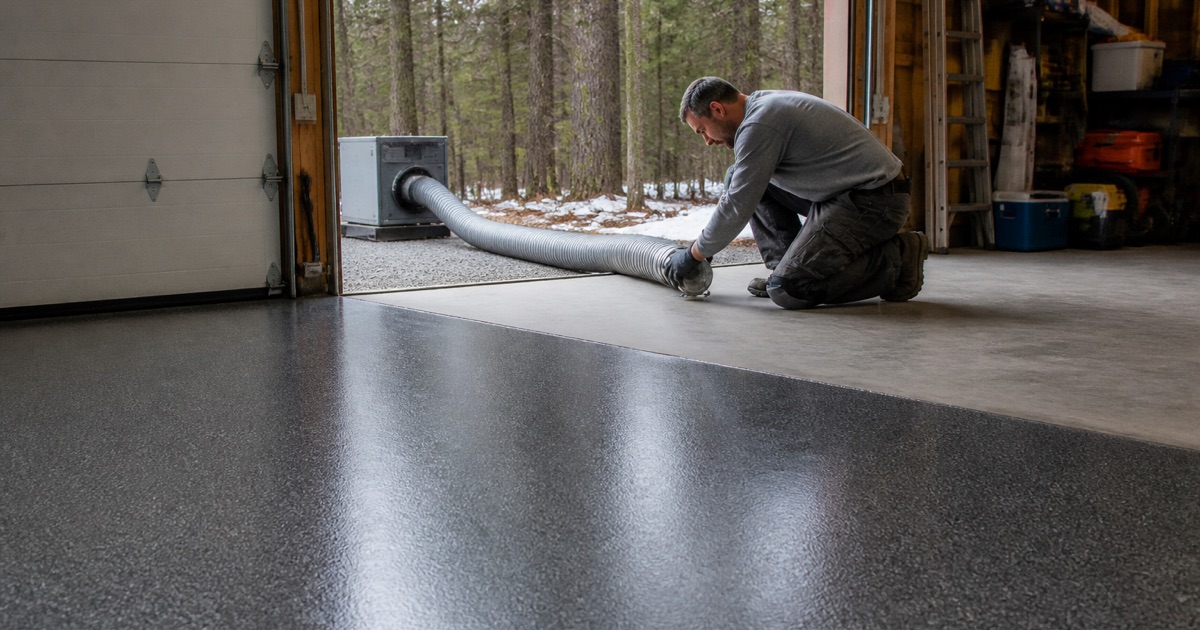
Lytle Creek is reached by a winding canyon road climbing off the freeway corridor into terrain that rises steeply behind it. Getting a planetary grinder, a dust extraction rig, generation and material up that road is a genuine planning question rather than a formality.
None of that makes a job impossible and all of it makes a job longer. We factor the travel honestly into a quote rather than pricing as though this were a suburban call, because pretending otherwise produces either a bad price or a bad day. Being clear about travel at the quoting stage avoids an awkward conversation later.
The Last Hundred Feet
The decisive detail is almost always the driveway rather than the road. Driveways here are frequently steep, unpaved or decomposed granite, and structures are often set well back from the road with limited turnaround.
So we confirm grade, surface, turnaround space and whether a heavy machine can physically be walked to the slab before committing to a date. That conversation takes a few minutes at the survey and prevents a wasted trip that costs a full day and helps nobody. It is the single most useful question we ask on a canyon property, and it takes about two minutes.
Power, Water and What We Bring
A planetary grinder and an extraction rig want real power, and a canyon property does not always have a supply that will carry them. We check on the survey and bring generation where it is needed rather than discovering the gap after driving up.
There is also no equipment hire or material supply up here, so anything forgotten is a round trip rather than a detour. That is why we plan a canyon job with more contingency in the van than we would for a job ten minutes from base. That preparation is invisible when it works and extremely obvious when it is missing.
Looking for epoxy flooring closer to El Cerrito? See Epoxy Flooring in El Cerrito.
Being Straight About the Numbers
333 Housing Units
The whole community is 333 housing units, 328 of them detached, and the estimates carry margins of error enormous relative to those figures. We use them to understand the shape of the place and never to quote precise counts.
That shape is clear enough: a small, almost entirely detached, largely owner-occupied canyon community with no commercial or industrial anchors. It is a place we serve properly when asked rather than a market we work systematically. Saying that plainly is more useful than implying a coverage we do not really have.
What the Data Cannot Tell You
One caution worth stating because it looks like a finding and is not: the survey records no housing units built during the 1970s here. On a community this size that is a sampling artifact rather than a real construction gap, and building a story on it would be wrong.
We mention it because it is exactly the kind of number a contractor might quote to sound informed. The honest position is that the sample is too small to support decade-by-decade claims, and the useful information comes from looking at the actual building. On a community this small, one site visit is worth more than any amount of published data.
Combining Work Where We Can
Given the travel, the sensible approach here is to identify everything worth coating in one visit and price it as a program rather than returning for each slab. A garage, a shop and a patio done together cost meaningfully less per square foot than three separate trips up the canyon.
We set the numbers out slab by slab so the choice stays visible, and we are equally happy to say that a single small job does not justify the trip on its own and suggest coordinating with a neighbor. That happens more often than people expect up here, and it works well for everyone involved.
The Work Itself
Canyon Properties and Their Buildings
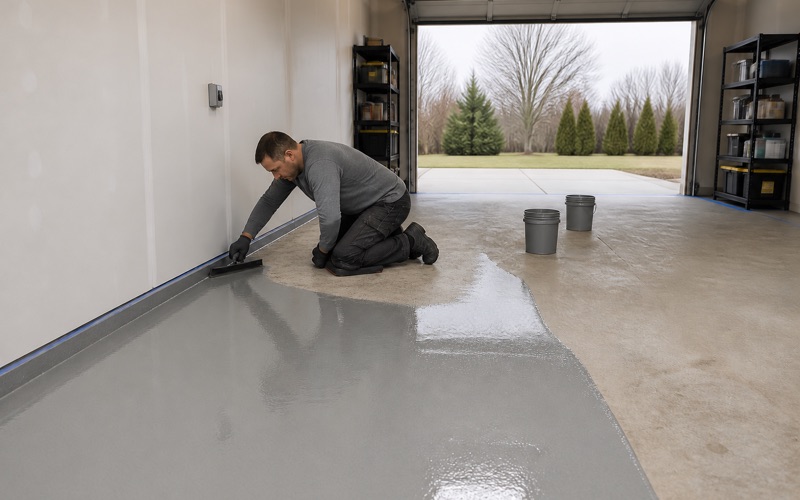
The buildings here are mostly detached houses with garages, and frequently a workshop, equipment building or storage structure as well. Those outbuildings take harder use than a domestic garage — point loads, dropped tools, solvent and hydraulic fluid — which points at a higher-build, chemically resistant system rather than a decorative one.
They are also usually uninsulated, so the daily temperature swing inside is wider than in an attached garage. That narrows the application window and makes measuring the surface temperature at the time of the pour necessary rather than optional.
Testing Before Ordering
We moisture test every slab before ordering anything, reading a vapor emission rate at the surface with the ASTM F1869 calcium chloride test and the condition of the slab at depth with the ASTM F2170 in-situ relative humidity probe. ASTM F710 is where the threshold numbers actually live.
On a canyon property built at various times by various people, the variation between two slabs on one parcel is frequently larger than between two houses in a tract. Only testing separates them, and the ASTM D4263 plastic sheet test is a screen rather than a measurement because it is asymmetric.
Finishes That Suit a Canyon Building
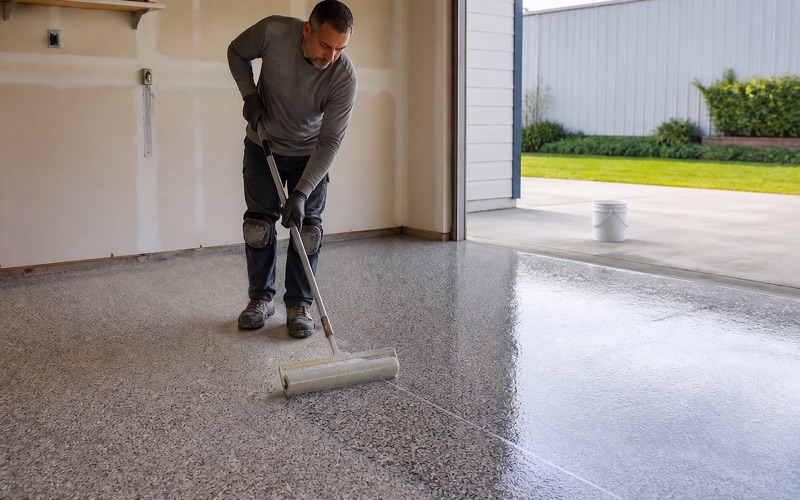
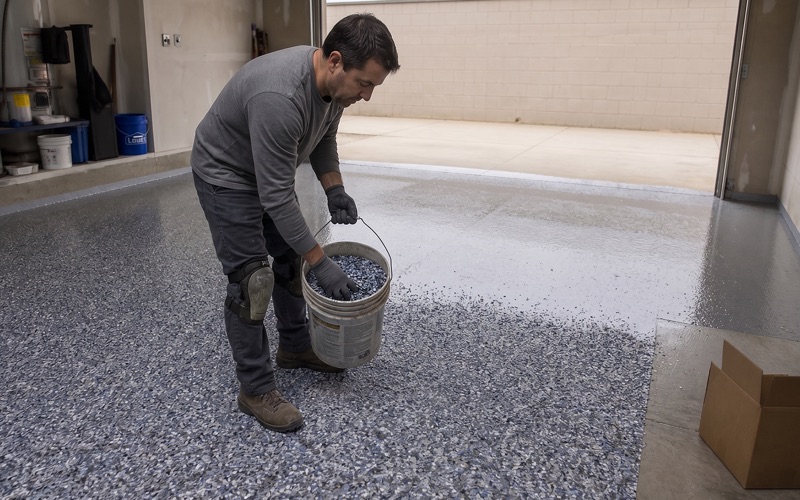
Practical considerations lead here. A floor that sees grit, mud, wet boots and firewood benefits from a full flake or quartz broadcast rather than a smooth finish, both for grip and because texture hides what a working canyon garage does to a floor.
Elevation and heat both matter for scheduling. Pot life on a common system runs about 60 minutes at 55 degrees and collapses toward 20 minutes at 95 degrees, and a coating needs to go down at least 5 degrees above the dew point, so we read surface temperature and dew point on the day rather than working from a forecast.
Beyond the Garage Floor
Concrete Resurfacing and Overlays
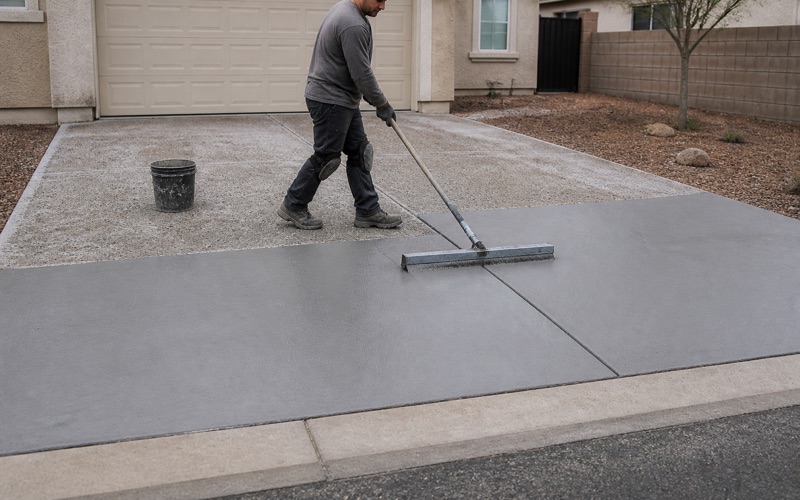
Where an exterior slab is worn at the surface rather than failing structurally, a polymer-modified cementitious overlay rebuilds it in thin lifts over properly profiled concrete, for a fraction of the cost and disruption of replacement. Scaling, spalling and crazing all resurface well. On a canyon property the exterior concrete usually takes more punishment than the garage floor does.
The judgment is whether the slab beneath is worth building on. Widespread structural cracking, settlement or a slab that moves under load is a replacement problem, and an overlay placed over any of those fails visibly within a season. We assess honestly and say which case you have rather than quoting hopefully. Taking on an overlay over a failing slab up here would mean two trips instead of one, which serves nobody.
Polished Concrete as an Alternative
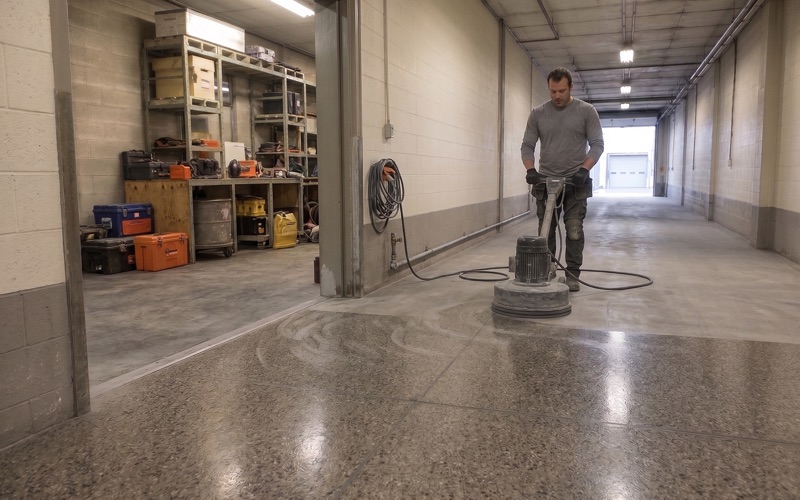
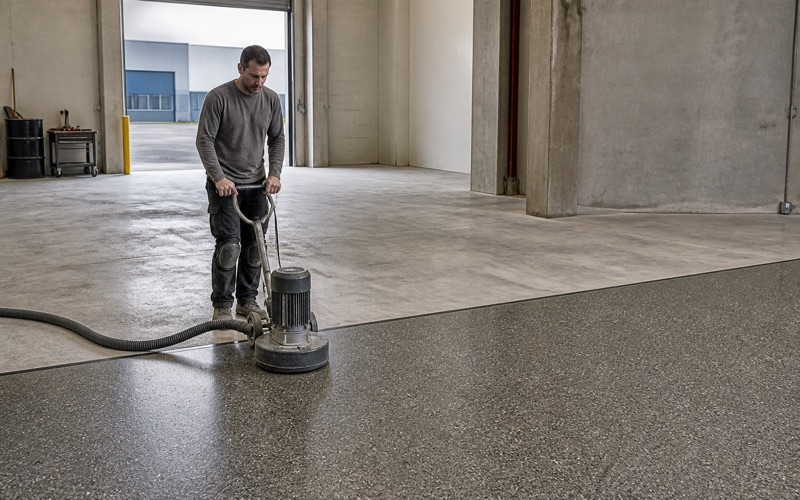
On a sound slab, polished concrete is worth considering instead of a coating, and it is especially worth considering where a moisture reading has come back high. The floor is ground through progressive grits, densified with a chemical hardener that reacts inside the concrete, and polished to a chosen gloss level.
Nothing is bonded on top, so there is no film for vapor pressure to lift. What polishing cannot do is conceal a patched or contaminated slab, and it exposes whatever the concrete contains permanently, which is why we grind a test area first and let the floor itself decide. That test patch is the only irreversible part of the process, which is why we do it before anything is agreed.
Combining Work in One Visit
Where a property needs more than one slab done, doing them in a single mobilization is meaningfully cheaper per square foot than returning for each, because the equipment and the setup are shared across all of it. We price each slab separately so the choice stays visible rather than bundled. Given the travel involved, that arithmetic matters more here than almost anywhere else we work.
It also produces better transitions between surfaces. A garage threshold meeting a driveway looks considerably better when both sides were planned as one job rather than coated years apart in different systems and different colors.
- 20+ Years Experience
- Free Estimates
- Every Slab Moisture Tested