Colton Epoxy Flooring installs epoxy flooring in Loma Linda, CA, and this is one city where the commercial half of our work is plainly the larger one. We have more than twenty years of resinous flooring behind us in this valley, and Loma Linda is a short drive from our base, which matters for the kind of phased, after-hours work its buildings need.
The reason the balance tips here is tenure. Loma Linda is the one renter-majority city in our service area, so the addressable residential market is far smaller than its resident count implies — a few thousand owner-occupied detached houses rather than a city-sized pool of them.
What sits alongside that is an institutional and medical floor concentration with no equal nearby, and those two facts together decide how we work here. The result is a city where most of our hours go into buildings that cannot close, and where the residential work is steady rather than dominant.
A City of 25,000 That Is a 3,000-House Residential Market
Why the Population Figure Misleads
Only 37.9% of occupied units here are owner-occupied and only 45.9% of housing is single-family detached, both the lowest in this part of the valley. Sizing a residential market off resident count would overstate it several times over, and we would rather say that plainly than quote as though every resident had a garage. It also means we do not chase volume here; we quote what is genuinely there and spend the rest of our time in the buildings.
That is not a complaint about the city. It is a description of a place built around an institution, where a large share of the housing exists to serve people who are here for a period rather than permanently. That produces a rental stock with landlords making floor decisions, which is a different sale from a homeowner’s and often a more durable specification.
The Owner-Occupied Third Is Still Real Work
Three thousand owner-occupied detached houses is a genuine market and we treat it as one. Those jobs run as they do anywhere: assess the slab, test it, grind to an ICRI concrete surface profile, repair the joints and spalls, then build the system and topcoat it. The slab conditions are ordinary for the valley, which means the moisture question is answered by testing rather than by the build date on the house.
What differs slightly is the mix of finishes. A university-and-hospital city has a lot of long-tenure professional households, and a written specification naming the system, the film build and the cure schedule tends to land better here than a price alone. People who work in specified environments professionally tend to read a scope closely, and we would rather be quoted against on detail than on headline price.
Condominium and Apartment Common Areas
The low detached share means a meaningful part of the residential stock is condominium and apartment, which is property-management work rather than homeowner work. Common laundry rooms, stairwells, corridors, trash enclosures and parking areas all take coatings, and all are bought on a maintenance cycle. A manager wants to know the service life and the refresh cost as much as the installation price, because the second number is the one that recurs.
That work also runs into a rule worth flagging: Rule 1113 subsection (c)(6) prohibits applying, or soliciting the application of, industrial maintenance coatings for residential use, and a residential building’s shared parking structure is still part of a residential property. That is a genuine constraint rather than a technicality, and settling the category before quoting keeps the product legal to apply where it is going.
Looking for epoxy garage floor closer to Rialto? See Epoxy Garage Floor Services in Rialto.
The Institutional Floors Are the Larger Half
Hospital, Clinic and Dental Floors
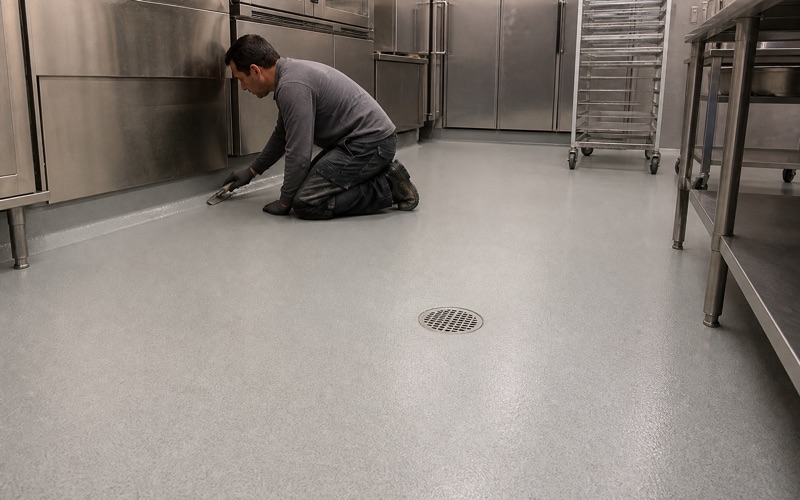
Loma Linda carries a density of medical floor stock that no other city on our service area comes close to — hospitals, a children’s hospital, a federal veterans hospital, a dental school and a health-sciences university. Those buildings run kitchens, dish rooms, sterile processing, imaging suites, pharmacies and clinical corridors, and every one of them is specified around cleanability. None of those rooms is chosen on appearance, and a specification written around looks rather than around cleaning and chemical exposure will be the wrong one.
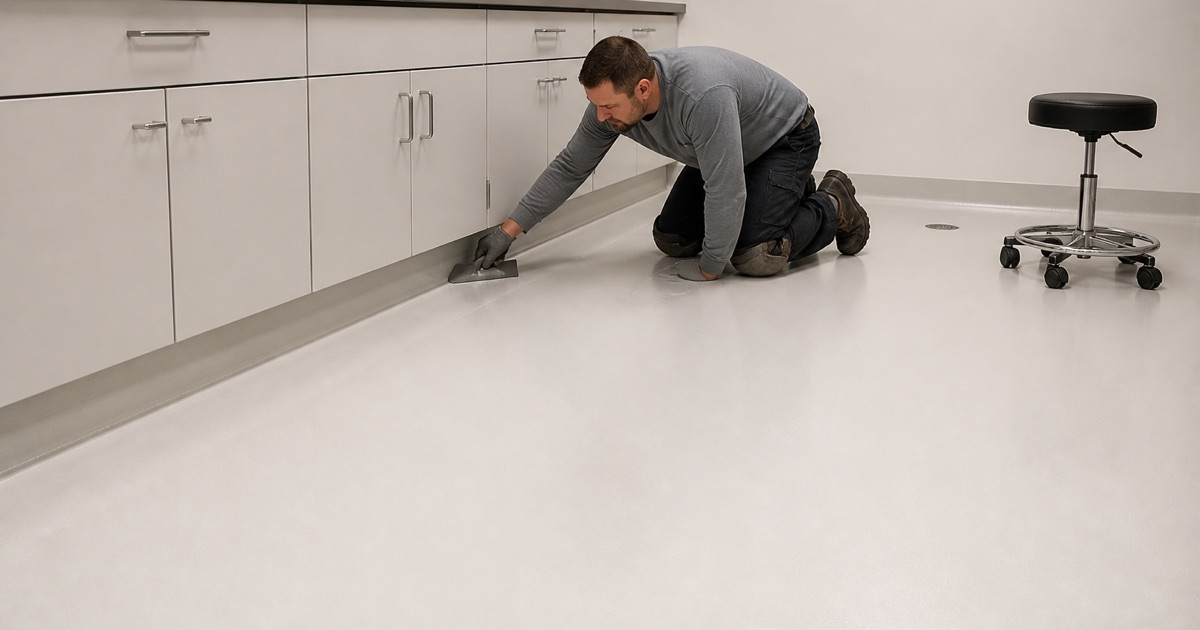
What that means in practice is a seamless, coved, chemically resistant floor with no junction at the wall for water or contamination to get behind. The coving detail matters as much as the resin choice does. A seam at floor level is exactly where water and contamination get behind a system and lift it, so the junction is treated as part of the floor rather than as trim.
Laboratory and Research Floors
Wet laboratories are their own problem. The floor has to resist whatever is used in the room, tolerate spillage and repeated cleaning, and stay seamless under equipment that gets moved and re-anchored over time. Anchor points and penetrations are where a lab floor usually fails first, so how they are detailed matters more than the headline chemical resistance figure.
Specifying one starts with what is actually used in that lab rather than with a product family. We would rather ask an uncomfortable number of questions at quoting than install a chemically inappropriate floor into a room that will find out for us. The list of reagents used in a room is a better guide to specification than the name of the department it belongs to.
A Permit Path That Does Not Run Through City Hall
This is the fact most often got wrong here. Acute-care hospital buildings in California are reviewed by the Department of Health Care Access and Information rather than by city building and safety, and the veterans hospital is a federal facility. Neither route runs through the city counter, and neither timeline resembles the one a residential permit follows.
So on the largest floors in this city, the plan-check route is not the one a contractor would assume from the address. Knowing that before a schedule is written is the difference between a realistic program and an optimistic one. It is also the sort of thing a contractor from outside the area learns the expensive way, halfway through a project.
Working in Buildings That Never Close
Phasing Around Clinical Use
Almost nothing here can shut. We break a floor into rooms, zones or wings that can be prepared, coated and cured while the rest of the building operates, and we agree that sequence with whoever runs the space before quoting rather than after. The sequence is what determines how many nights the job takes, so it belongs in the proposal rather than being settled on the first morning.
On clinical floors that sequence is set by patient activity rather than by our convenience, and it frequently means nights, weekends and a longer overall program in exchange for no disruption to the service. That trade is almost always worth making, because a closed clinical room costs far more per day than the extra shifts do.
Containment, Dust and Air
Grinding produces a great deal of dust and a hospital cannot absorb any of it. Work areas are contained, negative air and HEPA extraction run continuously, and access routes are protected for the duration. Protecting the route matters as much as containing the room, since the dust that causes a problem is usually the dust that travelled.
In healthcare that plan gets more scrutiny than the coating specification, and rightly so. We would rather over-specify containment and be told to relax it than under-specify it and be asked to stop. A stopped job in an occupied hospital is expensive in ways that have nothing to do with flooring.
Fast-Cure Systems and Return to Service
Where a room has to be back in use quickly, a polyaspartic or polyurea topcoat is what makes the schedule possible, turning a multi-day wait into an overnight one. That single property is often what decides whether a clinical floor can be replaced at all without relocating the service it houses. The trade-off is a short pot life that shortens further as the slab warms, so those jobs are batched small and sequenced tightly. On a hot slab that window narrows further, which is why the crew size and the batching plan are set before the first mix rather than adjusted during it.
We quote return-to-service against the actual slab temperature and dew point on the day rather than a label figure, because a clinical floor released early is a floor damaged before the room reopens. We give those dates in writing ahead of the work so the facility can plan the reopening around them rather than around an estimate.
Preparation Does Not Change
Testing Before Specification
Every slab is moisture tested before a system is chosen, using the ASTM F1869 calcium chloride test and the ASTM F2170 in-situ relative humidity probe with thresholds read from ASTM F710. On an institutional floor the cost of getting that wrong is measured in closed rooms rather than in materials. Where a slab reads high we specify a moisture vapor barrier primer sized to the number, and that decision is made before anything is ordered.
Mechanical Preparation, Never an Acid Etch
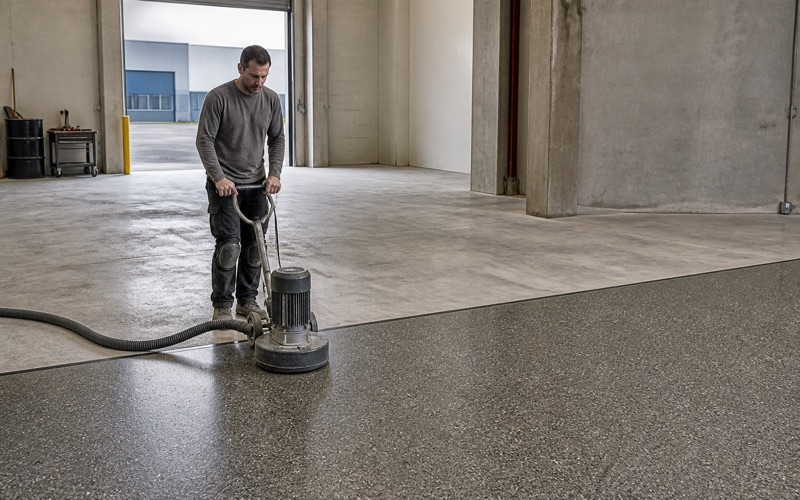
Large floors are shot blasted for speed and uniformity, smaller and edge areas are ground, and both are taken to the concrete surface profile the coating system specifies. Edges, corners and the area around fixed equipment are always cut in by hand, because a blaster cannot reach them and an unprepared perimeter is where a floor starts lifting. We do not acid etch, because it softens the surface and leaves the coating bonded to a weakened layer rather than to sound concrete. It also cannot produce a consistent profile on a hard-troweled slab, which is most of what an institutional building has.
- 20+ Years Experience
- Free Estimates
- Every Slab Moisture Tested