Colton Epoxy Flooring installs epoxy flooring in Lake Mathews, CA, and this page is deliberately honest about scale rather than padded to look busier. We have more than twenty years of concrete work behind us in this region, and part of that is knowing when a community is a small, specific market rather than a route. Describing it accurately is more useful to a customer here than pretending to a coverage we do not have.
Lake Mathews holds barely more than a thousand houses spread across a very large area of mostly undeveloped land. It is the thinnest market we cover, and anyone claiming otherwise has not looked at it. A page that implied a busy local service area would read as false to anybody who lives here.
What defines the place is not housing at all. Its dominant land use is protected watershed — roughly 16,059 acres of open space in the planning area, a 13,000-acre reserve and a 2,800-acre reservoir — which is why the housing count is what it is. The land use explains the market in a way that the population figure on its own never would.
A Watershed With Some Houses Around It
Why the Housing Count Is Low
The land here is largely protected open space rather than developable ground, so the residential component is small by design rather than by accident. That is worth understanding before anyone quotes this community, because it explains why a map showing sixteen square miles corresponds to barely more than a thousand houses.
For us that means Lake Mathews is a place we serve properly when we are asked rather than a route we run. A crew coming here for a single small garage is doing so at the customer’s expense, which is why we would rather combine work or be straight about the travel. Most owners here are entirely reasonable about that once it is explained rather than hidden in a price.
No Multifamily at All
Unusually, the housing survey records no units at all in any multifamily category here. There is genuinely no property-management, apartment or parking-deck half to this market, which is not true of anywhere else we cover. It is a genuinely unusual finding and it simplifies what we offer here rather than limiting it. Every other community on our service area has at least some shared housing; this one genuinely has none.
That simplifies things considerably. Every job here is a private property, usually with a single decision-maker, and the work is residential garages and outbuildings rather than shared common areas on a maintenance cycle. That tends to make the conversations more direct and the decisions faster.
Large Parcels, More Than One Slab
Rural acreage means most properties carry more than a house and its garage. Detached shops, equipment buildings, RV or boat storage and barns are common, and each of those has a slab that may be worth coating. Quoting the garage alone on a property like this describes a fraction of the available work.
So we walk the property and price each slab rather than quoting the garage alone. Doing several in one mobilization costs meaningfully less per square foot than returning for each, and on a property this far out that saving is larger than it would be closer in. Travel is a real component of the cost out here, and spreading it across several slabs is the honest way to reduce it.
Looking for warehouse floor coating closer to Ontario? See Ontario Warehouse Floor Coating.
Working on a Rural Property
Access, Power and Water
Large lots usually solve the staging problem that constrains a suburban driveway — there is room to position a trailer, turn a vehicle and work without blocking anything. That part is easy here. It is one of the few things about working this far out that is genuinely simpler than in town.
What is less reliable is services. A planetary grinder and a dust extraction rig want real power, and an outbuilding at the back of several acres frequently does not have it, while a property on a well rather than a meter is worth confirming for water. We check both on the site visit and bring generation where it is needed rather than discovering the gap on the morning. A generator on the trailer is a small cost; a wasted trip up here is not.
Outbuildings Are a Different Specification
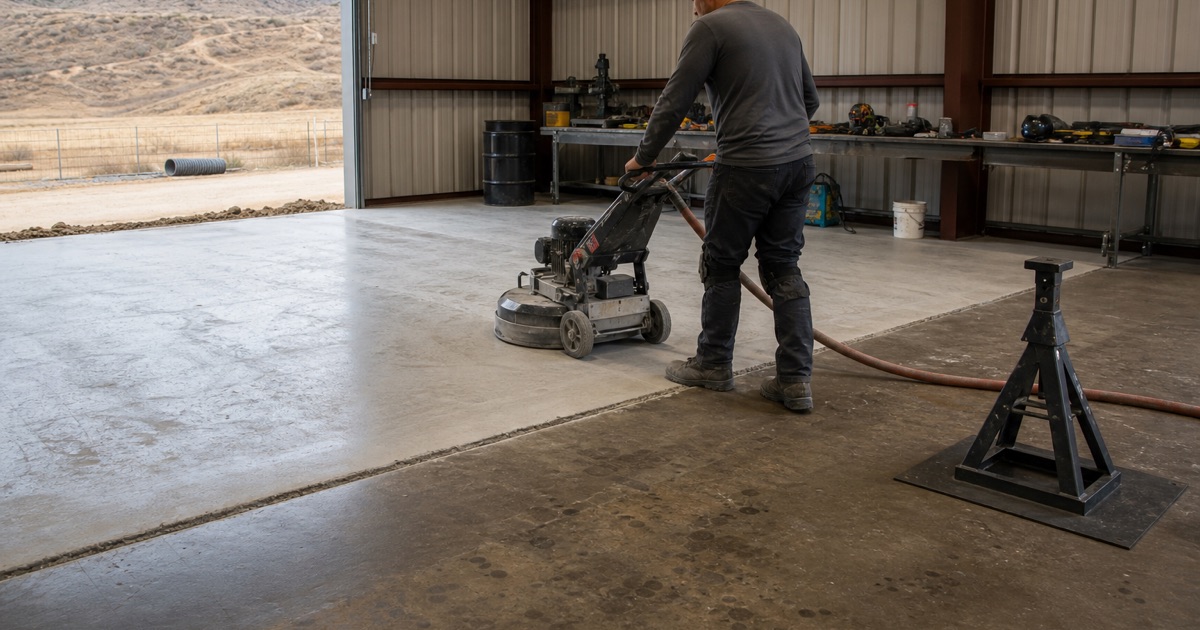
A workshop or equipment building takes point loads from jack stands and hoists, dropped tools, welding spatter, solvent and hydraulic fluid, which is a harder duty than a domestic garage and points at a higher-build, chemically resistant system rather than a decorative one.
Those buildings are usually uninsulated too, so the daily temperature swing inside one is wider than in an attached garage. That narrows the application window and makes measuring surface temperature at the time of the pour necessary rather than optional.
Testing Each Slab Separately
On a property with several slabs placed at different times by different people, one reading tells you about one floor. We test each before ordering product for it, using the ASTM F1869 calcium chloride test and the ASTM F2170 in-situ relative humidity probe with thresholds from ASTM F710.
The variation between two buildings on the same parcel is often larger than between two houses in a tract. One may have a vapor retarder beneath it and the next may be a pour somebody did themselves decades ago, and only testing separates them.
Being Straight About the Numbers
Wide Margins on a Small Population
The survey estimates for a community this size carry margins of error large enough to matter — the housing unit total carries a margin of several hundred on a figure of about 1,673, and individual build-era counts have margins approaching or exceeding half their estimates.
So we treat the shape of the distribution as reliable and the individual counts as approximate, and we would rather characterize the community than quote a precise figure the data cannot support. Anyone presenting exact statistics about Lake Mathews is over-reading them.
An Unusual Economic Signature
The economics here are distinctive: high property values on moderate household incomes, which is what large rural acreage held over decades looks like in the data. The buyer is frequently a long-tenure owner rather than a recent purchaser.
That tends to mean practical decisions about buildings people have used for years rather than finishing touches on a new house, and it usually favors a specification chosen for durability over one chosen for appearance.
Heat and the Working Window
Slab temperature governs the working day as it does across this region. Pot life on a common system runs about 60 minutes at 55 degrees and collapses toward 20 minutes at 95 degrees, with the recoat minimum shortening alongside it.
In an uninsulated outbuilding on open ground that swing is wider still, so we read surface temperature and dew point on the day rather than working from a forecast. A coating needs to go down at least 5 degrees above the dew point, and that is a measurement rather than a judgment call.
What We Recommend Out Here
Durability Over Decoration
The buildings that matter most on a rural property are usually working ones, and the specification that suits them is chosen for wear and cleaning rather than for appearance. A higher-build system with real chemical resistance outlasts a decorative floor in a shop or an equipment building by a wide margin.
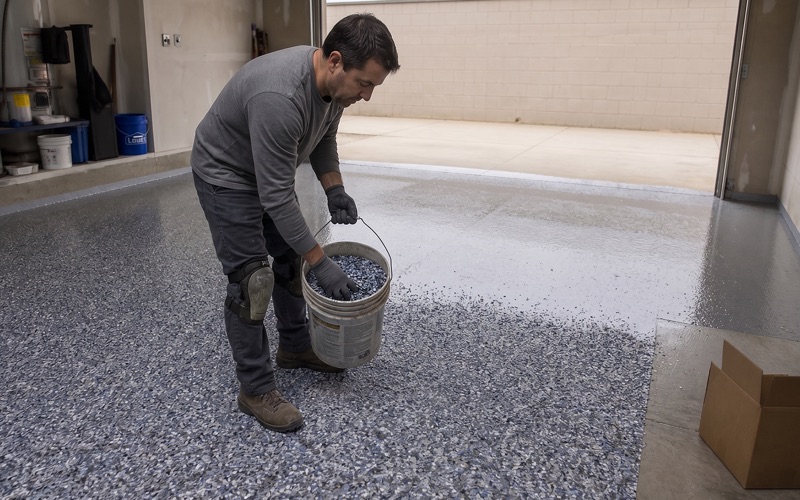
That does not mean the finish has to be plain. A quartz broadcast gives genuine texture and slip resistance while still looking considered, and it handles the point loads and spills that a fine flake floor would show. Where a garage is genuinely domestic, a conventional flake system is still the right answer. The mistake worth avoiding is specifying one system across a whole property when the buildings do quite different jobs.
Exterior Slabs and Sun
Driveways, approaches and covered exterior areas on a rural property take direct inland sun, which rules out an epoxy topcoat because epoxy ambers under ultraviolet light. Exterior work gets aliphatic polyaspartic or polyurea chemistry, or a cementitious overlay where the surface is worn rather than structurally failing.
Texture is designed into an exterior finish rather than added afterwards, because a smooth slab that gets wet is a hazard on a property where people are carrying things. On a long rural approach, slip resistance matters more than the finish anyone notices. It is also the thing most likely to be regretted if it is left out to save a little on the broadcast.
Combining Work and Being Realistic
The most cost-effective approach here is almost always to identify everything worth coating in one visit and price it as a program, then let the owner decide how much of it to do now. Splitting it across two seasons is fine; splitting it across two mobilizations a year apart is expensive.
We set the numbers out slab by slab so that choice is visible rather than bundled. On a property this far from town, the arithmetic of combining work is the single biggest lever on what the job actually costs. That is worth knowing before deciding to do only the garage this year and think about the shop next.
- 20+ Years Experience
- Free Estimates
- Every Slab Moisture Tested