Colton Epoxy Flooring installs epoxy flooring in Lake Arrowhead, CA, and two things make this community different from anywhere else we work: who owns the buildings, and how few months of the year the conditions actually allow the work. Both of those shape a job here more than any decision about products does.
Lake Arrowhead is a second-home market first and a residential market second. Most of its housing sits in seasonal, recreational or occasional use, and well under half the stock is occupied at all. The usual owner-occupied framing understates the addressable pool here considerably rather than describing it. A market sized on owner-occupied units alone would miss most of the buildings that actually need floors.
The second constraint is temperature, and here it is measured rather than estimated. NOAA 1991-2020 normals for the Lake Arrowhead station put the average daily mean below 50 degrees in six months of the year, including 36.5 degrees in January. Having a real station record rather than a nearby proxy is unusual in the mountains and it makes the planning considerably more confident.
More Than Half These Houses Are Not Lived In
Who Actually Approves the Work
When the owner is elsewhere, the practical questions change. Who authorizes the job, who provides access, who is on site to see the slab before it is coated, and who signs off at completion are all worth settling before a date is agreed rather than on the morning.
The buyer here is frequently an absentee owner, a family trust or a property manager rather than somebody standing in the garage. That is not a difficulty, it is simply a different process, and we run it with photographs, written scopes and clear decision points rather than assuming a conversation on site. It works well once everyone knows that is the process, and badly when it is assumed to be the same as a job in town.
Vacation Rentals Change the Economics
A large share of this housing is rented out, and that changes what a floor is worth. A garage or utility floor that fails is lost booking revenue rather than an inconvenience, and downtime for repair lands in the middle of a season. That reframes a floor from a cosmetic decision into an operating one, which usually clarifies the specification quickly.
That usually argues for a more durable specification rather than a cheaper one, and for scheduling work in a shoulder period rather than a peak one. Owners renting property here are generally well aware of both, and the conversation is refreshingly practical. Owners who run their property as a business tend to ask the right questions about service life and refresh cost.
Coordinating Access
The commonest scheduling problem here has nothing to do with concrete. It is arranging access on a property nobody lives in, sometimes through a manager, sometimes through a lockbox, occasionally around a cleaning schedule between bookings.
We raise it at quoting rather than discovering it on the day, because a crew and a trailer of equipment arriving at a locked house on a mountain is an expensive kind of wasted morning. It is entirely avoidable with one conversation at the quoting stage.
Looking for epoxy flooring closer to Calimesa? See Epoxy Flooring Services in Calimesa.
Six Months Below Fifty Degrees
What the Station Record Says
The temperature constraint here is grounded in an actual NOAA station record rather than inferred from a nearby town. The 1991-2020 normals put the average daily mean below 50 degrees in six months of the year, with January at 36.5 degrees.
That matters because 50 degrees is a hard published minimum on common epoxy floor coatings, applying to air, surface and material alike, with a requirement to be at least 5 degrees above the dew point on top of it. For a substantial part of the year the conditions sit below what the products allow. That is a property of the chemistry rather than a limitation of any particular crew, and no contractor can work around it.
Who Is Available When the Weather Is
The scheduling problem here is two constraints at once rather than one. The conditions have to allow the work and the property has to be available, and on a house that is rented out through the season those two windows do not always overlap generously.
That is why we would rather look at a floor months ahead and hold a scope than be called in the week somebody notices a problem. An owner who books into the right part of the year gets a straightforward job; one who reacts in December is waiting regardless of who they call.
Booking a Season Rather Than a Week
The practical consequence is that mountain work is planned around conditions rather than a fixed date, with a target window agreed and the working days confirmed closer to the time. Customers here are generally used to that, because it is how most trades operate at this elevation.
We would far rather move a date than do the work badly. A job shifted to the right month costs nothing; a coating applied outside its specification looks finished, fails to develop its properties, and cannot be recovered without starting again. There is no way to rescue a coating that cured outside its specification; the material is on the slab and removing it is a fresh job.
Working on a Mountain Property
Getting Equipment Up and In
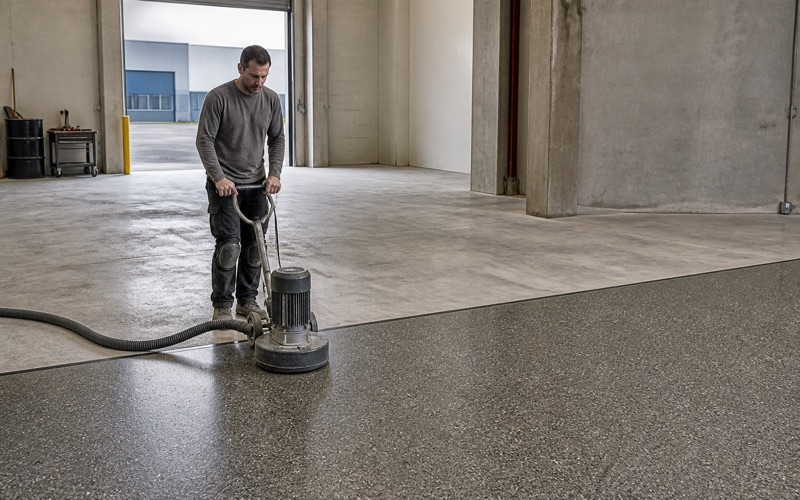
Access here is a genuine planning question rather than a formality. Getting a planetary grinder, a dust extraction rig and material up the mountain and then onto a particular property takes thought, and driveways are frequently steep, narrow or unpaved.
We confirm the last hundred feet before committing to a date — grade, surface, turnaround room and whether a heavy machine can physically be walked to the slab. That conversation takes a few minutes at the survey and prevents a wasted trip that costs a full day.
Heating a Space to Extend the Window
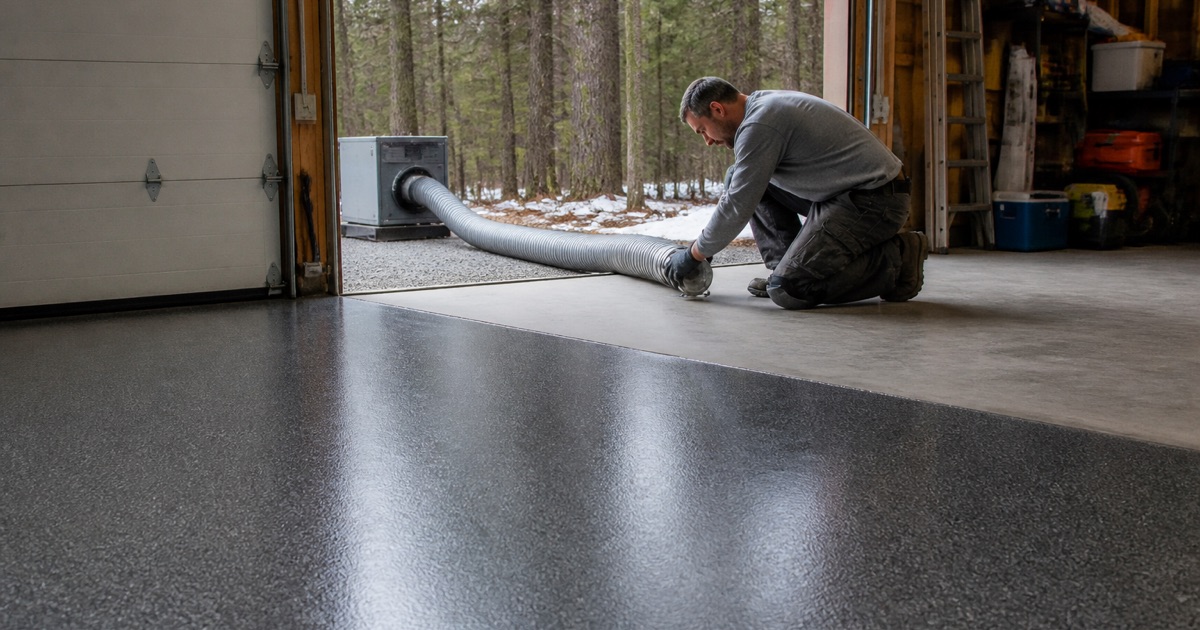
Where a job genuinely has to happen outside the comfortable season, the answer is sometimes to heat and control the space rather than to hope. That is a real option in an enclosed garage, and it carries its own requirements around ventilation, even heat distribution and holding the temperature through cure rather than merely during application.
It also costs money, and we would rather set that out as an honest option than either refuse the work or take it and hope for a warm week. Once the trade-off is clear the choice belongs to the owner.
Finishes That Suit a Mountain Building
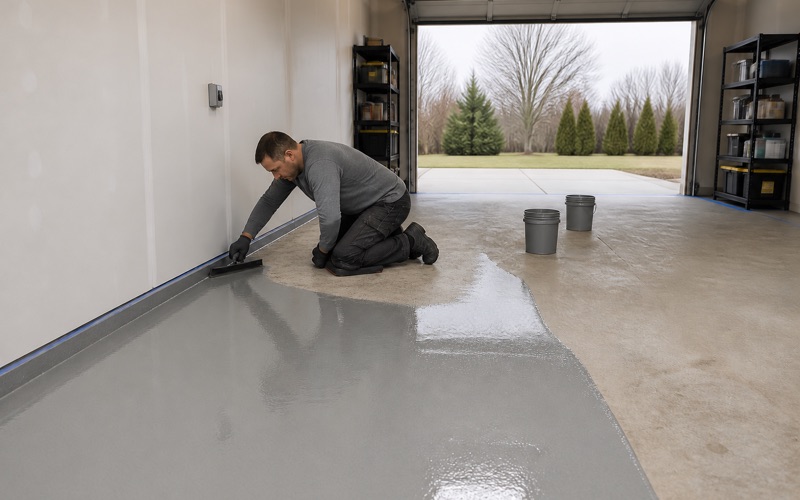
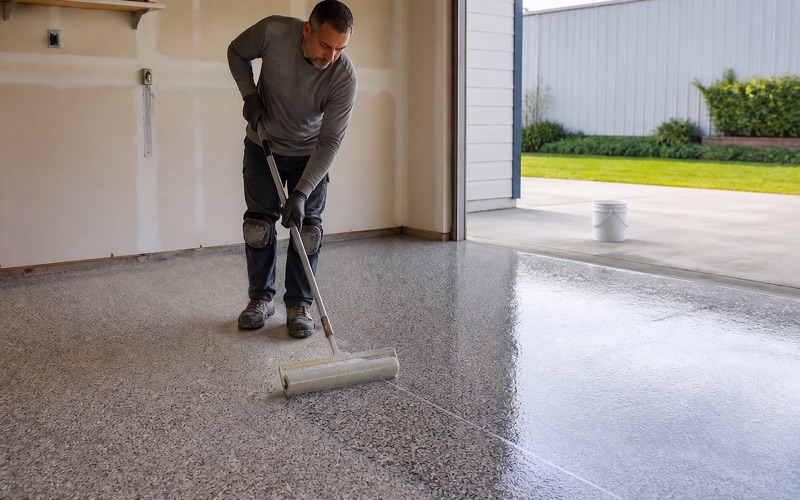
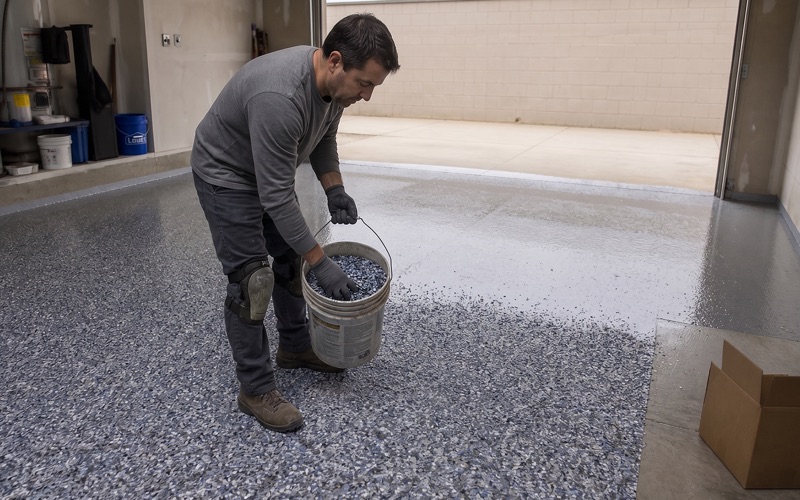
Practical considerations lead here. A floor that sees wet boots, grit, snow melt and firewood benefits from a full flake or quartz broadcast rather than a smooth finish, both for grip and because texture hides what a mountain garage does to a floor.
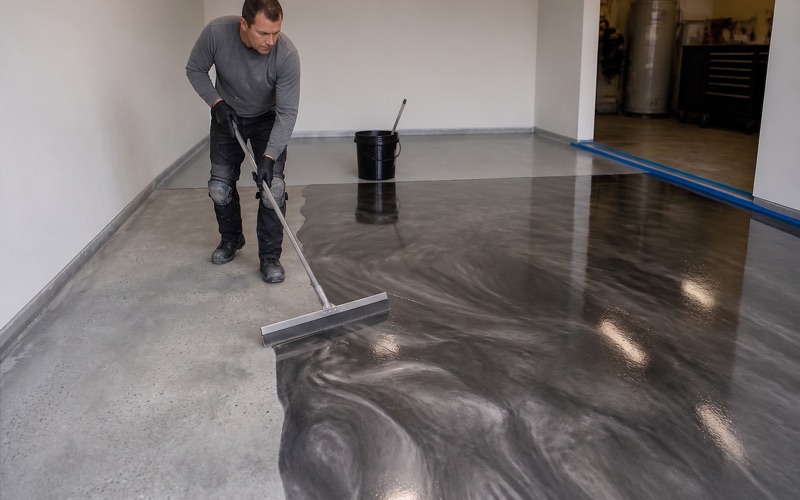
Gloss level is worth deciding deliberately too. High gloss shows every mark and every piece of tracked-in grit, while satin hides a great deal and is usually what people are happiest with a year later in a building used hard and cleaned rarely.
What We Recommend Up Here
Testing Older Mountain Slabs
Mountain concrete can hold seasonal moisture in ways a valley slab does not, so testing matters here even where the build date looks reassuring. We use the ASTM F1869 calcium chloride test to read a vapor emission rate at the surface and the ASTM F2170 in-situ relative humidity probe to read the state of the slab at depth, with thresholds taken from ASTM F710.
The ASTM D4263 plastic sheet test is worth knowing as a screen and nothing more, because it is asymmetric — a positive result fails a slab while a negative one proves nothing at all. On a property that sits empty for months at a time, a single reading taken on one dry afternoon is not the whole picture, and we say so rather than over-claiming.
Polished Concrete as an Alternative
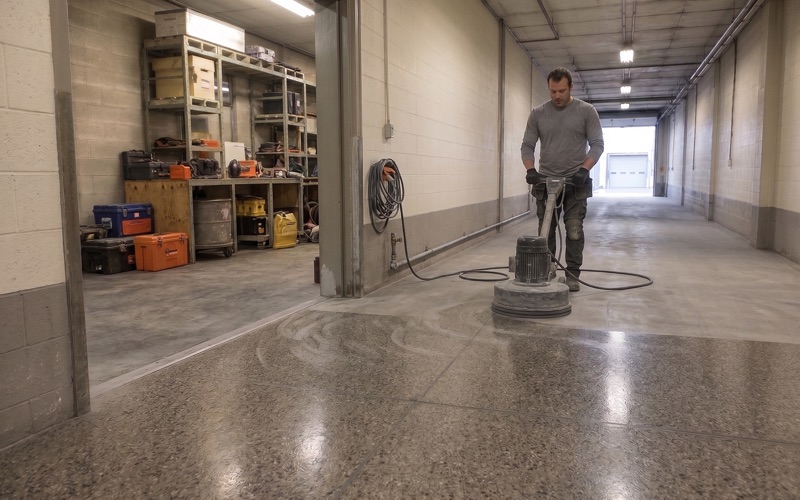
On a sound slab that reads high for moisture, polished concrete deserves genuine consideration, because the failure mode that defeats a coating simply does not apply. The floor is ground through progressive grits, densified with a chemical hardener and polished to a chosen gloss, so nothing is bonded on top for vapor pressure to lift.
It also removes the recoat cycle entirely, which on a rental property is worth real money over a decade. What it cannot do is conceal a patched or contaminated slab, so we grind a test area and let the concrete itself decide whether it is a candidate.
Planning Work Around the Season
The most useful thing an owner here can do is decide early and book into the window rather than reacting to a failure in November. A floor identified in spring can be scheduled comfortably; the same floor discovered in December waits until conditions allow, whatever anybody would prefer.
We are happy to survey out of season and hold a scope ready for the right month. That costs nothing, and it means the work happens under conditions that let the material do what it is supposed to rather than under pressure.
- 20+ Years Experience
- Free Estimates
- Every Slab Moisture Tested