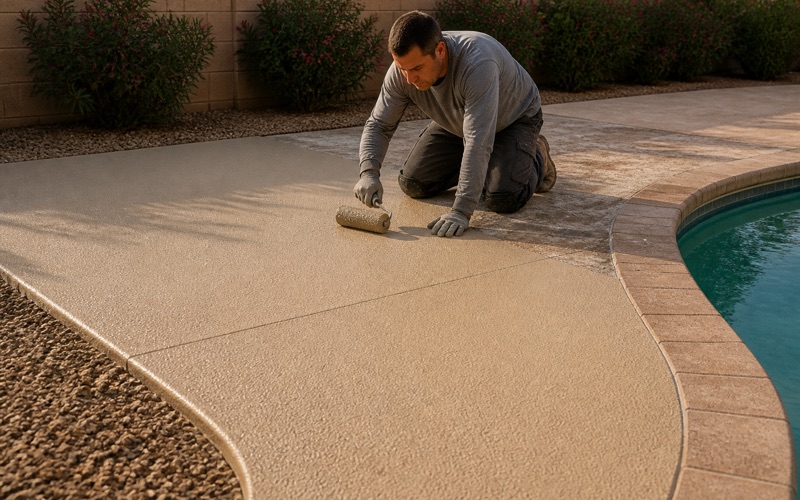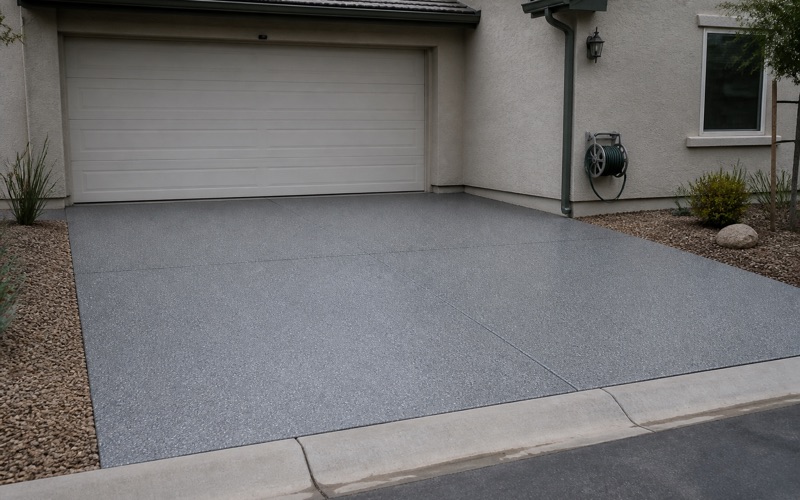
Colton Epoxy Flooring installs concrete floor coating systems in Jurupa Valley, CA, and this is the one city on our service area where a citywide average is actively misleading. We have more than twenty years of concrete work behind us in this valley, and Jurupa Valley is where that experience mostly amounts to knowing which questions to ask before quoting anything at all.
The reason is that Jurupa Valley is not a single suburb that grew outward from a center. It is a merger of seven formerly unincorporated communities, incorporated as one city in 2011, and those communities were built at different times for different reasons and have almost nothing in common as substrates. A crew can move from a 1950s small-lot street in Rubidoux to a 2010s tract in Mira Loma to large-lot rural residential in Sky Country inside a single working day.
Alongside that sits one of the newest and densest warehouse markets in the region. Over half the residential slabs here predate 1980 and roughly a fifth predate 1960, while the Mira Loma distribution buildings are recent power-troweled placements — which means the two halves of this city need preparation that is not merely different but opposite in what it is trying to achieve.
Seven Communities, No Average Job
Why We Will Not Quote This City Over the Phone
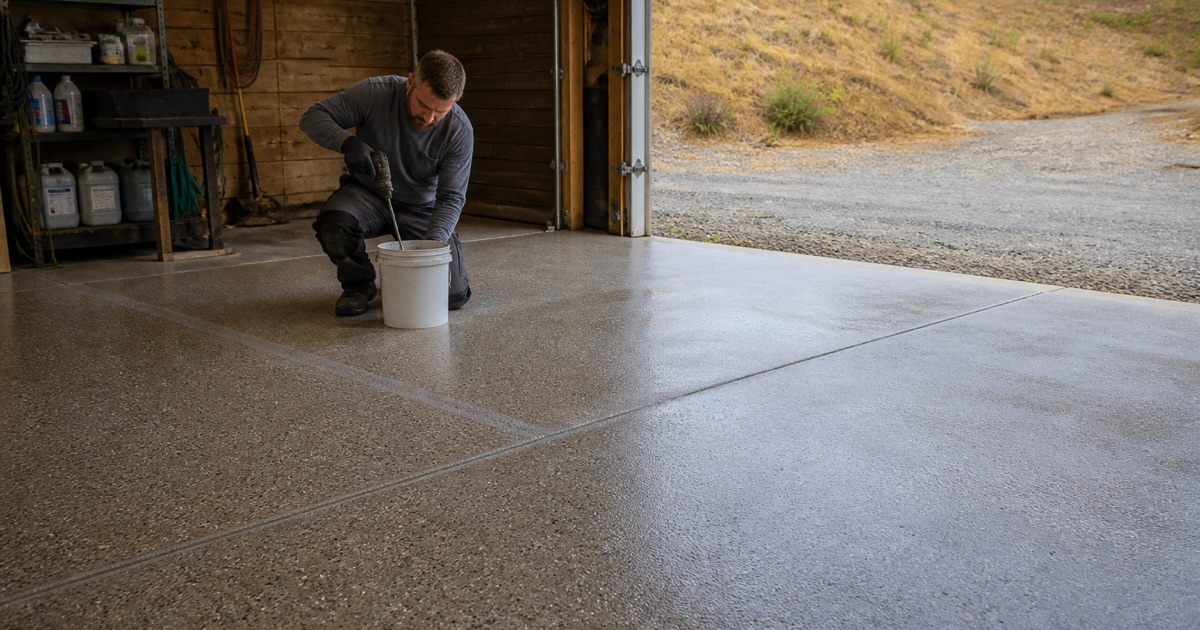
In most places a build era and a square footage get you close enough to a number to be useful. Here they do not, because two addresses with the same city name can be seventy years apart in construction and completely different in lot size, slab quality and what has already been done to the floor. A citywide average describes nowhere in particular and misleads about everywhere.
So we quote from a site visit rather than from an address, and we say so up front rather than producing a number and revising it later. The visit costs nothing and it is the only honest way to price work in a city assembled from this many separate places.
The Older Rubidoux and Crestmore Side
Roughly 6,300 units citywide predate 1960, concentrated in the older communities on the Rubidoux and Crestmore side of the city. Concrete from that era was commonly poured with no under-slab vapor retarder beneath it, which makes moisture vapor emission testing a standard line item on those jobs rather than an optional extra somebody can decline.
Those are also smaller lots with smaller, often detached garages, which changes the practical shape of the work as much as the technical side. Less room to maneuver, tighter turns for equipment and slab edges that have broken down where a door has sat for decades are all normal there, and all of them belong in the quote rather than in a surprise.
The Newer Tract Side
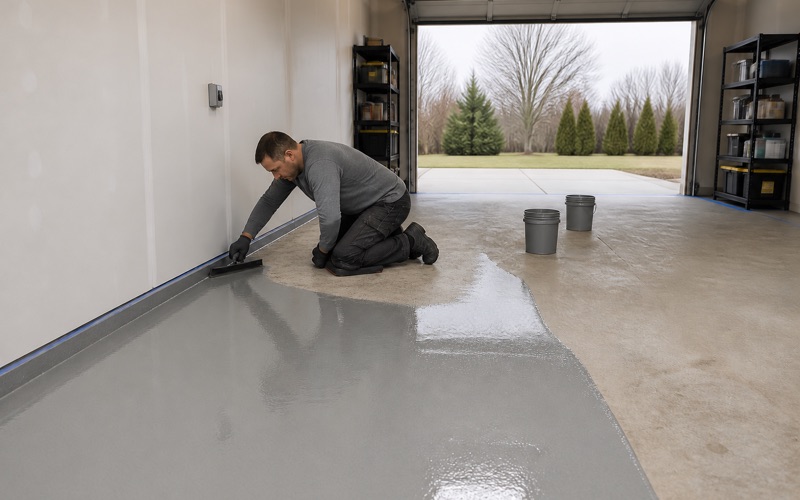
At the other end, the 2010s tract housing behaves like new construction anywhere: a modern attached bay on a sound, uncoated slab placed over a vapor retarder, where the job is a clean grind, joint fill, prime, broadcast and topcoat. The price is more predictable and the risk is lower, because most of the variability in a garage quote comes from what is already on the floor and how the slab was placed.
We still test those slabs, because the California Residential Code exempts garages from the under-slab vapor retarder requirement and a modern build date is therefore not a guarantee that anything is under there. It is a short test against the cost of a floor that has to come off, which makes it an easy decision.
Looking for commercial epoxy flooring closer to Riverside? See Commercial Epoxy Flooring Services in Riverside.
Industrial Floors on the Mira Loma Side
Power-Troweled Slabs and the Opposite Problem
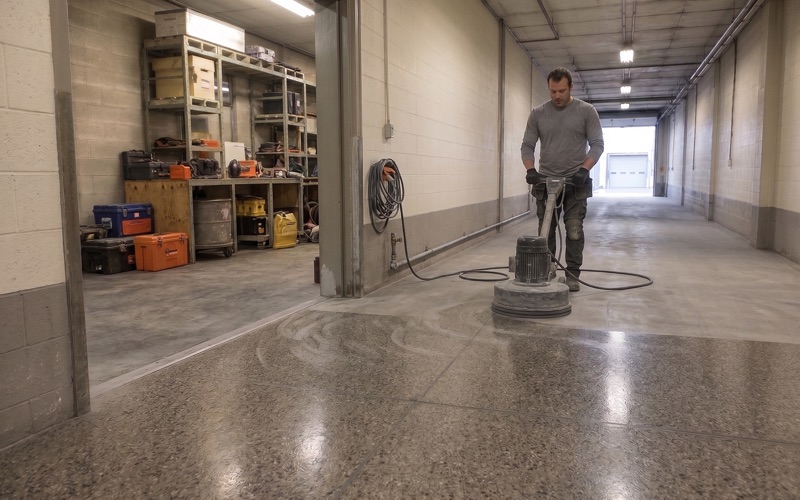
A recent distribution slab is dense, burnished and low-porosity, and the difficulty is not that the concrete is compromised but that there is nothing for a resin to key into until the surface has been opened mechanically to a specified profile. That is the exact reverse of the problem an old porous garage floor presents, and it is why the same crew carries completely different tooling for the two.
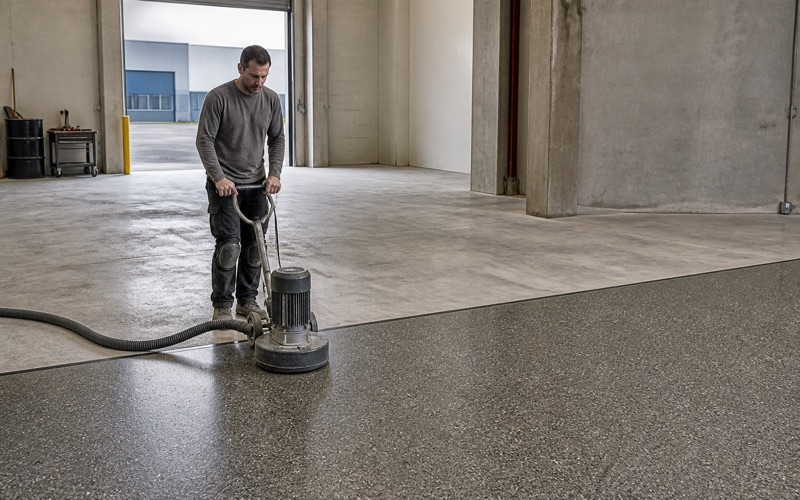
Large areas get shot blasted because steel media opens a deeper, more uniform profile far faster than a planetary grinder manages across that much floor, with the media recovered in a closed loop. Edges, corners and everything around racking uprights and fixed equipment still get cut in by hand, because a blaster cannot reach any of it and an unprepared perimeter is where a large floor begins lifting.
What a Distribution Floor Is Specified On
The specification starts from traffic rather than appearance. Joint filling with a semi-rigid material protects joint edges from hard-wheeled forklifts, which matters because once an edge starts breaking down it accelerates as every wheel hits a larger step than the last. Crack repair, and a coating or hardener chosen on abrasion and impact resistance, follow from the same reasoning.
We ask about wheel material and pallet-jack routes before proposing anything, since those two answers narrow the product range faster than square footage ever does. Striping is then laid out to the racking plan and to the operator’s own safety program rather than to a generic template, which usually produces a more useful layout because it follows how the building actually moves.
Cold Storage, Described Honestly
There is cold storage in this city, and it is worth being straight about what it needs. A freezer floor cannot take a standard ambient-cure resin system: the substrate sits below the minimum application temperature, thermal cycling moves the slab against whatever is bonded to it, and the work has to be staged around a controlled thaw and a plant shutdown rather than simply booked into a weekend.
Urethane cement rather than epoxy is the honest answer in most of those rooms, because its thermal expansion behaves far more like the concrete beneath it. We would rather say that at quoting and lose the job to someone promising something easier than install a system that will delaminate the first time the room cycles.
Practicalities Across a Very Mixed City
Access Varies More Than Anywhere Else We Work
Sky Country’s large rural parcels, Rubidoux’s tight older streets and Mira Loma’s dock-height industrial access are three genuinely different staging problems, and the only thing they have in common is that we check before the day rather than on it. On a rural parcel the questions are power, water and whether a grinder can be walked to an outbuilding; in an older neighborhood it is driveway width and turning room; in a warehouse it is a clear route through racking.
Getting that wrong does not usually make a job impossible, it makes it a day longer, and a day is the difference between a quote that holds and one that does not. We would rather ask several dull questions at the site visit than improvise on the morning.
Heat and the Working Window
Slab temperature governs the calendar across all seven communities equally. Pot life on a common system runs about 60 minutes at 55 degrees and collapses toward 20 minutes at 95 degrees, with the recoat minimum shortening in step, which is a published behavior rather than a rule of thumb and is the reason a summer program is planned differently from a spring one.
On a large industrial floor that decides crew size as much as start time, because a batch that sets before it has been back-rolled shows permanently and cannot be corrected afterwards. We size the crew to the slab and the season, and where an area is too large to hold a wet edge in one pass we plan a deliberate break at a joint or a column line rather than letting one appear at random.
One Air District, One Set of Category Rules
Whatever else varies here, the air district does not. Jurupa Valley sits inside the South Coast Air Quality Management District, where Rule 1113 caps floor coatings at 50 grams per liter of volatile organic compounds and industrial maintenance coatings at 100, and defines the two categories as mutually exclusive rather than as a spectrum.
Subsection (c)(6) prohibits applying, or soliciting the application of, industrial maintenance coatings for residential use, which is worth settling explicitly on any property mixing the two. A workshop or barn on a residentially zoned parcel is a residential property however industrial the wear it takes, and on large rural lots here that situation is common rather than unusual.
What the Residential Work Actually Involves
Reading the Slab Before Choosing a System
On the older side of the city the first hour is diagnostic rather than productive. We look at what is already bonded to the floor, at how any previous coating failed, and at whether the cracking present is dormant shrinkage or active movement, because those three answers between them decide the entire specification and the price attached to it.
Moisture testing follows, using the ASTM F1869 calcium chloride test to read a vapor emission rate at the surface and the ASTM F2170 in-situ relative humidity probe to read the state of the slab at depth, with the threshold numbers taken from ASTM F710. The ASTM D4263 plastic sheet test is a useful screen and nothing more, because it is asymmetric: a positive result fails a slab while a negative one proves nothing at all.
Repair Is Scope, Not an Extra
Grinding an older floor exposes work rather than simply preparing a surface, and on pre-1960 concrete that is the norm rather than the exception. Control joints get filled with a semi-rigid material so they can keep moving without the coating bridging and cracking above them, spalls and broken edges are cut back and patched, and oil that has soaked into the slab is treated before priming so it cannot bleed back through.
All of that is scoped and priced with the floor rather than raised once the grinder is running, because an older slab where repair is treated as a variation produces a quote that moves halfway through the job. On the newer tract side the same list is usually much shorter, which is most of why those jobs price lower.
Finishes That Suit the Building
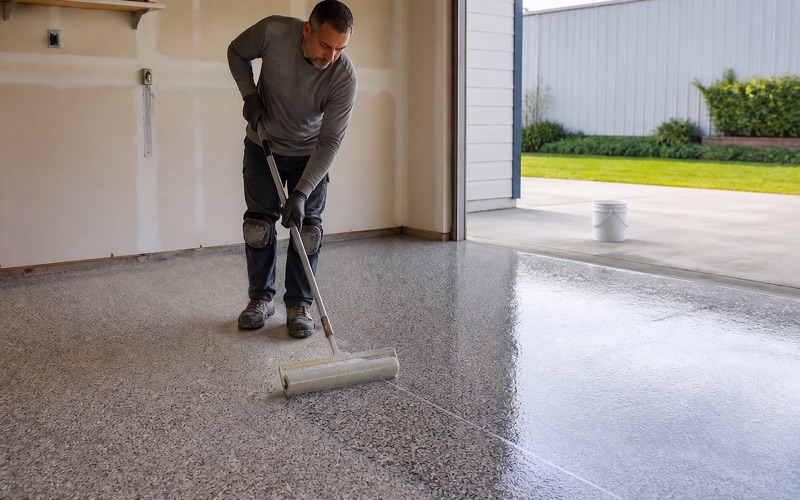
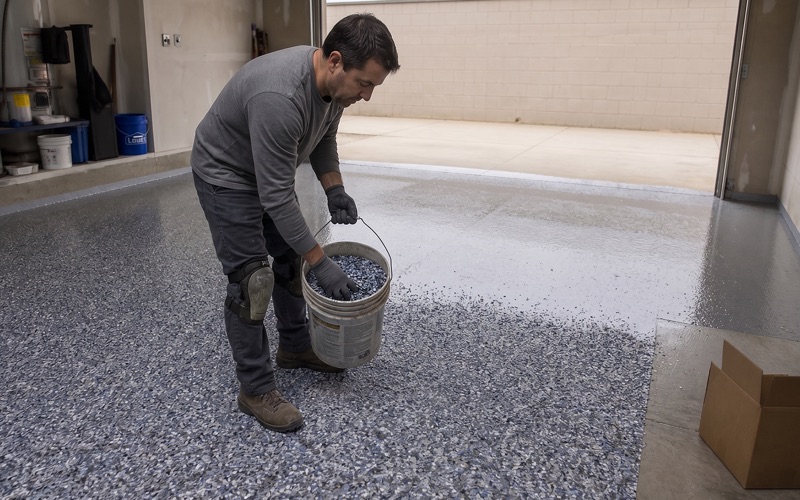
The finish conversation changes with the community as much as the technical one does. A repaired older slab benefits from a full flake broadcast, which throws chip to refusal until no base color shows and conceals joint fills and patches that a lighter scatter would leave visible. A sound newer slab has nothing to hide, so a light scatter or even a plain solid color becomes genuinely viable.
Outbuildings on the larger rural parcels are different again. A workshop slab takes point loads from jack stands and hoists, dropped tools, welding spatter and solvent, so it wants a higher-build system with real chemical resistance and a finish chosen for cleaning rather than for appearance.
- 20+ Years Experience
- Free Estimates
- Every Slab Moisture Tested