Colton Epoxy Flooring installs epoxy flooring in Highland, CA, covering residential garage floors, polished concrete and the commercial floors in and around the city. We have more than twenty years of concrete work behind us in this valley, and Highland is a short drive from our base, which makes both a Saturday garage and a phased overnight commercial job practical.
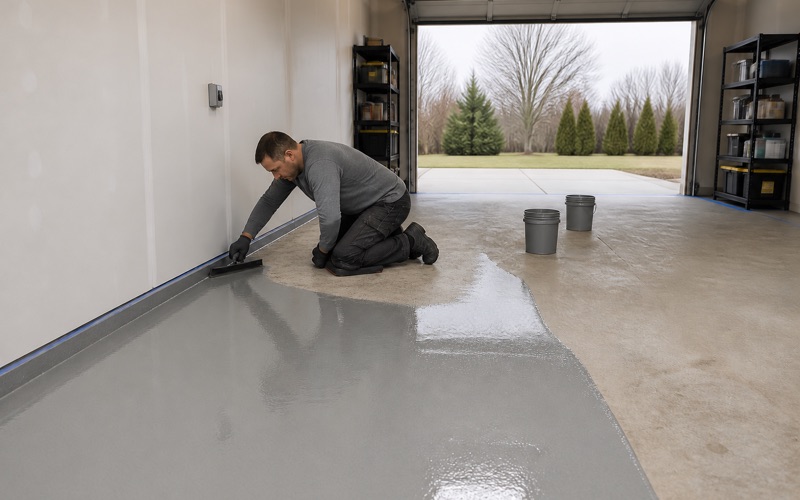
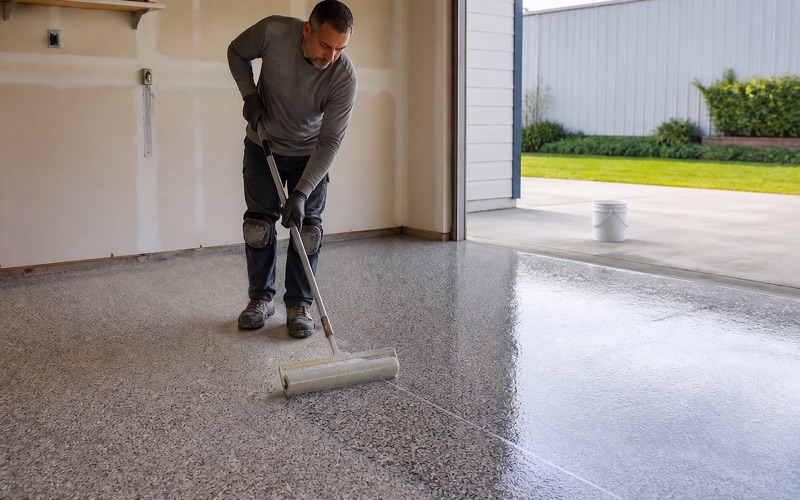
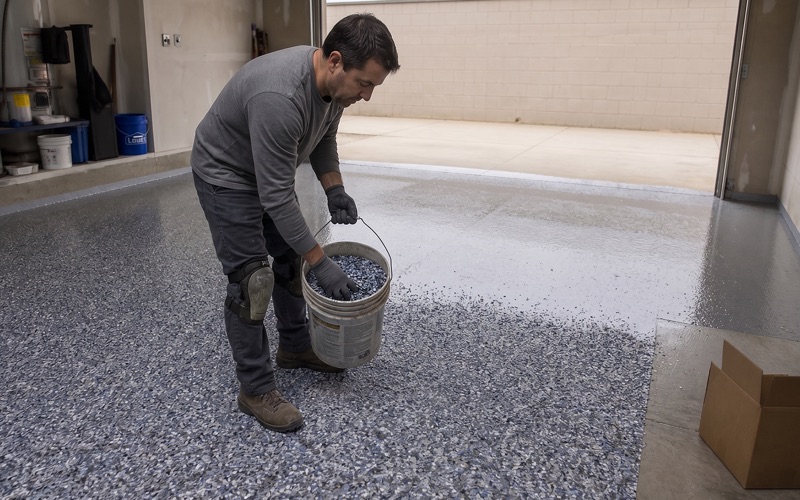
Highland is the most strongly residential city we serve, at 75.2% single-family detached with roughly 8,100 owner-occupied detached houses. The modal job here is genuinely typical: an attached two-car garage on a 1980s or 1990s slab, and the work runs the way it should — grind, repair, prime, broadcast, topcoat. There is less unusual work here than in the older cities nearby, and that consistency is worth something to a homeowner comparing quotes.
The fact worth knowing about Highland, and the one almost never stated locally, is jurisdictional. The San Manuel Reservation adjoins the city but is federal trust land, outside both City of Highland and San Bernardino County building jurisdiction, with the Yuhaaviatam of San Manuel Nation operating its own building authority. It is the kind of thing everyone in the trade eventually learns, usually by getting it wrong once on a job that mattered.
A Building Authority That Is Neither City Nor County
Three Possible Answers to One Question
Ask who permits a building in this area and there are three legitimate answers depending on where the parcel sits: the City of Highland, San Bernardino County for unincorporated land nearby, or the Nation’s own building authority on trust land. Those are genuinely separate systems rather than variations on one, and a contractor who assumes the city permits everything within sight of it will be wrong on some of the most significant buildings here. The boundary is not marked in any way that helps, so the answer comes from the parcel record rather than from looking at a map.
For the coating work itself nothing changes — the slab, the preparation and the products are what they are regardless of who reviews the paperwork. What changes is the route, the lead time and who the contract is actually with, and none of those are things to establish once a program is already underway. We settle it during the quoting stage, which costs a phone call and removes the most likely source of delay.
Why It Matters Commercially
This is not an administrative curiosity, because the resort on that land is the largest concentrated commercial floor market anywhere near here. A gaming floor measured in hundreds of thousands of square feet, a hotel tower, a theater and multiple restaurants together generate exactly the kind of back-of-house floor work this trade exists for.
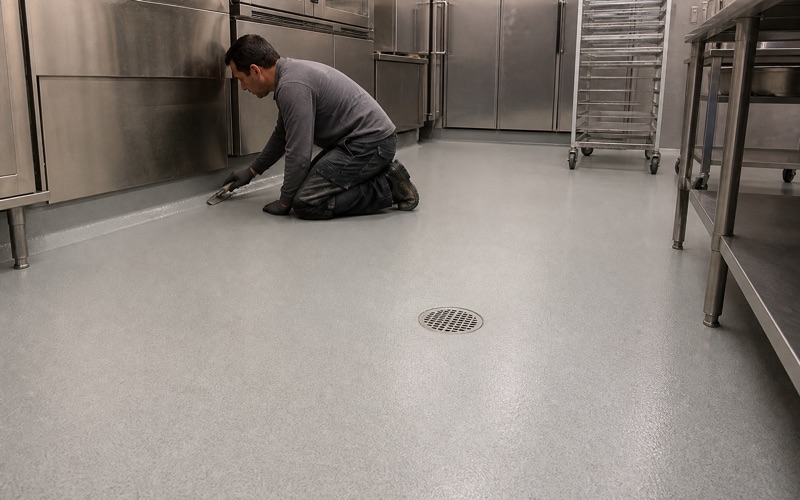
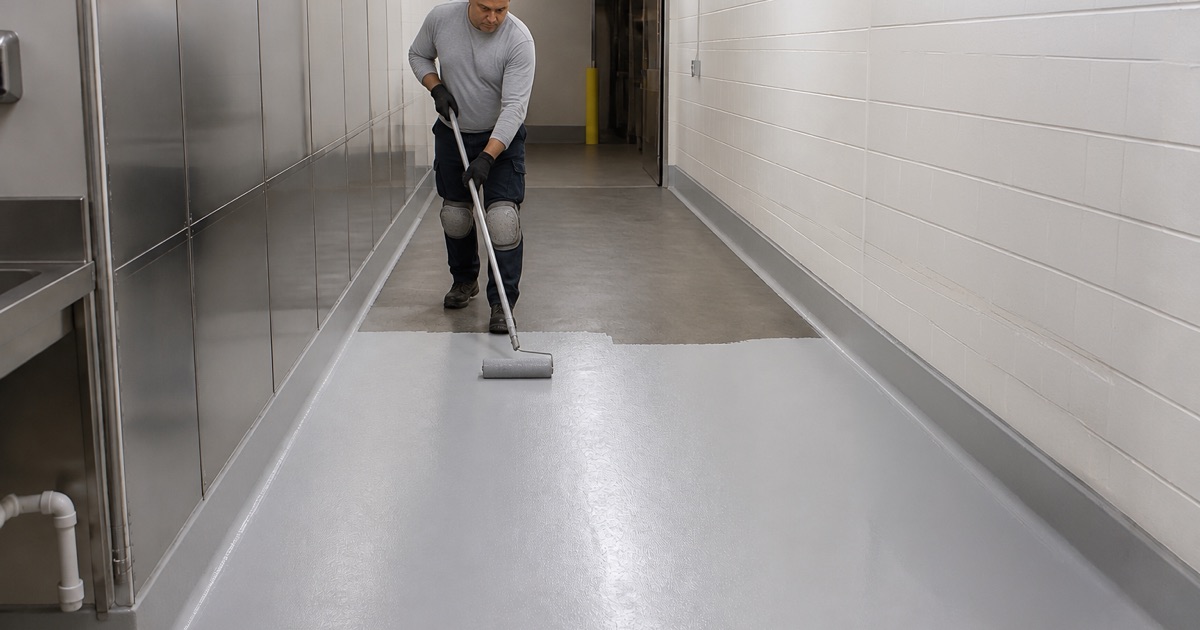
Kitchen floors, dish and prep areas, walk-in coolers and freezers, service corridors and loading docks are all seamless-coving, chemical-resistance, phased-installation problems. They are the same technical brief as a hospital or a distribution building, delivered under a different contracting arrangement. The scale is also unlike anything else nearby, which changes crew size, sequencing and how many nights a program runs.
Working on Trust Land
Work on trust land is contracted rather than permitted through a local counter, which affects paperwork and lead time rather than method. Knowing that in advance means a realistic program instead of an optimistic one, and it means the right conversations happen with the right people at the start. That is worth more than any technical advantage a contractor can offer on a job of that size.
We treat it as we treat any large commercial client: establish the review path before quoting, agree the phasing with whoever runs the space, and put the sequence in the proposal rather than settling it on the first morning.
Looking for polyaspartic floor coating closer to Moreno Valley? See Polyaspartic Floor Coating in Moreno Valley.
The Residential Work Highland Actually Hands Us
A 1980s or 1990s Attached Bay
At 75.2% single-family detached, Highland is more consistently residential than its neighbors, and the housing skews to the 1980s and 1990s building waves. That produces a predictable job: an attached two-car garage on a slab somewhere between 25 and 45 years old, with a familiar set of conditions on it.
What we find is control-joint and shrinkage cracking, lipping at the door threshold, edge curling, decades of oil where the car has sat, and very often a failed one-part paint or store-bought kit that has to come off before anything new goes down. None of that is unusual and none of it rules out a coating. It does mean the repair work is genuine rather than nominal, and it belongs in the scope rather than arriving as a variation once the grinder is running.
Removing What Somebody Already Tried
On a garage of this age the previous attempt is close to standard. A consumer kit or a one-part garage paint is thin, tough and unevenly bonded, so it loads grinding tooling and tears rather than cutting cleanly, and the flake in it grinds at a different rate from the resin around it.
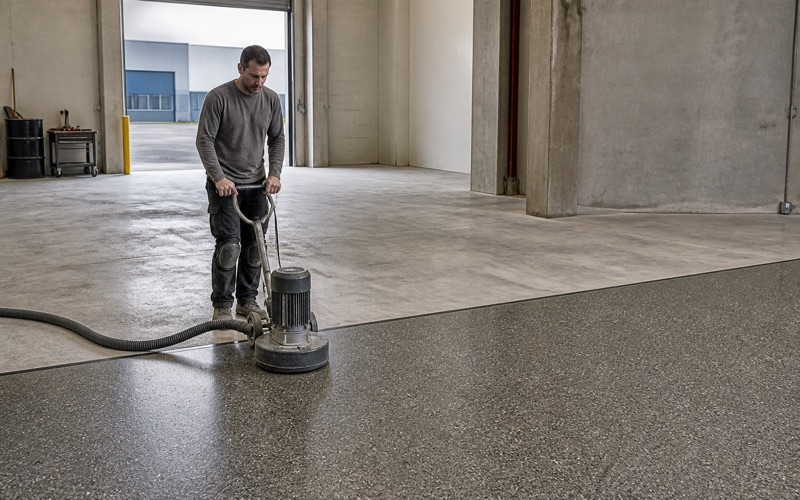
We shear that off with polycrystalline diamond tooling before switching to a conventional grit sequence to profile the concrete underneath, and we price the removal as its own line so you can see what it costs. It is frequently the single largest variable between two quotes on the same garage. A quote that does not mention removal at all is either assuming bare concrete or planning to raise it later.
Testing Even on Newer Slabs
A 1990s build date is not a guarantee, because the California Residential Code exempts garages from the under-slab vapor retarder requirement. A garage slab may have nothing beneath it however recent the house is, so every floor gets moisture tested before product is ordered.
We use the ASTM F1869 calcium chloride test for a surface emission rate and the ASTM F2170 in-situ relative humidity probe for the slab at depth, with thresholds read from ASTM F710. Where a reading comes back high the answer is a moisture vapor barrier primer sized to that number rather than a heavier decorative system. Sizing the primer to the measured number matters, because one chosen by guesswork is an expensive layer that may not do the job it was bought for.
Commercial and Practical Notes
Phasing Work in Buildings That Stay Open
Resort, hospitality and retail floors have almost no closed hours, so the work is phased by room, zone or shift rather than booked as a block. We agree the sequence with whoever runs the space before quoting, because that sequence determines how many nights the job takes and therefore what it actually costs the operator.
Containment and HEPA extraction run throughout, access routes are protected, and a fast-cure polyaspartic or polyurea topcoat is usually what makes an overnight turnaround possible at all. Return-to-service dates are quoted against the actual slab temperature and dew point rather than a label figure.
Access and Staging
Residential access here is generally easy — standard tract streets, ordinary driveways and no gated layer of consequence — so getting a planetary grinder and dust extraction rig on site is rarely the constraint. The compact city footprint keeps drive time between jobs short, which matters in summer when the usable part of the day is the cooler part.
Commercial access is a different question and gets settled in advance: service entrances, freight routes, hours when a corridor can be closed, and where equipment can be staged without crossing a public area.
Heat, Pot Life and Category Rules
Slab temperature governs the working day. Pot life on a common system runs about 60 minutes at 55 degrees and collapses toward 20 minutes at 95 degrees, with the recoat window shortening alongside it, so summer work means early starts and small batches rather than optimistic scheduling.
Highland sits inside the South Coast Air Quality Management District, where Rule 1113 caps floor coatings at 50 grams per liter and industrial maintenance coatings at 100, treating the two as mutually exclusive. Subsection (c)(6) prohibits applying or soliciting industrial maintenance coatings for residential use, and we settle which category a building falls into before quoting.
What Else We Install Here
Polished Concrete and Concrete Resurfacing
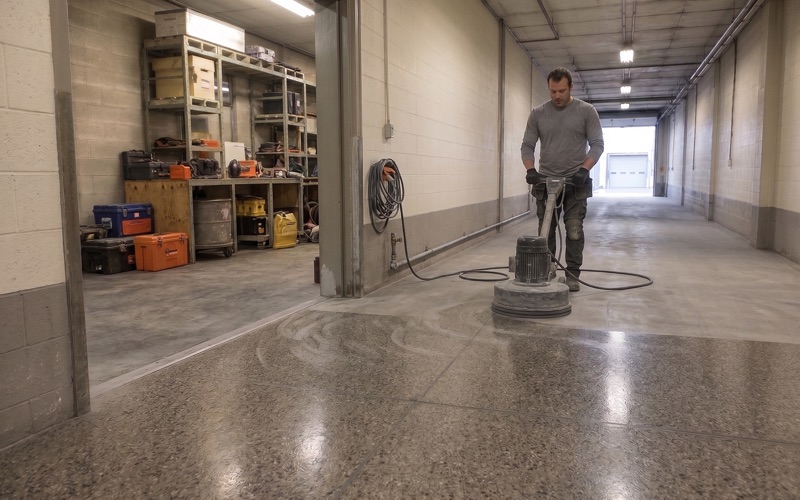
Not every floor wants a coating. Polished concrete grinds, densifies and polishes the slab itself to a chosen gloss level, so the finished surface is the concrete rather than something bonded on top of it, which means there is nothing that can blister or delaminate.
It suits commercial and institutional floors with long maintenance horizons particularly well, because there is no recoat cycle to budget for. What it cannot do is hide a patched or contaminated slab, so we grind a test area first and let the concrete itself decide whether it is a candidate.
Exterior Slabs Need a Different Specification
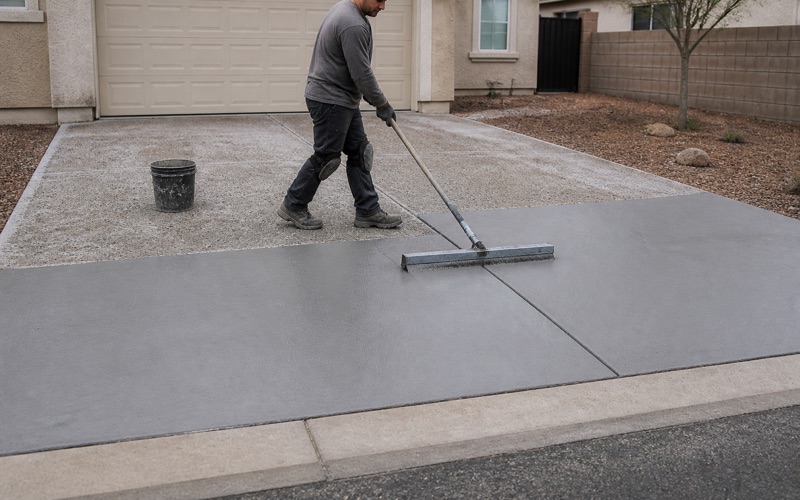
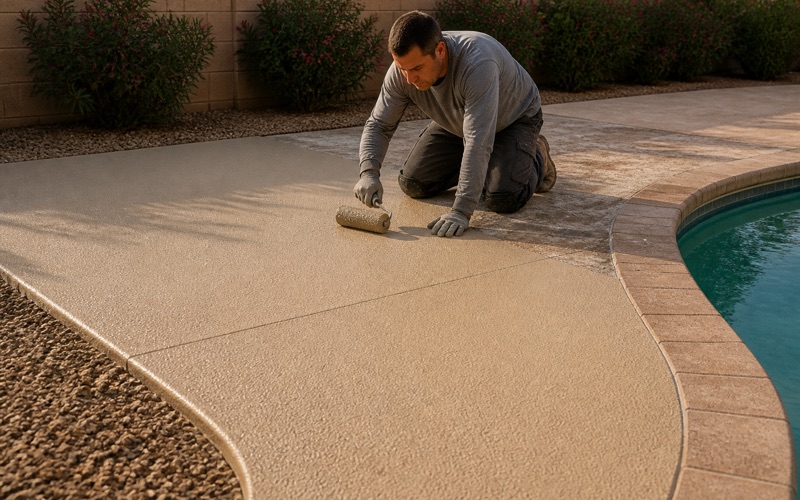
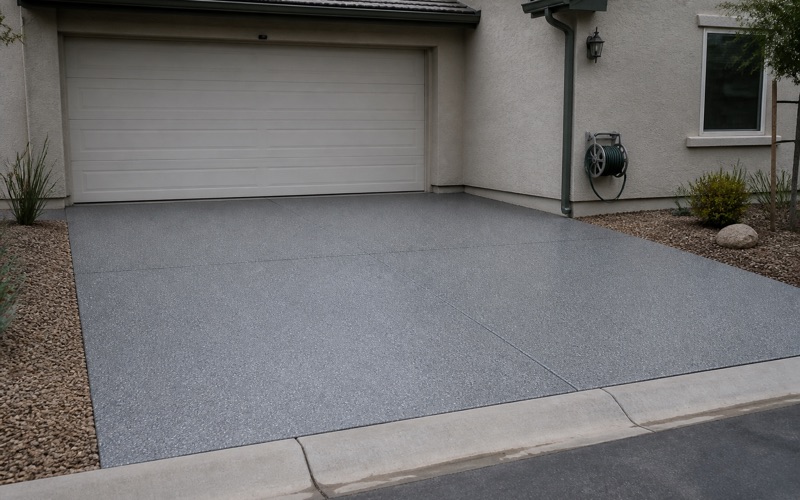
Driveways, patios and pool decks are not garage floors with more sunlight on them. Epoxy ambers under ultraviolet light, so exterior work uses aliphatic polyaspartic or polyurea chemistry, or a cementitious overlay, both of which hold their appearance in direct sun.
Texture is designed into an exterior finish rather than added at the end, because a smooth slab that gets wet is a genuine hazard. On a pool deck we also think about color and surface temperature together, since a dark slab in full inland sun gets too hot to cross barefoot and infrared-reflective pigment widens the usable palette.
Doing More Than One Slab at Once
Where a property needs a garage floor and a driveway, or a patio and a pool surround, doing them in one visit usually makes sense. The mobilization and much of the preparation equipment is shared, so the second slab costs meaningfully less per square foot than it would as a separate job.
It also produces a better result at the transitions. A garage threshold meeting a driveway looks considerably better when both sides were planned together rather than coated a year apart in different systems.
- 20+ Years Experience
- Free Estimates
- Every Slab Moisture Tested