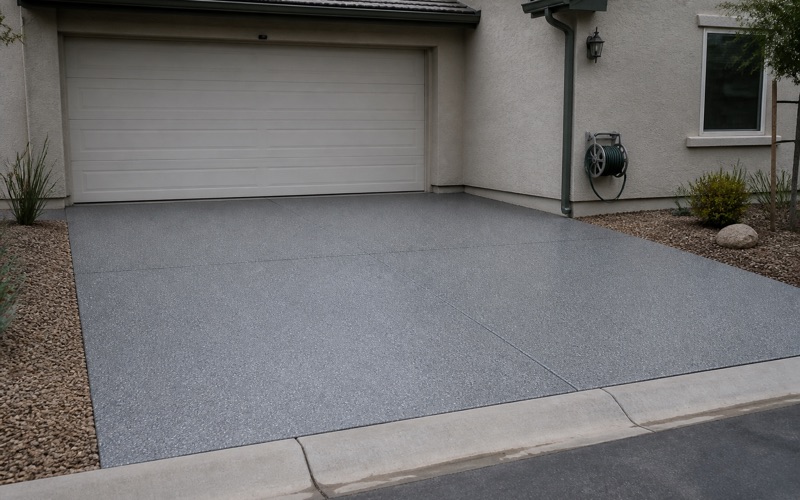
Colton Epoxy Flooring installs epoxy flooring in Highgrove, CA, working mostly on garage floors and the newer concrete that makes up the great majority of this community. We have been coating slabs in this valley for more than twenty years, and Highgrove is close enough to our base that we are on site in minutes rather than hours.
It is also the newest housing we work on anywhere nearby. Around 60% of Highgrove’s homes were built in 2000 or later, and close to 30% went up in the 2010s alone. That single fact changes almost everything about how a floor here gets scoped, and it makes this community genuinely different from the older cities a few minutes up the road.
There is a second difference that catches people out, and it has nothing to do with concrete. Highgrove is in a different county from most of what surrounds it.
Three Miles From Colton and in Another County
Unincorporated Riverside County, Not San Bernardino
Highgrove is an unincorporated census-designated place in Riverside County. There is no Highgrove city government, no city hall and no city building department, which surprises people who assume a community this size has one. Permits come from Riverside County Building and Safety at 4080 Lemon Street in Riverside, filed through the county’s online portal.
None of that makes a job harder, but it does make the paperwork different. Knowing where a permit actually comes from before quoting is part of what a local crew is for.
That matters more than a mailing address does. A homeowner calling the nearest city about a permit gets told, correctly, that they cannot help, and a contractor who has not worked here before frequently makes the same mistake on the customer’s behalf. It is a small thing that costs a week when it goes wrong, and it is entirely avoidable.
A County Line You Can Drive Across in Two Minutes
The operationally strange part is how short the distance is. A crew working Grand Terrace on Monday and Highgrove on Tuesday has crossed from San Bernardino County into Riverside County and into a different building department with its own queues and its own process, despite a drive of a few minutes.
We work both sides of that line constantly, so it is routine for us. It is worth knowing about because it is exactly the sort of detail that delays a job by a week when nobody accounts for it in advance. For a homeowner it rarely matters at all; for a commercial tenant improvement with a permit on the critical path, it matters a great deal.
What the Air District Does Not Change
One thing that does not change at the county line is the air district. Both sides sit inside the South Coast Air Quality Management District, where Rule 1113 caps floor coatings at 50 grams per liter of volatile organic compounds and industrial maintenance coatings at 100, treating the two as mutually exclusive. The product going on your floor is chosen against that regardless of which county the parcel is in.
That consistency is genuinely useful, because it means the same product decisions and the same category rules apply across everything we do in this area. The category question only becomes complicated where a building is residential in law but industrial in the wear it takes.
Looking for epoxy flooring closer to Bloomington? See Bloomington Epoxy Flooring.
What a Newer Slab Means for the Work
The Modal Job Is a Clean Prep-and-Coat
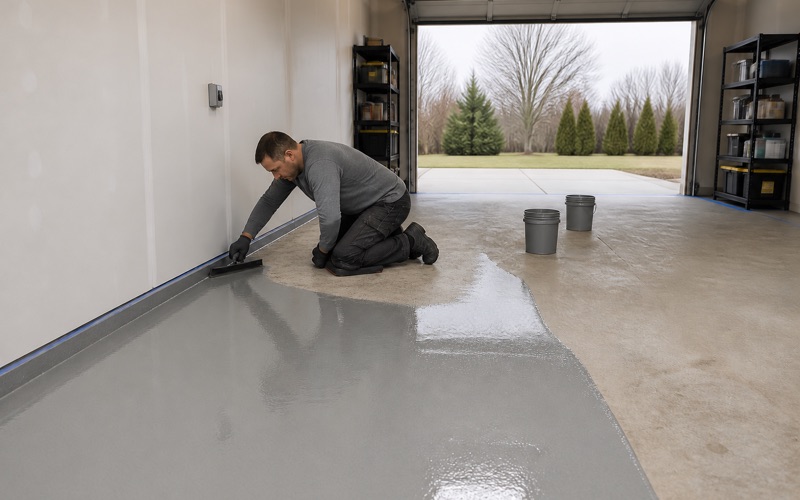
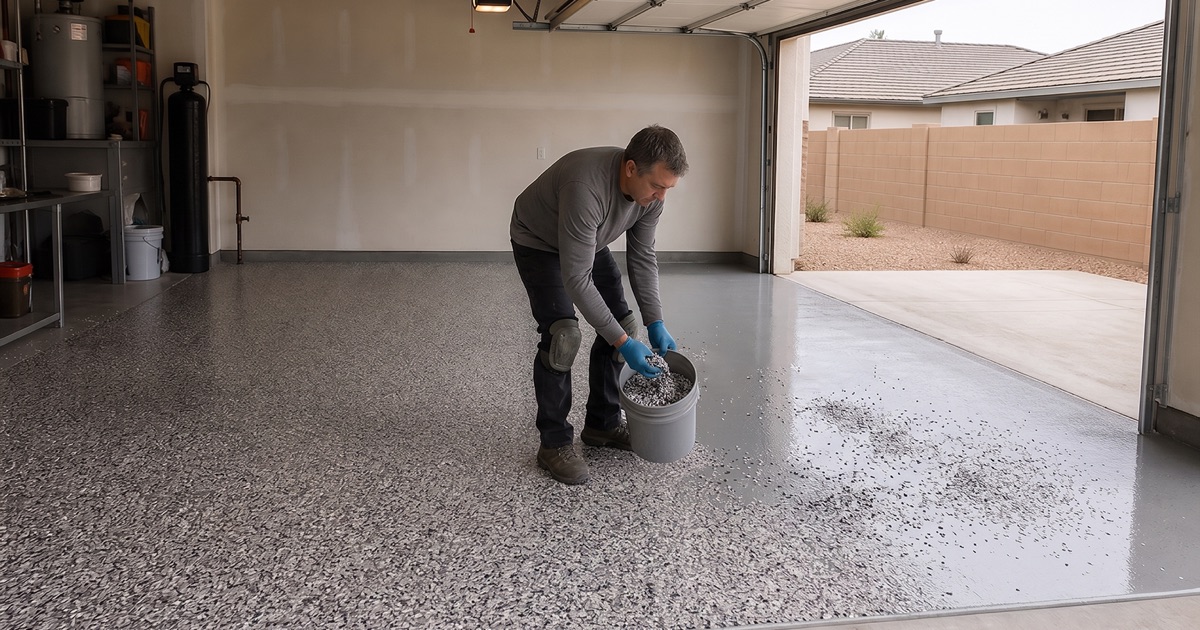
Because roughly 60% of housing here was built in 2000 or later, the typical Highgrove garage is a modern attached two-car bay on a sound slab that has never been coated. That is the most straightforward version of this job: grind to profile, fill the joints, prime, build the system and topcoat it.
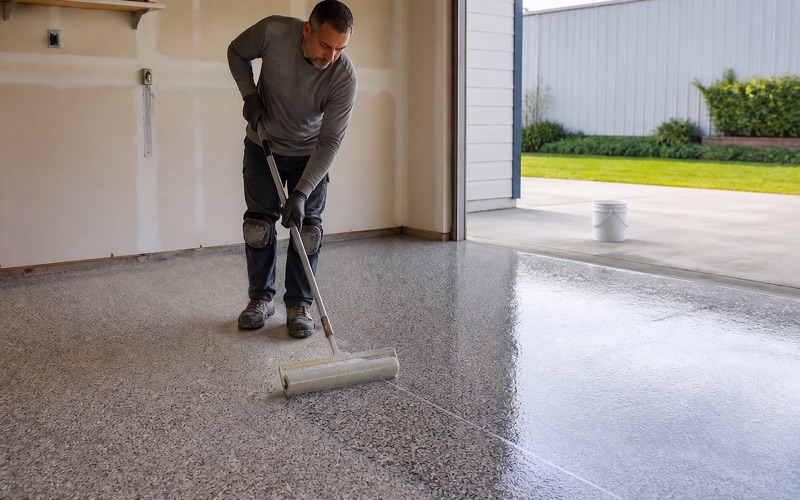
It is also the version where the finish choice matters most, because there is no repaired slab to conceal. On a sound modern floor a lighter flake or even a solid color is genuinely viable, where on an older patched slab a full broadcast is doing concealment work as well as decoration.
It also means the price is more consistent than in an older community. There is usually no failed coating to shear off, no deep spalling to rebuild and no crack network to route and fill, and those three things are most of the variability in a garage quote. Take them away and what is left is largely a question of area and finish.
Where the Older Tier Sits
Highgrove is not uniformly new, and the minority of older homes here behave like older stock anywhere else in the valley. On those slabs we test rather than assume, because the era before under-slab vapor retarders became routine practice is the era where a floor fails for reasons that have nothing to do with the coating on it.
Those houses are a minority here and they are worth identifying early, because they are the ones where a quote given over the phone would be wrong. We would rather find that out on a site visit than halfway through a grind.
Why We Still Test a New Slab
A modern build date is not a guarantee, and this is the point most often misunderstood. The California Residential Code exempts garages from the under-slab vapor retarder requirement, so a garage slab may have nothing beneath it however recent the house is. Every slab is moisture tested before product is ordered, using the ASTM F1869 calcium chloride test and the ASTM F2170 in-situ relative humidity probe with thresholds read from ASTM F710.
The ASTM D4263 plastic sheet test is worth knowing about because it is the one homeowners have usually heard of, and it is asymmetric: a positive result fails a slab but a negative one proves nothing. It is a useful screen and it is not a substitute for a measured reading. We run the measured tests either way, because the cost of the test is trivial against the cost of a floor that has to come off.
Reading the Numbers Honestly
A Small Community With Wide Margins
Highgrove is a small place statistically as well as physically, and the estimates describing it carry margins of error large enough to matter — the total housing count of around 2,600 units carries a margin in the hundreds. We use those figures to understand the shape of the community rather than to quote precise counts, and we would rather characterize the housing than claim a precision the data does not support.
What the shape clearly shows is a community built overwhelmingly within the last twenty-five years, and that conclusion holds even with wide margins around any single number. It is a robust reading rather than a fragile one, and it is enough to plan against.
That is the level of confidence worth acting on. We plan for a newer-slab market here and treat the older houses as identified exceptions rather than pretending we know the exact split.
What That Means for Your Quote
Practically, it means we quote from the slab in front of us rather than from a demographic profile. A site visit costs nothing, takes very little time, and is the only way either of us finds out whether your particular garage is the clean modern case or one of the exceptions to it.
It also settles the questions that decide the finish rather than the price: how much natural light the garage gets, whether the door stands open most of the day, and what the floor is actually used for.
Working in Highgrove
Access and Staging
Access here is straightforward — standard suburban driveways, ordinary street widths and no gated or master-planned layer to negotiate. Getting a planetary grinder and a dust extraction rig onto a site is not a constraint, which keeps the job on schedule and keeps mobilization costs where they should be.
The compact footprint helps too. Short drive times between jobs mean a crew can start early and stay on site through the working part of the day rather than losing an hour to the freeway at each end. In summer that is worth more than it sounds, because the working part of the day is the cool part of it.
Inland Heat and the Cure Calendar
Heat is the constraint that does bite. Slab temperature drives pot life hard: on a common system it runs roughly 60 minutes at 55 degrees and collapses toward 20 minutes at 95 degrees, with the recoat minimum shortening in step. Summer work means early starts, smaller batches and a sequence planned across the slab before anything is mixed.
We also read return-to-service against the actual surface temperature and dew point on the day rather than a label average, and we give you the date you can park on the floor before we start rather than after.
What We Do Beyond Garages
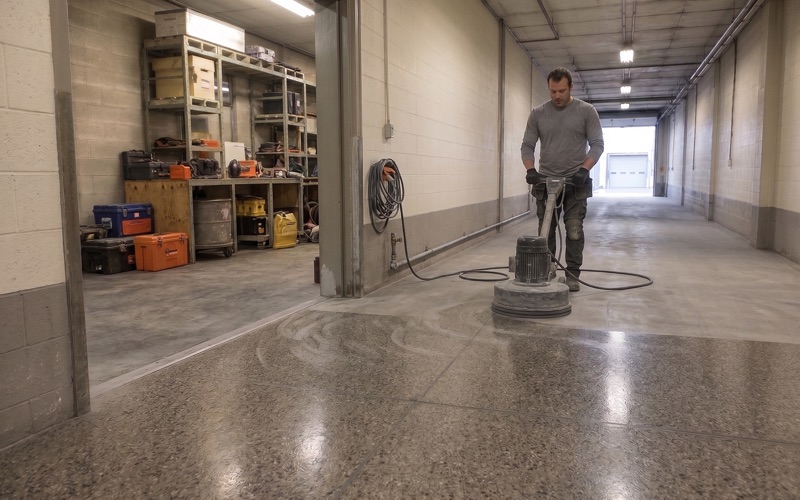
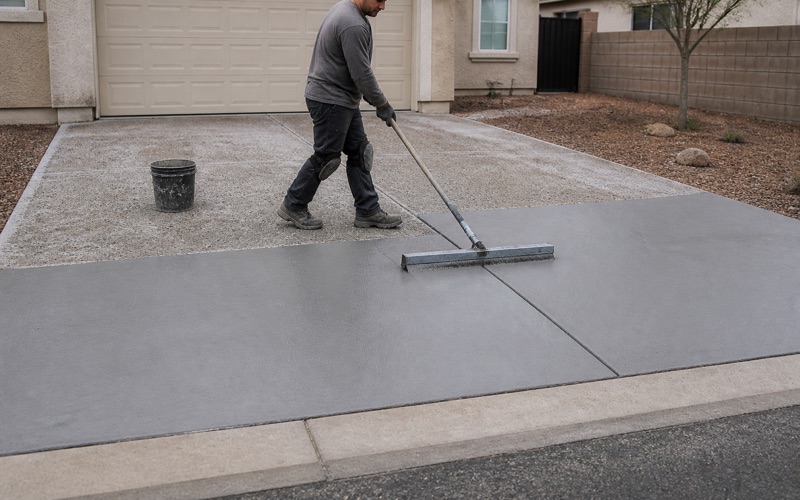
Garage floors are the bulk of the residential work, but the same crew handles polished concrete, concrete resurfacing on driveways and patios, and coatings for the light commercial and industrial buildings in and around the community. The specification changes considerably between those, and exterior work in particular needs ultraviolet-stable chemistry rather than the epoxy that suits an enclosed garage.
Where a house needs both, doing them together usually makes sense. The mobilization and much of the preparation equipment is shared, and the threshold between a garage and a driveway looks far better when both sides were planned as one job.
- 20+ Years Experience
- Free Estimates
- Every Slab Moisture Tested