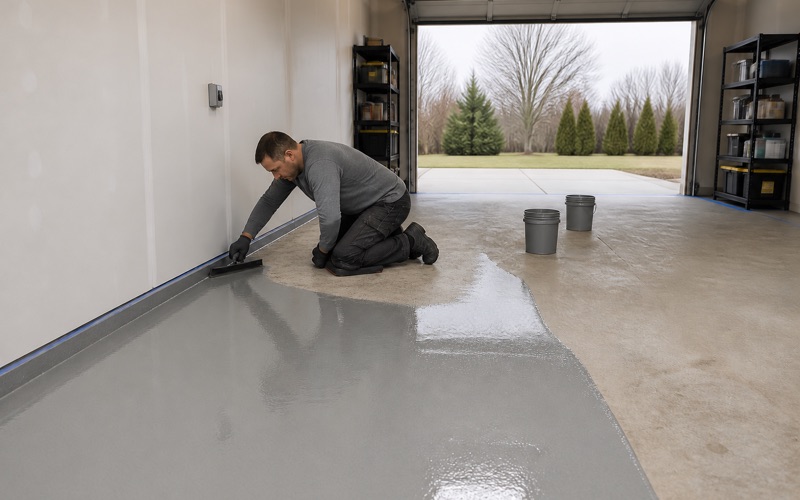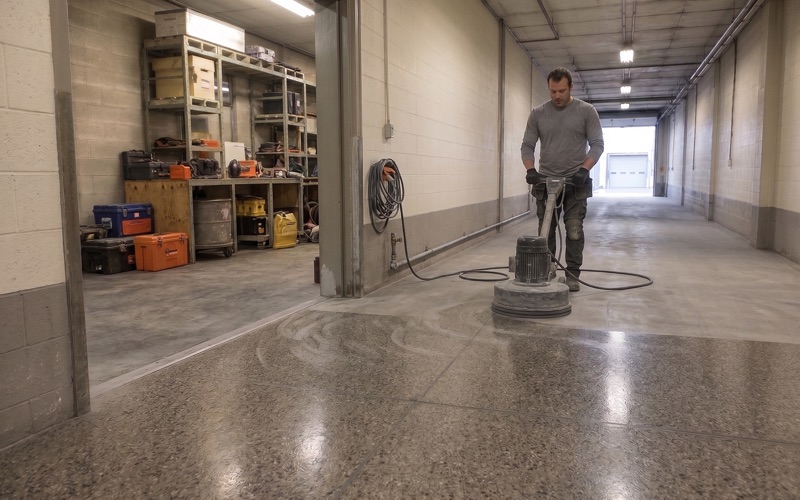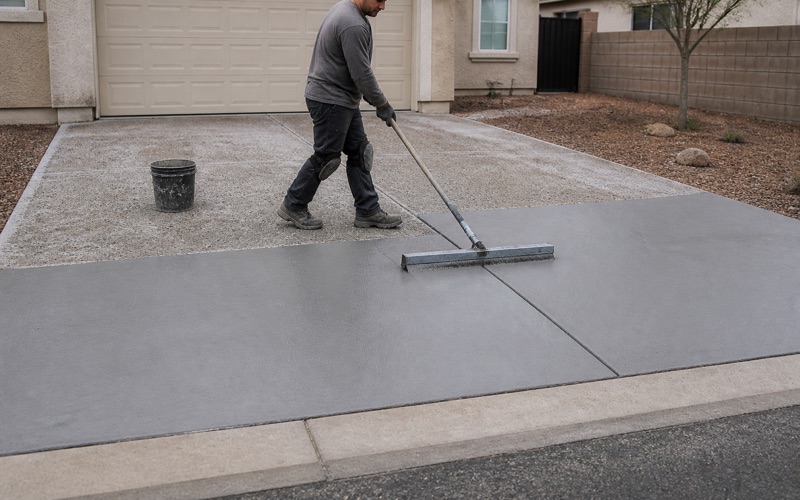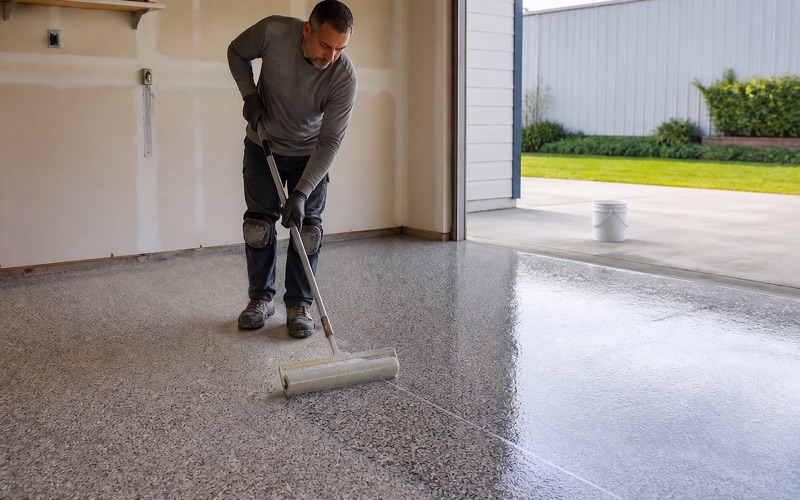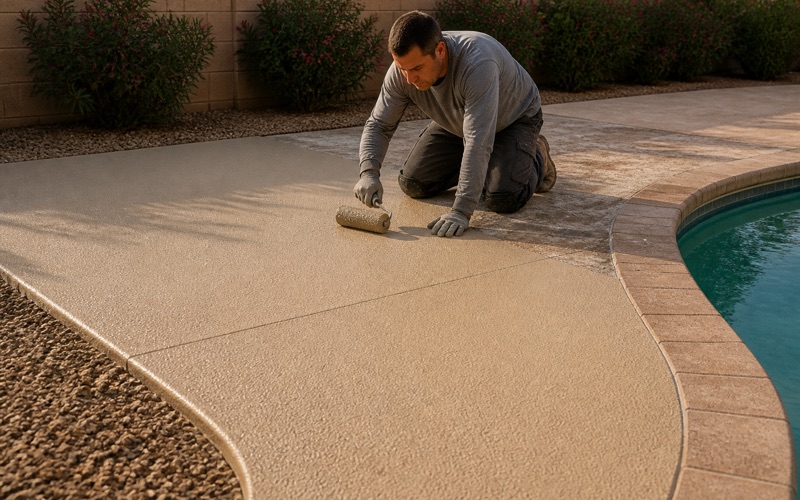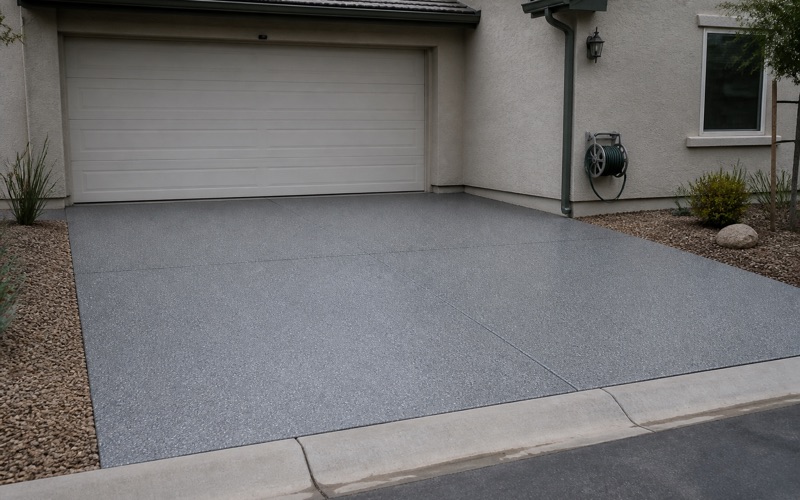
Colton Epoxy Flooring installs epoxy flooring in Grand Terrace, CA, covering garage floors, polished concrete, and the coated common areas that a small city with a lot of shared housing actually needs. We have spent more than twenty years working on slabs in this valley, and Grand Terrace is close enough to our own base that a site visit costs nothing but the drive.
It is also a city that rewards being honest about what a population figure means. Residents are not garages, and Grand Terrace has proportionally less detached, owner-occupied housing than anywhere else we cover — so the addressable residential market here is a fraction of what the headline number suggests.
That composition is the interesting part rather than a limitation. It means a larger share of the coating work here sits in buildings somebody manages rather than in garages somebody owns.
What the Housing Mix Means for Floors Here
Roughly Three Thousand Garages, Not Thirteen Thousand
Of 5,069 total housing units, 3,021 are single-family detached. The rest — around 1,470 units in multifamily structures, plus 373 mobile homes — either have no garage slab at all or have something quite different from one. Sizing this market off population overstates it several times over, and a contractor quoting on that basis is planning for work that does not exist.
We would rather be straight about it, because it changes what we do here. This is not a city we treat as a volume garage route; it is one where the mix of work is unusual and the drive is short.
The Highest Multifamily Share We Cover
Roughly 1,470 units sit in multifamily structures, including 499 in buildings of fifty units or more and 473 in three-and-four-unit structures. That is proportionally the largest shared-housing component anywhere in our service area, and it is what makes the property-management side of this trade genuinely worth pursuing here rather than a footnote to a garage business.
It also changes who we are talking to. A homeowner decides on a Saturday and pays once; a manager decides against a budget cycle and buys the same floor again in eight years. Both are good customers and they want completely different conversations.
Mobile Homes Are a Different Product Entirely
At 7.4% of all housing, the 373 mobile homes here are a real part of the city and mostly outside the garage trade. A manufactured home has a carport or a detached pad rather than an integral bay, so the work is a carport pad, an awning slab or a patio. It is honest work and it gets priced as what it actually is.
The one thing we will not do is quote a carport pad as though it were a garage floor. The exposure is different, the traffic is different and the right system is often different, so calling it by the correct name keeps the price honest in both directions.
Looking for epoxy flooring closer to Highgrove? See Epoxy Flooring Services in Highgrove.
Coating Work a Property Manager Buys
Parking Structures and Podium Decks
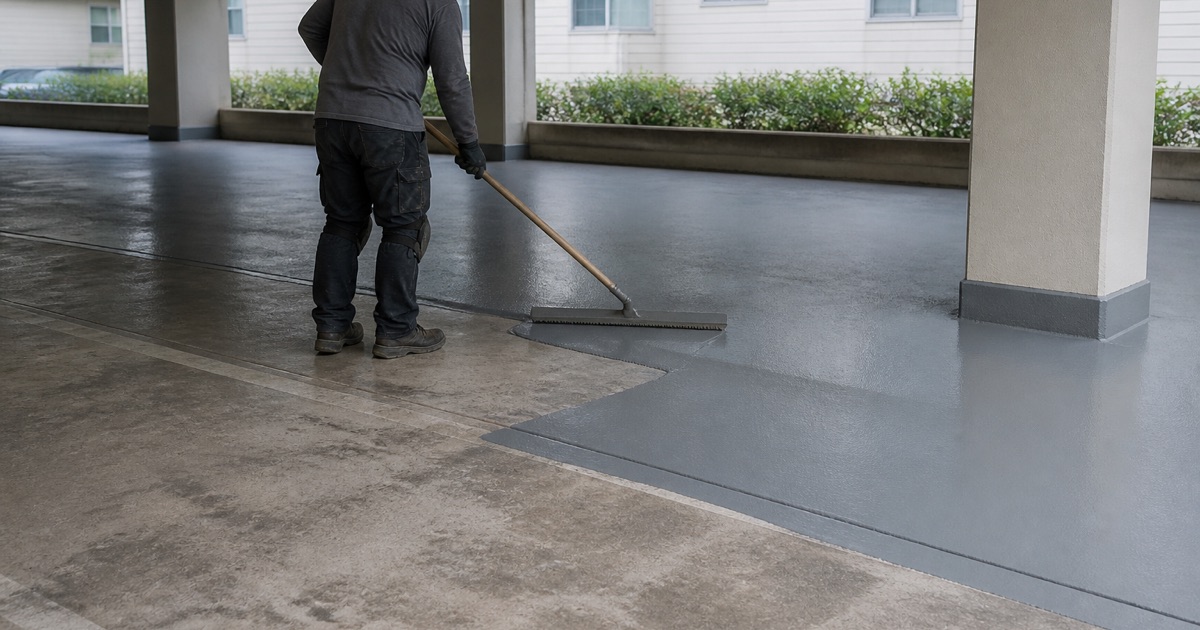
A parking deck is a traffic coating rather than a decorative floor. It takes vehicle weight, turning loads, water, oil drip and ultraviolet exposure on the top level, and it usually has to stay partly in use throughout. We phase those jobs by bay and by level so residents keep somewhere to park, and the sequence goes into the proposal rather than being worked out on the first morning.
The other thing separating deck work from garage work is the joint detail. A structure moves considerably more than a slab on grade, so joints and the perimeter are treated as movement to accommodate rather than surface to cover over.
Laundry Rooms, Stairwells and Trash Enclosures
The unglamorous shared spaces are where a coating earns its money in managed housing. A common laundry room floor takes standing water and detergent daily, a stairwell takes constant foot traffic and has to stay safe when wet, and a trash enclosure takes leakage, pressure washing and impact. All three want a seamless, cleanable, chemically tolerant surface with texture designed in rather than added at the end.
These are also areas resurfaced on a schedule rather than once. A manager buying on a maintenance cycle wants to know how long a floor lasts and what refreshing it costs, which is a different conversation from the one we have with a homeowner.
The Rule That Catches People Out on Residential Buildings
Grand Terrace sits inside the South Coast Air Quality Management District, where Rule 1113 caps floor coatings at 50 grams per liter of volatile organic compounds and industrial maintenance coatings at 100, treating the two as mutually exclusive categories. Subsection (c)(6) prohibits applying, or soliciting the application of, industrial maintenance coatings for residential use.
That subsection matters directly in multifamily work and it is routinely missed. An apartment complex’s parking structure is part of a residential property, so the product decision there is a deliberate one rather than an automatic reach for the industrial category. We settle it before quoting rather than afterwards.
The Garage Job This City Hands Us
A 1970s or 1980s Attached Two-Car Bay
The residential work here is unusually consistent, because 1,399 units were built in the 1970s and 1,373 in the 1980s — together 54.7% of everything in the city. The typical job is an attached two-car garage on a slab somewhere between 35 and 55 years old, which makes both scoping and pricing more predictable than in a mixed-era community.
What we find on those slabs is a familiar list: control-joint cracking, settlement and lipping at the door threshold, edge curling, and decades of oil soaked in where the car has always been parked. None of it is unusual and none of it rules out a coating.
What it does mean is that the repair work is real rather than nominal. Joint fill, spall patching and oil treatment on a slab this age are part of the floor rather than an upsell, and we scope and price them with it so nothing arrives as a surprise once the grinder is running.
Removing What Is Already There
The other consistent feature of a fifty-year-old garage is that somebody has already tried. A failed one-part garage paint or a store-bought kit sits on a large share of these floors, and taking it off is frequently the real scope of the job rather than an addition to it.
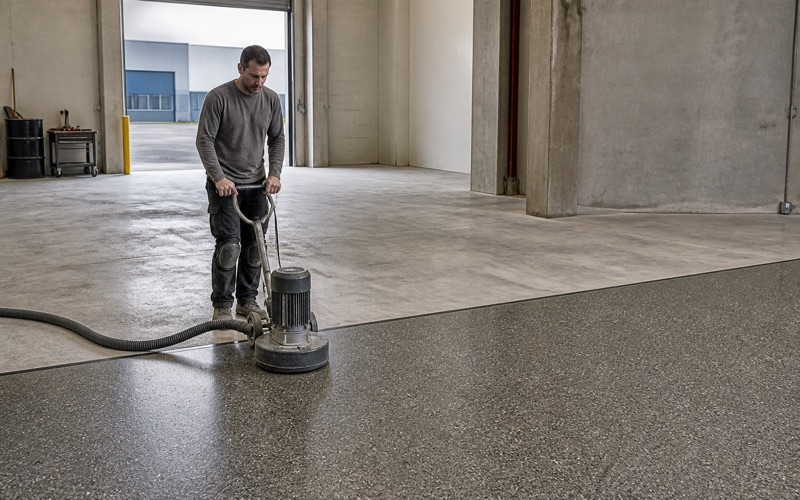
That removal is sheared off with polycrystalline diamond tooling rather than ground through, which is faster and saves the conventional diamonds for profiling the concrete underneath. We price it as its own line so you can see what it is costing you.
Where Moisture Becomes the Question
About 1,430 units here predate 1970 and only 430 predate 1960, so the pre-vapor-retarder tier is real but modest. On that older stock under-slab vapor retarders were frequently not used at all, and testing belongs in the scope rather than being sold as an extra afterwards. We use the ASTM F2170 in-situ relative humidity probe and the ASTM F1869 calcium chloride test, with thresholds read from ASTM F710.
Where a reading comes back high the answer is a moisture vapor barrier primer sized to the number rather than a heavier decorative system. Getting that wrong is the single most expensive mistake available on an older garage floor, and it is entirely avoidable for the cost of a test.
Working Here in Practice
A Built-Out City With No Construction Pipeline
Grand Terrace is effectively finished building. Only 581 units have gone up since 2000 and just 11 since 2020, which means essentially every job is on an existing slab. That puts preparation, repair and coating removal at the center of the work rather than the clean prep-and-coat a growing community offers.
It also means the customers here tend to be long-tenure owners rather than recent buyers, and they are usually deciding whether to fix a floor they have looked at for years rather than finishing a house they just moved into.
Small-Format Commercial, With the Heavy Work Next Door
The commercial floors inside the city are modest in scale — a supermarket, pharmacies, an auto parts store, a bank branch, a restaurant, and a handful of distributors and manufacturers. Grocery and pharmacy back-of-house, restaurant kitchens and distributor warehouse floors are the realistic verticals rather than half-million-square-foot tilt-up.
The heavy industrial floor stock is on the Agua Mansa corridor and along I-215 in Colton and Highgrove, immediately outside the city limits rather than inside them. We work both, and it is worth being clear which side of the line a building sits on.
Permits, Access and Heat
The city’s permit counter runs shorter hours than its office, with permits handled over an afternoon window only, so anything needing a same-day permit interaction has limited hours to work with. Access by contrast is easy: modest tract streets, standard driveways and a compact footprint keep drive time short, and getting a grinder and extraction rig on site is never the constraint here.
Heat still governs the calendar. Pot life on a common system runs about 60 minutes at 55 degrees and drops toward 20 minutes at 95 degrees, so summer garage work means early starts and small batches rather than optimistic scheduling.
- 20+ Years Experience
- Free Estimates
- Every Slab Moisture Tested