Colton Epoxy Flooring installs epoxy flooring in El Sobrante, CA, and this community is the exception to almost everything we say about concrete elsewhere in this region. We have more than twenty years of coating work behind us here, and part of what that is worth is knowing when the standard argument does not apply. It is easy to run one story everywhere and considerably more useful to notice where it stops being true.
Across most of this area the case for moisture testing rests on age: slabs poured before under-slab vapor retarders became routine practice, carrying vapor drive that will push a coating off. In El Sobrante that case is simply wrong. 46.5% of the housing was built between 2000 and 2009 and 53.9% dates from 2000 or later, while only 1.8% predates 1960 and there are no recorded units built during the 1960s at all. A housing stock with a gap like that is unusual and it tells you the community was built in a distinct wave rather than gradually.
This is also the cleanest pure-residential market we cover — 98.2% single-family detached and 92.3% owner-occupied, with an addressable pool of 3,432 owner-occupied detached houses and almost no rental, multifamily or commercial component to speak of. That makes it the most straightforward market we cover in terms of who we are actually talking to.
The Newest Slabs We Work On
What 2000s Concrete Actually Means
A slab placed in 2005 is 16 to 25 years old, was almost certainly laid over a modern under-slab vapor retarder, and has never been coated. That is the most favorable starting point this trade offers, and it changes both the risk and the price of the work. Fewer unknowns on the slab means fewer contingencies in the quote, which benefits the customer directly.
ASTM E1745, the standard defining a modern under-slab vapor retarder, was first published on 10 March 1997. That date is the honest dividing line between concrete placed before the practice was codified and concrete placed after it, and essentially all of El Sobrante’s housing sits on the later side of it. Having a dated standard to point at is more useful than a vague claim about how things used to be done.
Why We Will Not Run the Old-Slab Argument Here
A contractor who arrives talking about pre-vapor-retarder slabs and decades of neglected concrete is describing a different community. It would be an easy way to sell a heavier specification and it would not be true, and we would rather be accurate than persuasive. Overstating a risk to sell a heavier system is a short-term win and a long-term reputation problem.
The honest scope here is different: an original builder-grade floor reaching the end of its life, hot-tire pickup on a surface that has taken twenty years of parking, and a first-time coating rather than stripping somebody else’s failure. That is a genuinely easier job and it prices accordingly. Being straight about that is part of why customers here tend to compare quotes on specification rather than on fear.
Why We Still Test
None of that removes the test. The California Residential Code exempts garages from the under-slab vapor retarder requirement, so a garage slab may have nothing beneath it however recent the house is, and building era is a probability rather than a guarantee.
So we still run the ASTM F1869 calcium chloride test and the ASTM F2170 in-situ relative humidity probe before ordering, with thresholds read from ASTM F710. It takes very little time, it usually confirms what the build date suggests, and on the occasions it does not it saves the entire floor. A few minutes of testing against the cost of a floor that has to come off is not a close decision.
Looking for epoxy flooring closer to Mead Valley? See Epoxy Flooring Services in Mead Valley.
A Tight Slab Is Its Own Problem
Burnished Concrete Rejects a Coating
The technical difficulty on newer concrete is not deterioration, it is density. A hard-troweled tract garage floor has a burnished surface with very low porosity, and a coating applied to it without proper preparation is bonded to a surface film rather than to the slab.
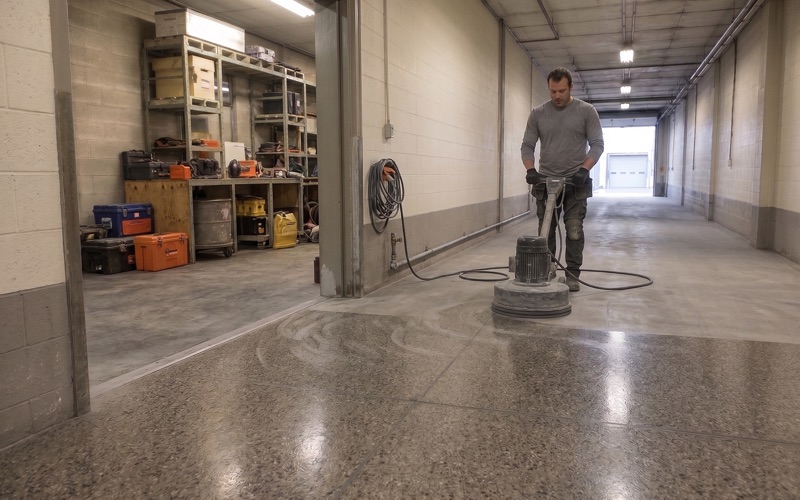
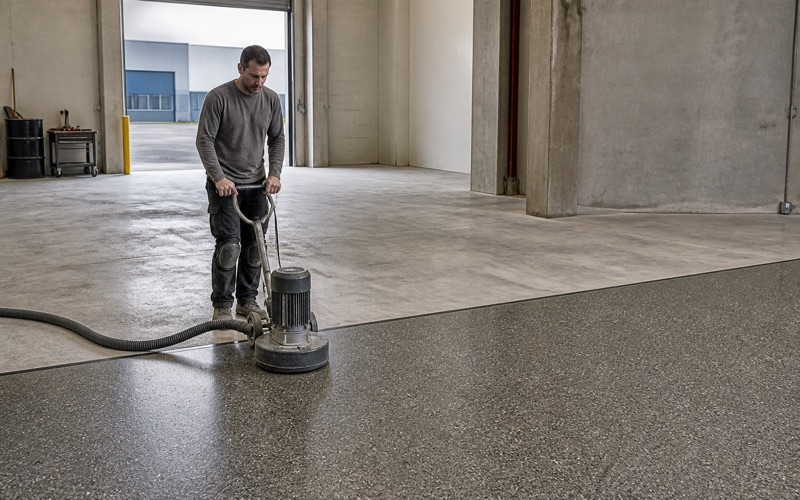
That is why the preparation here is entirely about mechanical profile rather than chemistry. We grind to a measured ICRI concrete surface profile with a diamond segment bond chosen against the slab hardness — and on hard modern concrete that means a soft bond, which reads backwards until you have watched it work. Getting that choice wrong burnishes the floor instead of cutting it, which wastes a day and achieves nothing.
Why an Acid Etch Fails Here Specifically
Acid etching is the most common way a modern garage floor gets ruined. On a burnished slab it cannot produce a consistent profile at all, it softens the surface it does reach, and it leaves residue behind unless neutralized and rinsed perfectly.
The result is a coating bonded to a weakened, inconsistent layer, which lifts in sheets within a year or two under hot tires. On older porous concrete an etch is merely inadequate; on a tight 2000s slab it is close to guaranteed to fail. That is the single most useful thing a homeowner in this community can know before hiring anyone.
What a Twenty-Year-Old Builder Floor Looks Like
What we actually find is a sound slab with cosmetic and wear problems: tire marks, staining where a car has always sat, some control-joint cracking, and occasionally a homeowner’s own attempt at a consumer kit that never bonded properly.
That is a straightforward job — grind, fill joints, treat contamination, prime, broadcast and topcoat — and it is why quotes here tend to hold. The variability that makes older cities unpredictable mostly is not present.
What Else These Properties Need
Larger Parcels and Outbuildings
The hills south of Lake Mathews mean larger parcels than a tract subdivision, so detached shops, RV garages and outbuildings appear in the job mix more often than the housing type alone would suggest. Those slabs have their own requirements and are worth quoting separately.
A workshop floor takes point loads, dropped tools, welding spatter and solvent, which points at a higher-build system with real chemical resistance rather than a decorative one. An uninsulated outbuilding also swings further in temperature across a day, which narrows the application window.
Exterior Slabs in Full Sun
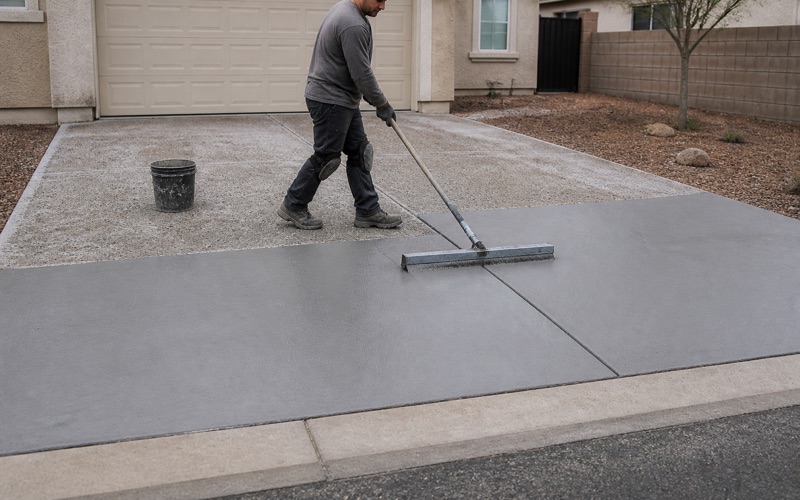
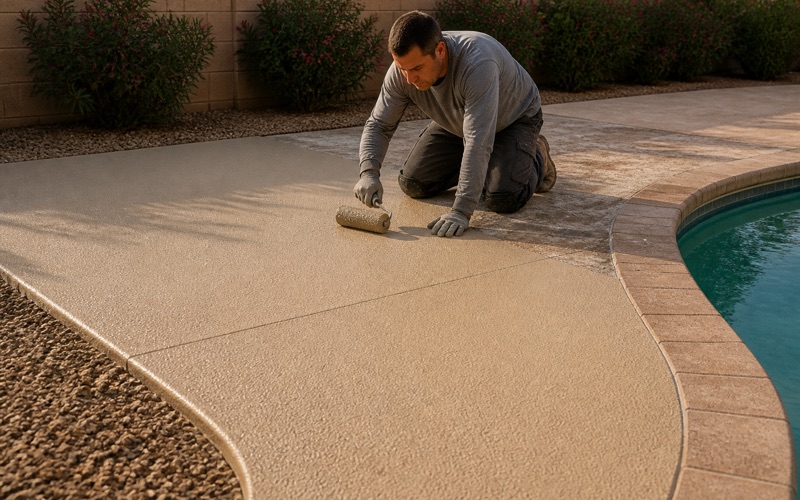
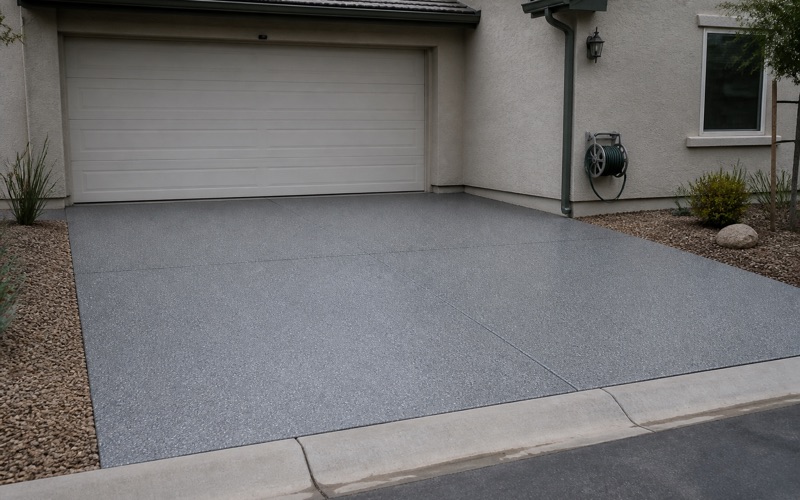
Driveways, patios and pool decks here take direct inland sun, and they need a genuinely different specification from a garage. Epoxy ambers under ultraviolet light, so exterior work uses aliphatic polyaspartic or polyurea chemistry, or a cementitious overlay, with texture broadcast in for slip resistance.
Color is a comfort decision outdoors as much as a design one, because a dark slab in full sun gets too hot to cross barefoot. Infrared-reflective pigment reduces how much heat a given color absorbs and widens what is genuinely usable around a pool.
Scheduling Around Heat and the Rules That Apply
Slab temperature governs the working day. Pot life on a common system runs about 60 minutes at 55 degrees and collapses toward 20 minutes at 95 degrees, with the recoat minimum shortening alongside it, so summer work means early starts and small batches.
El Sobrante sits inside the South Coast Air Quality Management District, where Rule 1113 caps floor coatings at 50 grams per liter of volatile organic compounds and industrial maintenance coatings at 100, treating the two as mutually exclusive. Subsection (c)(6) prohibits applying or soliciting industrial maintenance coatings for residential use, which is worth settling on a property with a working outbuilding on it.
What the Work Looks Like Here
A Straightforward Program
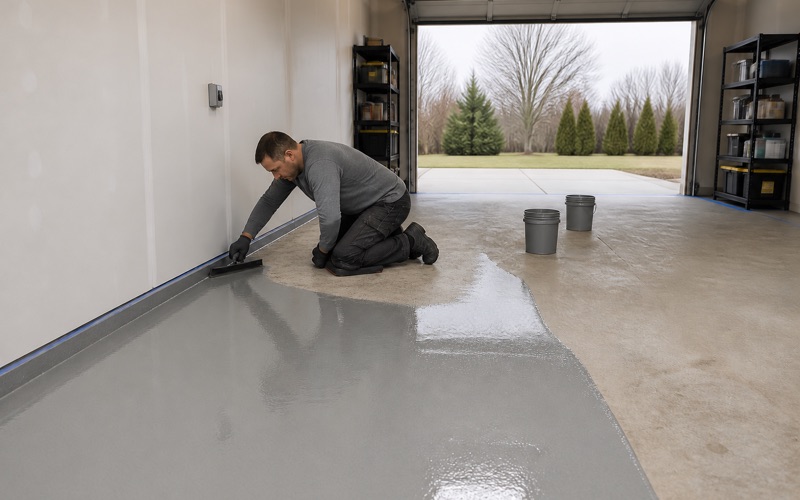
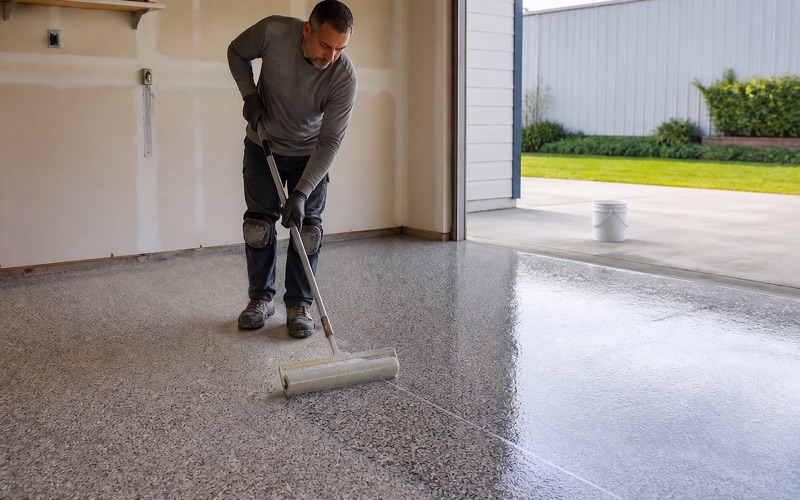
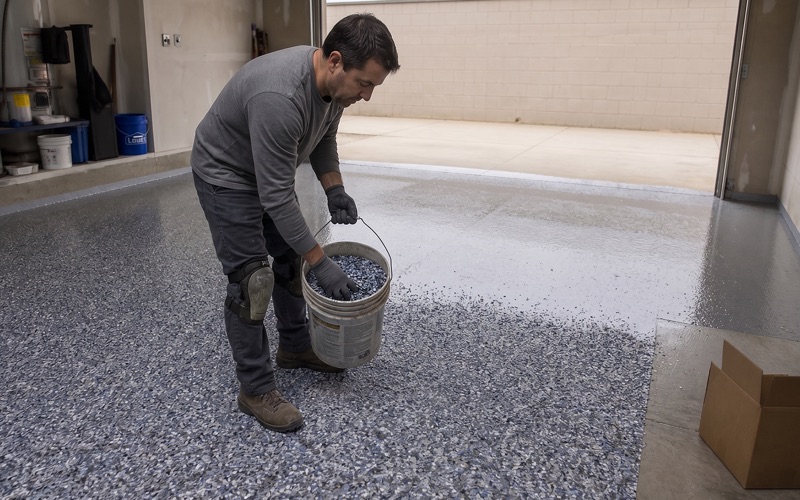
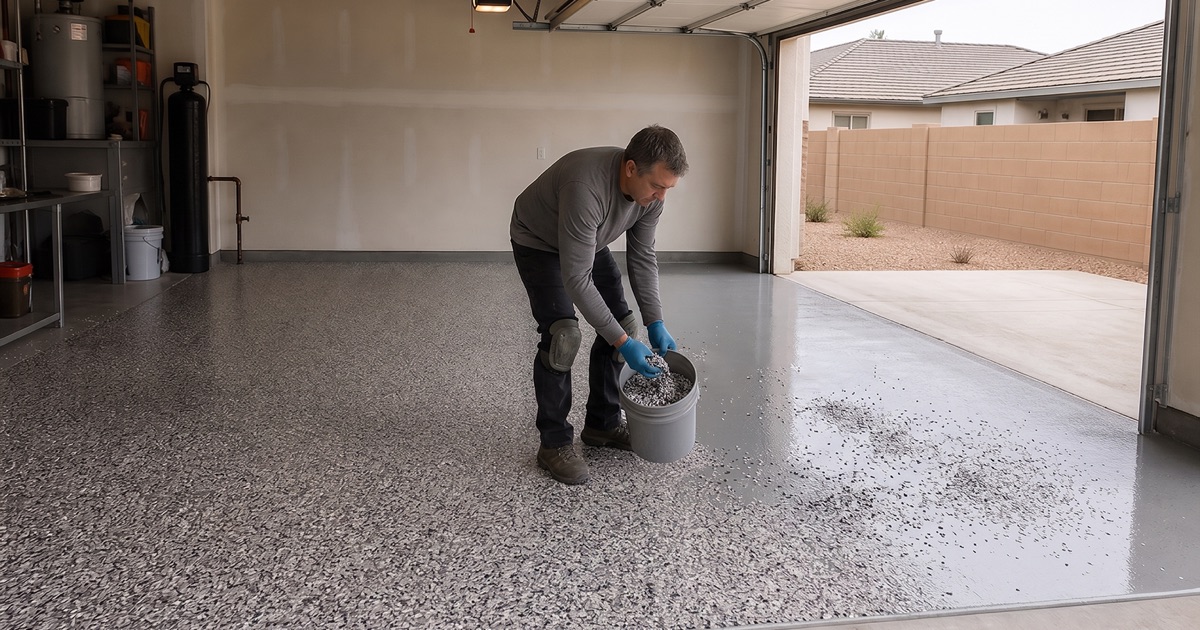
Because the slabs are consistent and mostly uncoated, a garage here is usually a one or two day job on site plus cure. We grind to profile, fill control joints with a semi-rigid material, treat any oil-contaminated area, prime, lay the body coat and broadcast into it, then scrape back and topcoat.
The written scope names the preparation method, each layer of the system with its film build, and the cure schedule, so a quote can be compared against another one line by line rather than on a headline number. On a market this predictable, the specification is genuinely the thing that differentiates two proposals.
Choosing a Finish With Nothing to Hide
A sound, unpatched slab widens the finish options considerably. On an older repaired floor a full flake broadcast is doing concealment work as well as decoration, but here a lighter scatter or even a plain solid color is genuinely viable, and that is a real saving rather than a downgrade.
Flake blends are sold under proper names at specified chip sizes, so we put the blend, the chip size and the broadcast rate in pounds per square foot into the scope. Two contractors quoting a gray flake floor may otherwise be quoting quite different products.
Return to Service
Cure rather than labor sets the calendar. Foot traffic comes first, then light use, then vehicles and hot tires last, and every one of those gates moves with slab temperature rather than with the calendar date.
We read return-to-service against the actual surface temperature and dew point on the day rather than a label average, and we give you the date you can park on the floor before we start rather than afterwards. On a household with one garage and nowhere else to put a car, that date is usually the most important number in the quote.
- 20+ Years Experience
- Free Estimates
- Every Slab Moisture Tested