Colton Epoxy Flooring installs epoxy flooring in Eastvale, CA, and the technical problem here is almost the opposite of the one most of this region presents. We have more than twenty years of concrete coating behind us in this valley, and Eastvale is where preparation method matters more than anything else on the quote. On a slab this consistent, the product choice is close to settled and the prep is where a floor is won or lost.
This is the newest housing stock we work on anywhere. Almost the entire city was built in 2000 or later, and the pre-1980 component is small enough to be a rounding error. The moisture-retarder guesswork, deep crack routing and coating archaeology that occupy us in older cities are largely absent. That is genuinely good news for a homeowner, because those three are what make a quote unpredictable elsewhere.
What replaces them is a different difficulty. A 2005 tract garage floor has a burnished, hard-troweled surface with very low porosity, and it will reject a coating bonded to nothing at all if the preparation is an acid etch instead of diamond grinding. The failure is not subtle and it is not slow; it appears under hot tires within a season or two.
A City With Almost No Old Concrete
What 418 Pre-1980 Units Means
In a city of 18,484 housing units, having only 418 built before 1980 is remarkable, and it changes the shape of the work. The pre-vapor-retarder tier that drives specification decisions across most of this region effectively does not exist here.
That makes quoting more predictable and the risk profile lower. Most of the variability in a garage price comes from what is already bonded to the floor and how the slab was placed, and in Eastvale both of those are usually favorable. It is one of the few cities where a careful phone conversation gets close to the right number, though we still visit before committing.
The Real Scope Is Usually Removal
The dominant condition we actually meet is a 15 to 25 year old floor with hot-tire pickup and peeling from a previous one-part DIY kit. Removing a failed prior coating rather than preparing bare concrete is frequently the real job, and it changes both the grinding time and the price.
A consumer kit is thin, tough and unevenly bonded, so it loads tooling and tears rather than cutting cleanly, and the flake in it grinds at a different rate than the resin around it. We shear it off with polycrystalline diamond tooling before switching to a conventional grit sequence for the concrete underneath. That removal is priced as its own line so the difference between a bare slab and a previously coated one is visible rather than buried in a rate.
Why We Still Test
A modern build date is a strong indicator and not a guarantee. The California Residential Code exempts garages from the under-slab vapor retarder requirement, so a garage slab may have nothing beneath it however recent the house is.
So we test every floor before ordering, using the ASTM F1869 calcium chloride test for a surface emission rate and the ASTM F2170 in-situ relative humidity probe for the state of the slab at depth, with thresholds read from ASTM F710. It confirms what the build date suggests almost every time, and on the rare occasion it does not it saves the whole floor. The test takes very little time and it is the cheapest insurance available on this kind of job.
Looking for epoxy flooring closer to Lake Mathews? See Epoxy Flooring Services in Lake Mathews.
Why a Tight Slab Rejects a Coating
What Power Troweling Leaves Behind
Power troweling densifies and closes the top of a slab, producing a burnished layer that is excellent for wear and close to useless for adhesion. There is nothing wrong with that concrete; there is simply almost no porosity for a resin to penetrate. Understanding that is what separates a contractor who prepares properly from one who assumes new concrete is easy concrete.
A coating applied to that surface without proper preparation is bonded to a thin surface film rather than to the slab. It looks perfect on the day, and it lifts in sheets under hot tires within a year or two. By then the original contractor is long gone and the homeowner is paying twice for the same floor.
Profile Is a Number, Not a Description
Preparation here is about achieving a specified concrete surface profile rather than about cleaning. The ICRI profile scale runs from CSP 1 through CSP 10, and every coating system names the profile it needs, which is what makes a manufacturer’s specification meaningful.
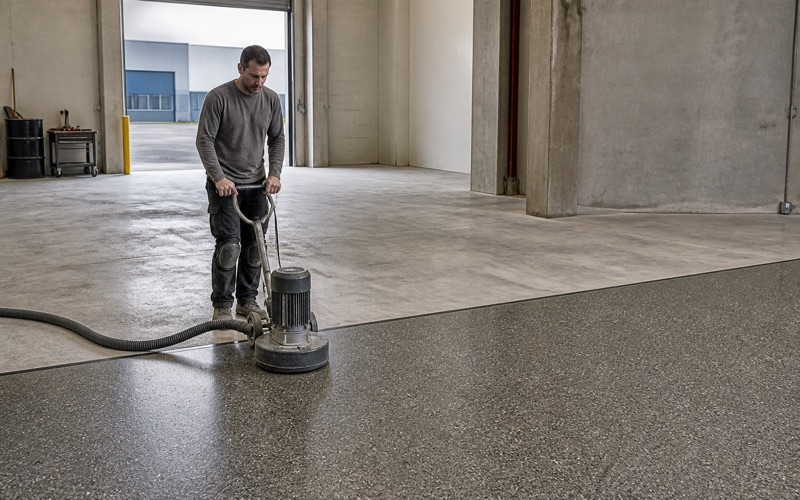
We grind to that number with a diamond segment bond chosen against the hardness of the slab — and on hard modern concrete that means a soft bond, which reads backwards until you have watched it work. A hard bond on hard concrete polishes the segment smooth and cuts nothing. Getting that choice wrong wastes a day of machine time and produces no profile at all.
Why an Acid Etch Fails Here Specifically
On older porous concrete an acid etch is inadequate. On a burnished 2000s slab it is close to guaranteed to fail, because it cannot produce a consistent profile on that surface at all, it softens what it does reach, and it leaves residue behind unless neutralized and rinsed perfectly.
That is the single most useful thing a homeowner in this city can know before hiring anybody. If a quote names an acid wash or an etch as its preparation, it is quoting a floor that will not last, whatever the product on top of it is. It is worth asking every contractor who quotes exactly how they intend to prepare the slab, and treating a vague answer as an answer.
What the Work Looks Like
A Predictable Program
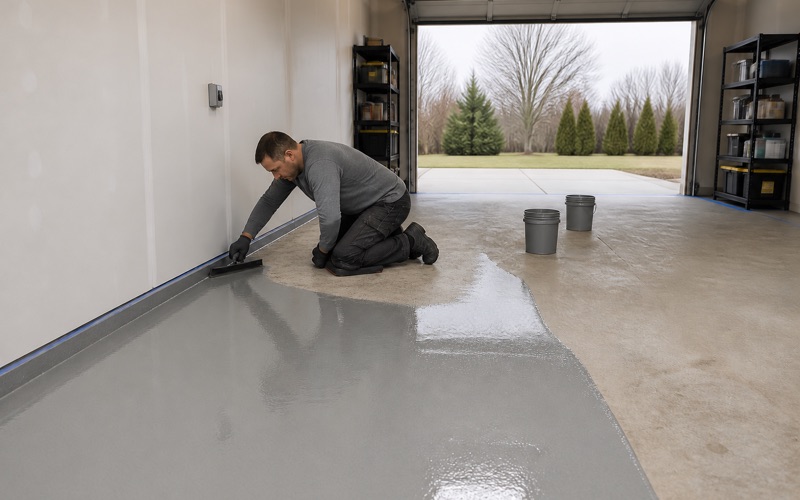
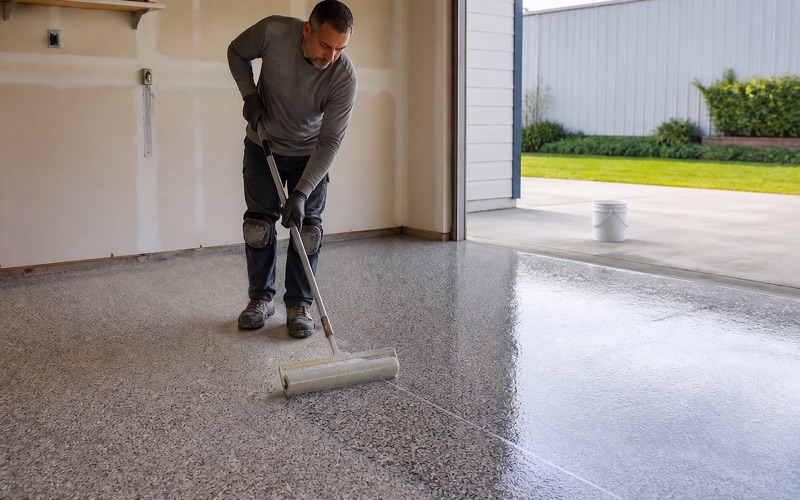
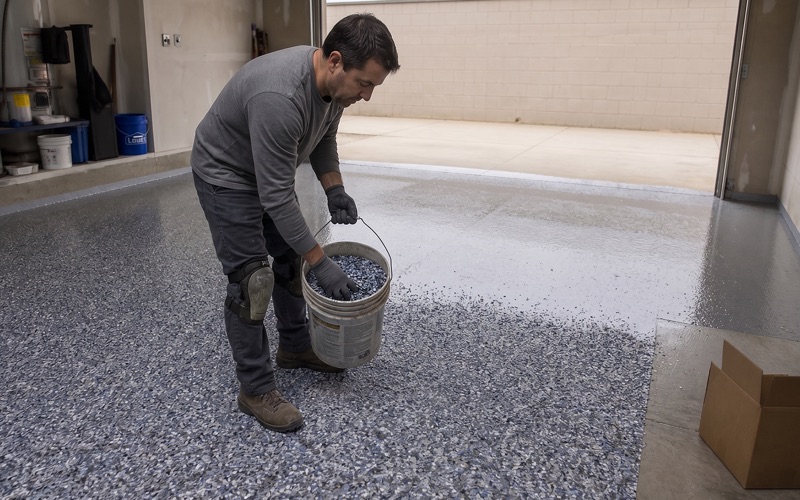
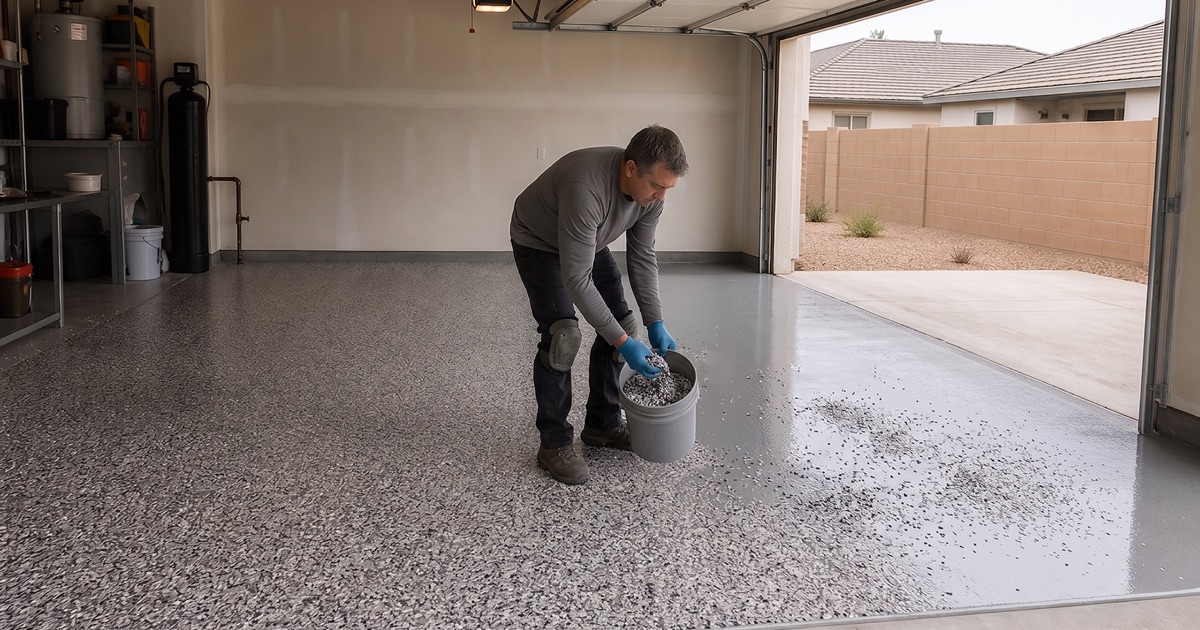
With sound slabs and consistent construction, a garage here is usually one to two days on site plus cure. We grind to profile, fill control joints with a semi-rigid material, treat any oil-contaminated area, prime, lay the body coat and broadcast into it, then scrape back and topcoat.
The written scope names the preparation method, the target profile, each layer with its film build and the cure schedule. On a market this uniform the specification is genuinely what differentiates two proposals, because the slabs themselves barely differ.
Choosing a Finish With Nothing to Hide
A sound, unpatched slab widens the options. On an older repaired floor a full flake broadcast is doing concealment work as well as decoration, but here a lighter scatter or even a plain solid color is genuinely viable, which is a real saving rather than a compromise.
Flake blends are sold under proper names at specified chip sizes, so we put the blend, the chip size and the broadcast rate in pounds per square foot into the scope. Without those three numbers two quotes for a gray flake floor may be quoting quite different products.
Return to Service and Heat
Cure rather than labor sets the calendar. Foot traffic comes first, then light use, then vehicles and hot tires last, and each of those gates moves with slab temperature rather than with the date on a calendar.
Pot life on a common system runs about 60 minutes at 55 degrees and collapses toward 20 minutes at 95 degrees, so summer work means early starts and small batches. We read return-to-service against the actual surface temperature and dew point and give you the date you can park on the floor before we start.
Beyond the Garage
Driveways, Patios and Pool Decks
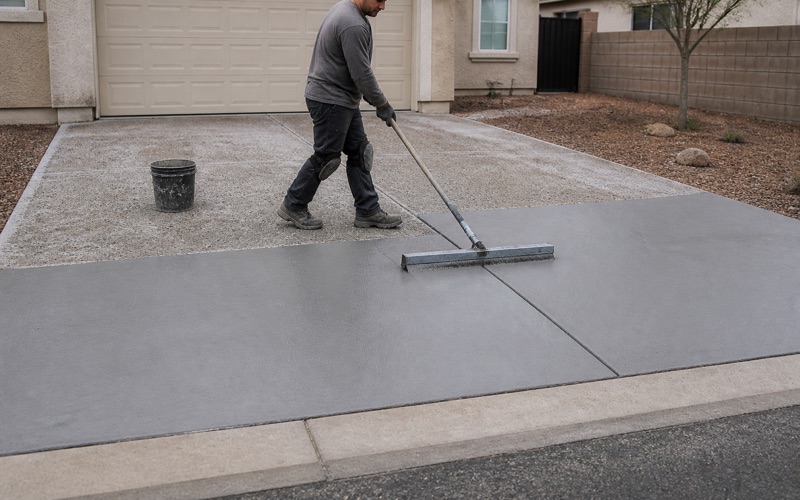
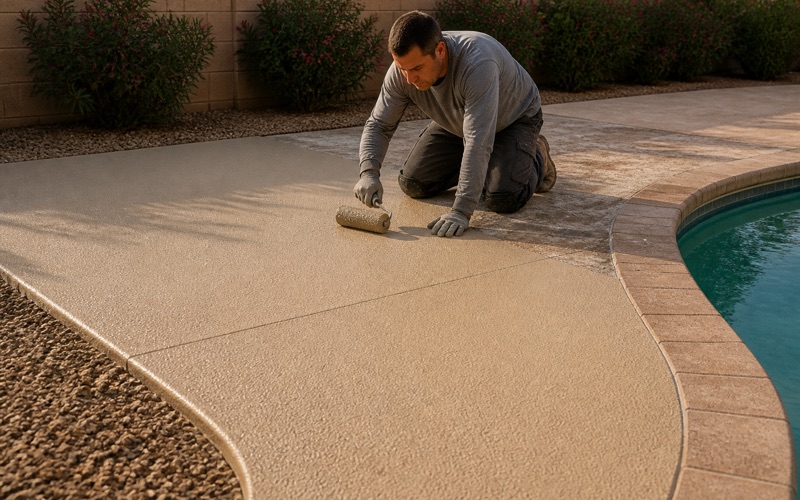
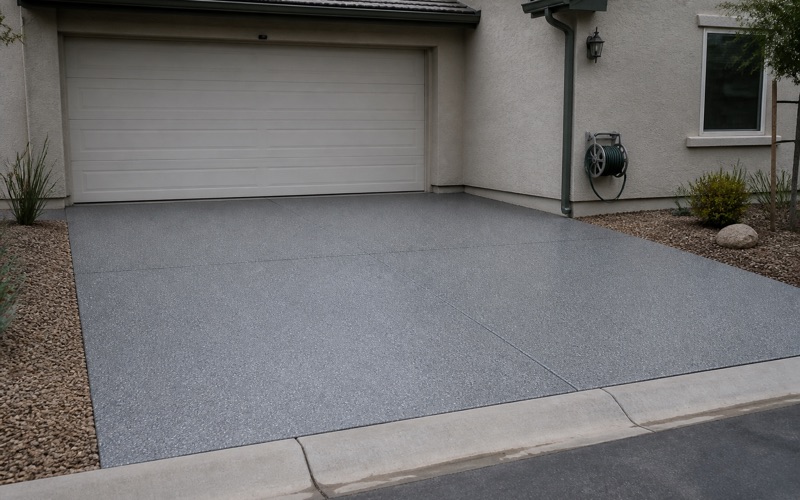
The same tract construction that makes the garages here consistent also produced driveways, patios and pool surrounds of similar vintage, and those are a genuinely different specification rather than the same system used outdoors. Ultraviolet exposure, thermal cycling and bare feet all change what the finish has to do.
Exterior work therefore uses aliphatic polyaspartic or polyurea chemistry, or a polymer-modified cementitious overlay where the surface is worn rather than failing, with texture broadcast in for slip resistance. On a slab in full inland sun, color and surface temperature are worth considering together rather than separately.
Polished Concrete Indoors
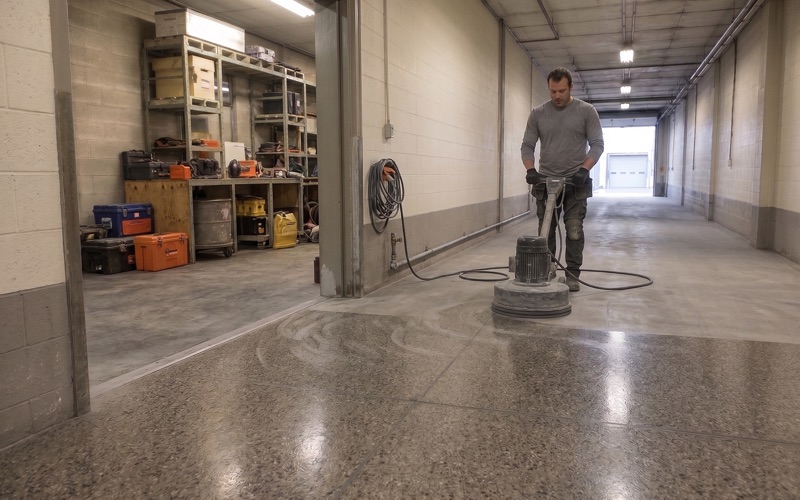
Where a slab is sound, flat and clean — which describes a great deal of concrete in this city — polished concrete is a real alternative to a coating. The floor is ground through progressive grits, densified with a chemical hardener that reacts inside the concrete, and polished to a chosen gloss level.
Nothing is bonded on top, so nothing can delaminate. What polishing cannot do is conceal a patched or contaminated slab, and it exposes whatever the concrete contains permanently, which is why we grind a test area first and let the floor itself decide.
Doing More Than One Slab
Where a property needs a garage floor and a driveway, or a patio as well, doing them in one visit usually makes sense. The mobilization and much of the preparation equipment is shared, so the second and third slabs cost meaningfully less per square foot than the first.
It also produces better transitions. A garage threshold meeting a driveway looks considerably better when both sides were planned as one job rather than coated years apart in different systems and different colors.
- 20+ Years Experience
- Free Estimates
- Every Slab Moisture Tested