Colton Epoxy Flooring installs epoxy flooring in Crestline, CA, and this is a page where the most useful thing we can tell you is when the work can actually happen. We have more than twenty years of concrete coating behind us in this region, and mountain jobs are the ones where being honest about the calendar matters more than anything on a product datasheet. A perfectly specified floor applied in the wrong month is still a failed floor.
Crestline sits at 4,613 feet. Published figures give average highs of about 45 degrees in January and 47 in February and December, and 50 degrees is a hard published minimum on common epoxy floor coatings — for air, surface and material alike, with a requirement to be at least 5 degrees above the dew point on top of it. For a good part of the year the conditions here sit below what the products allow. That is a property of the chemistry rather than a limitation of any particular crew, and no contractor can work around it.
The second thing worth knowing is the age of the housing. 27.4% of Crestline’s stock predates 1950 and 16.4% predates 1940, which is the oldest concrete anywhere on our service area. Between the altitude and the age of the housing, Crestline asks two unusual things of a contractor at the same time.
The Application Window Is Real
Fifty Degrees Is a Published Floor
The 50 degree minimum is not a preference or a comfort threshold. It appears in manufacturers’ published application conditions and it applies to air temperature, surface temperature and the material itself, all three, with the dew point requirement layered over it.
That means a coating applied outside those conditions is being applied outside its specification, whatever it looks like on the day. It may appear to go down perfectly well and then fail to develop its properties, which is a worse outcome than not starting, because the floor looks finished and is not. Those failures typically show up weeks later as softness, poor chemical resistance or a coating that never quite hardened.
Which Months Actually Work
With average highs in the mid-forties across December, January and February, those months are effectively closed for exterior and unheated interior work. The shoulder seasons need judgment rather than a rule, and the reliable window is the warmer part of the year. We book accordingly and tell customers the reasoning rather than simply offering a date.
We would far rather tell you that at enquiry than book a date we cannot honor. A job moved to the right month costs nothing; a job done in the wrong one costs the whole floor, and there is no way to recover it afterwards. Re-running a prompt on a failed floor is not an option; the material is on the slab and removing it is a fresh job.
Even at Fifty Degrees, Everything Slows
Reaching the minimum is not the same as good conditions. At exactly 50 degrees a published drying schedule stretches badly — the recoat minimum moving from around 8 hours out to 24 hours, foot traffic from one day out to two, and full cure from about a week out to ten days.
So a job at the edge of the window is a longer job rather than an equivalent one, and the schedule has to reflect that. We build those numbers into the program rather than discovering them, and we say clearly when a return-to-service date is being set by temperature rather than by our availability. That distinction matters to anyone trying to plan around the work, and it is easy to state honestly.
Looking for garage floor coating closer to Rancho Cucamonga? See Rancho Cucamonga Garage Floor Coating.
The Oldest Slabs We Work On
What 1940s Concrete Means
With 16.4% of housing predating 1940 and 27.4% predating 1950, the typical Crestline substrate is an original cabin slab. Under-slab vapor retarders were not routine practice anywhere near that early, so the working assumption is that there is nothing beneath the concrete.
Vapor moving up through an unprotected slab does not damage the slab; it pushes whatever is bonded on top of it off. On concrete of this age that is the dominant failure mode, and it is why testing comes before any product is ordered rather than after a coating lifts. On concrete this old the test is the most valuable few minutes in the entire job.
Testing on Mountain Concrete
We use the ASTM F1869 calcium chloride test to read a moisture vapor emission rate at the surface and the ASTM F2170 in-situ relative humidity probe to read the state of the slab at depth, taking the threshold numbers from ASTM F710 rather than from the test methods themselves.
The ASTM D4263 plastic sheet test is asymmetric and worth understanding as such: a positive result fails a slab, a negative one proves nothing. On old mountain concrete that can hold seasonal moisture it is particularly unreliable as a sole basis for a decision. We run the measured tests regardless of what a sheet test suggests.
Movement as Well as Moisture
Older cabin slabs frequently carry movement as well as moisture — settlement, seasonal shifting and cracking that is still active rather than dormant. An active crack telegraphs through any coating or overlay placed over it, so it is either addressed structurally or carried through the finished surface as a deliberate joint.
Telling an active crack from a dormant one comes from its edges, its width and how it runs across the slab. Where it is genuinely ambiguous we say so rather than guessing, because guessing here produces a floor that cracks in the same place within a year. An honest uncertainty stated at quoting is worth more than a confident answer that turns out wrong.
Working at Altitude
Getting Equipment Up and In
Mountain access is its own planning problem. Getting a planetary grinder, a dust extraction rig and material up to the community and then onto a specific property is a real question rather than a formality, and driveways here are frequently steep, narrow or unpaved.
We confirm the last hundred feet before committing to a date — grade, surface, turnaround space and whether a heavy machine can physically be walked to the slab. That conversation costs a few minutes at the site visit and prevents a wasted trip that costs a day.
Heating a Space to Work
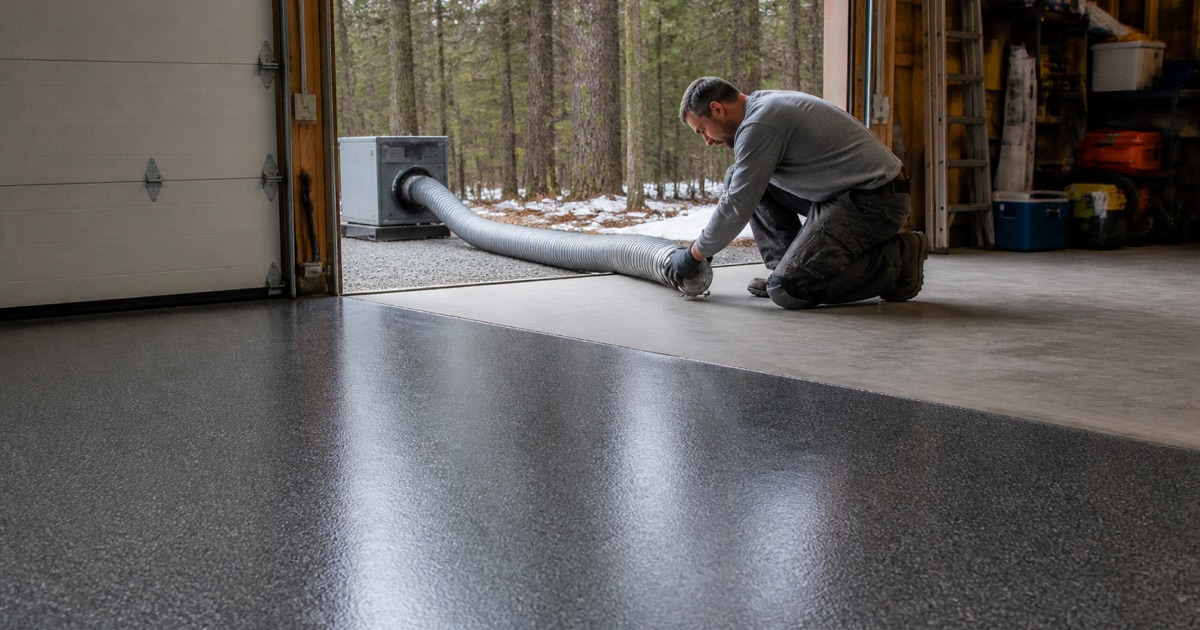
Where a job genuinely has to happen outside the comfortable window, the answer is sometimes to heat and control the space rather than to hope. That is a real option on an enclosed garage or cabin interior, and it comes with its own requirements around ventilation, even heat distribution and holding the temperature through cure rather than just during application.
It also costs money, and we would rather set that out honestly as an option than either refuse the work or take it and hope for a warm week. The choice belongs to the customer once the trade-off is clear.
What Suits a Mountain Property
Interior floors in cabins and garages are the bulk of the work here. Exterior slabs are harder to recommend confidently at this elevation, because freeze cycling and prolonged wet conditions are considerably more demanding than anything on the valley floor.
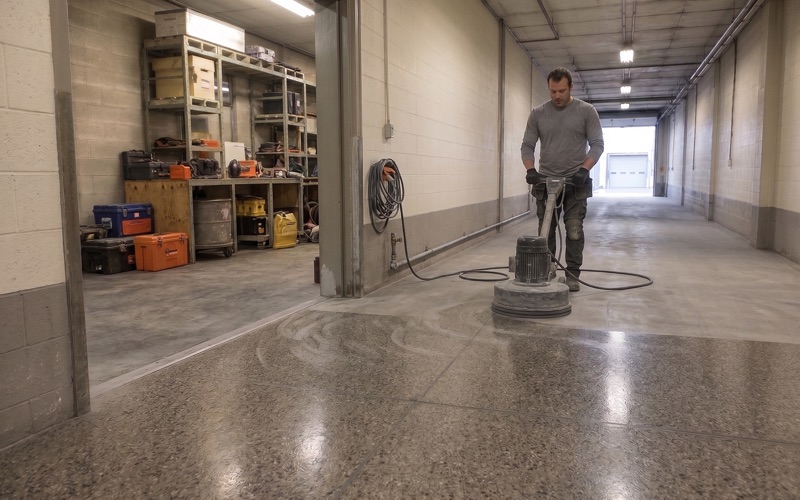
Where exterior work is wanted, it needs ultraviolet-stable chemistry, texture broadcast in for grip on a surface that will genuinely be icy, and a realistic conversation about service life. Polished concrete is also worth considering on a sound old interior slab, because with nothing bonded on top there is no film for moisture to lift.
Practical Notes for a Mountain Job
Planning Around Weather Rather Than Dates
A mountain schedule is built around conditions rather than a calendar, which means a degree of flexibility on both sides. We would rather agree a target window and confirm the working days closer to the time than commit to a fixed date months ahead and then be forced to choose between moving it and doing the work badly.
Customers here are generally used to that, because it is how most trades operate at this elevation. Saying it clearly at the start avoids the impression that a moved date is a contractor problem rather than a physical one.
Repair Is a Large Part of the Scope
On concrete approaching or past eighty years old, grinding exposes work rather than simply preparing a surface. Control joints need filling with a semi-rigid material so they can keep moving without cracking the coating above them, spalls and broken edges need cutting back and patching, and contaminated areas need treating before priming.
All of that is scoped and priced with the floor rather than raised once work has started. On a cabin slab it is frequently a larger share of the job than the coating itself, and a quote that does not mention it is not describing the same work.
Choosing a Finish for a Mountain Property
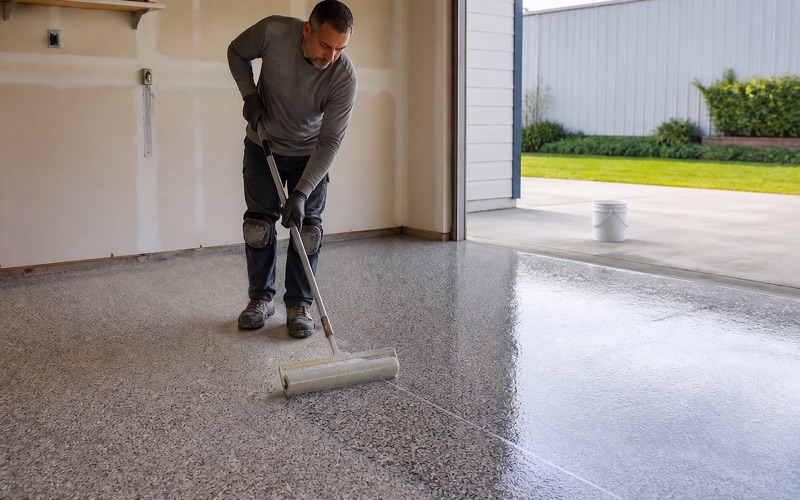
Practical considerations tend to lead here. A floor that sees wet boots, grit and firewood benefits from a full flake or quartz broadcast rather than a smooth finish, both for grip and because texture hides what a mountain garage actually does to a floor.
Gloss level is worth thinking about too. High gloss shows every mark and every piece of tracked-in grit, while a satin finish hides a great deal and is usually what people are happiest with a year later in a building that gets used hard.
- 20+ Years Experience
- Free Estimates
- Every Slab Moisture Tested