
Colton Epoxy Flooring provides concrete grinding and surface preparation across Colton, CA, and the surrounding cities including Grand Terrace, Bloomington, Rialto, Highgrove and Loma Linda, with more than twenty years spent opening slabs in this valley. Surface preparation is the least visible part of a floor and the part that decides whether it survives.
Almost every resinous floor failure we are called to inspect traces back to this step. The coating was not the problem; the bond was. Concrete leaves the trowel closed, and a resin applied to a closed, sealed or contaminated surface is stuck to a thin layer that then lets go and takes the floor with it.
We also take on grinding as a job in its own right — coating removal, leveling, trip-hazard reduction and preparation for another trade’s finish. Plenty of tile setters, polished concrete installers and general contractors would rather bring in a crew that does this every day than hire a machine and learn on your floor.
Why Concrete Has to Be Opened
What a Troweled Surface Actually Is
Power troweling densifies and closes the top of a slab, leaving a burnished layer with very little porosity. That layer is excellent for wear and almost useless for adhesion. Grinding removes it and exposes sound, open concrete that a primer can penetrate rather than merely sit on. How far down that has to go depends on how the slab was finished, which is why we test a patch before quoting the whole floor.
Why We Never Acid Etch
Acid etching is cheap, fast and the most common reason a garage floor fails. It softens the surface, cannot produce a consistent profile on hard-troweled concrete, and leaves salt residue behind unless it is neutralized and rinsed perfectly. The coating ends up bonded to a weakened layer rather than to the slab. It also cannot remove an existing coating at all, so on any previously finished floor it is not even a candidate.
The ICRI Concrete Surface Profile
Profile is specified rather than described. The ICRI concrete surface profile scale runs from CSP 1 through CSP 10, and every coating system names the profile it needs. Matching the preparation to that number is what makes a manufacturer’s specification meaningful rather than decorative. It is also the line a warranty claim will be judged against, so we record the profile achieved rather than describing it loosely afterwards.
The Methods and When We Use Each
Diamond Grinding
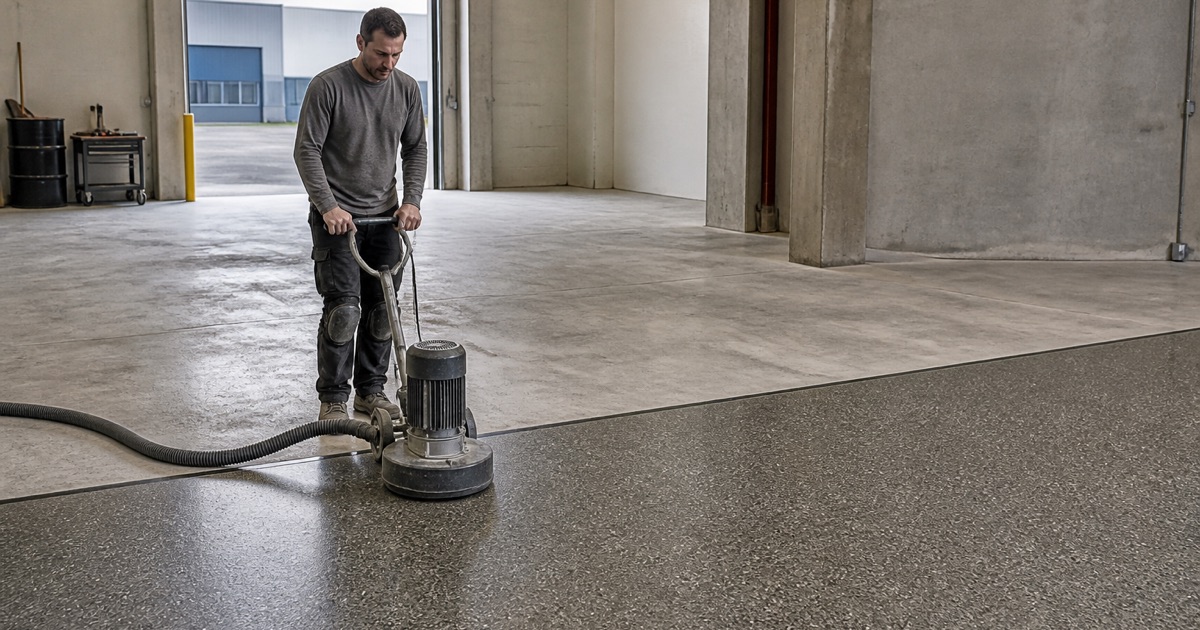
Diamond grinding is our default on residential and smaller commercial floors. It profiles, levels and removes coatings, works right up to edges when paired with a hand grinder and edger, and produces a controllable profile by grit sequence. It runs under continuous HEPA dust extraction, which is what makes it usable inside an occupied building.
Shot Blasting
On large commercial and industrial floors, shot blasting is faster and more uniform. Steel media is thrown at the slab and recovered in a closed loop, opening a deeper profile across open areas at a rate grinding cannot match. It cannot reach edges or work around fixed equipment, so hand grinding always follows it.
PCD Tooling for Coating Removal
Polycrystalline diamond tooling shears a coating off the slab rather than abrading through it. On a failed epoxy, a thick elastomeric or a stubborn consumer kit, that is dramatically faster than trying to grind the film away, and it saves the conventional diamonds for profiling the concrete underneath.
Scarifying for Heavy Removal
Where material has to come off in real thickness — a thick overlay, heavy build-up, badly out-of-level concrete — scarifying cuts aggressively with rotating drums. It leaves a coarse, uneven surface, so it is a first stage that grinding always has to follow rather than a finish in itself. Used on its own it leaves a texture no coating can level out, which is why it appears in a scope alongside grinding rather than instead of it.
Choosing the Diamond Bond
The Rule That Reads Backwards
Hard concrete takes a soft bond and soft concrete takes a hard one. A soft matrix wears away steadily to keep exposing fresh diamond on a slab that would otherwise polish the segment smooth; a hard bond holds its diamond on abrasive concrete that would strip a soft one in an afternoon.
Testing the Slab First
We test hardness before committing to tooling, because getting it wrong is expensive in both directions — either the machine burnishes the floor instead of cutting it, or a set of segments is destroyed in a fraction of the area it should have covered.
Dust, Containment and Working Occupied
HEPA Extraction as Standard
Dry grinding without proper extraction produces respirable silica dust and an unusable working environment. Our machines run under continuous HEPA dust extraction as a matter of course, not as an upgrade, and containment goes up wherever the rest of a building stays in use.
Working Around a Business
In an occupied building we contain the work area, run negative air, protect access routes and sequence the floor so the rest of the space keeps operating. In healthcare and food environments that plan gets more scrutiny than the coating specification, and it is written into the proposal.
- 20+ Years Experience
- Free Estimates
- Every Slab Moisture Tested