
Colton Epoxy Flooring coats and resurfaces concrete driveways across Colton, CA, and the surrounding cities including Grand Terrace, Bloomington, Highgrove, Rialto and Loma Linda, with more than twenty years of exterior concrete work behind us. A driveway is the largest and hardest-worked slab on most properties, and it takes a combination of abuse that no interior floor sees.
It carries vehicle weight and turning loads, it sits in full sun all day, it gets hot tires parked on it, and it is exposed to rain, oil and everything tracked in from the street. A driveway finish has to handle all of that at once, outdoors, on a slab that moves with temperature.
That rules out most of what works inside. Straight epoxy is the wrong answer here, and so is any finish without texture designed into it.
What a Driveway Actually Has to Survive
Hot Tires and Point Loading
A tire parked on a sunlit driveway is both hot and heavy, and a thin or poorly bonded film will soften under it and lift away when the car moves. This is the single most common driveway coating failure, and it is prevented by bond and by build rather than by any product claim. A driveway also holds heat long after the air has cooled, so the tire sitting on it in the evening is still working against the film.
Full Sun and Ultraviolet Exposure
Epoxy ambers under ultraviolet light, so an epoxy topcoat on a driveway yellows visibly within a season or two. Exterior work uses aliphatic chemistry — polyaspartic or polyurea — or a cementitious overlay, both of which hold their appearance in direct sun. The difference shows first on lighter colors, where ambering reads as a dirty cast that no amount of cleaning removes.
Daily Thermal Movement
An exterior slab in this valley cycles substantially between night and afternoon, every day of the year. That movement concentrates at joints, so joints are carried through any new surface rather than bridged, and the perimeter is detailed to let the slab move. Where a driveway meets a garage threshold or a walkway, that junction is treated as a joint rather than a place to run the finish straight through.
Systems That Work on a Driveway
Polymer-Modified Overlays
Where the surface is scaled, pitted or worn but the slab is sound, a polymer-modified cementitious overlay rebuilds it. Applied in thin lifts over a properly profiled slab, it restores a uniform surface, accepts integral color, and can be textured or stamped while still plastic. It also lets a driveway change appearance entirely rather than simply being repaired, which is often what prompts the job in the first place.
Textured and Stamped Finishes
Driveways take stamped patterns and textured finishes well, and they are more than cosmetic here: a broomed, knockdown or stamped surface provides the grip a smooth finish would not, on a slope that gets wet and carries vehicles. On a driveway with any real grade, that texture is the difference between a surface that works in the rain and one that does not.
Aliphatic Coatings With Aggregate
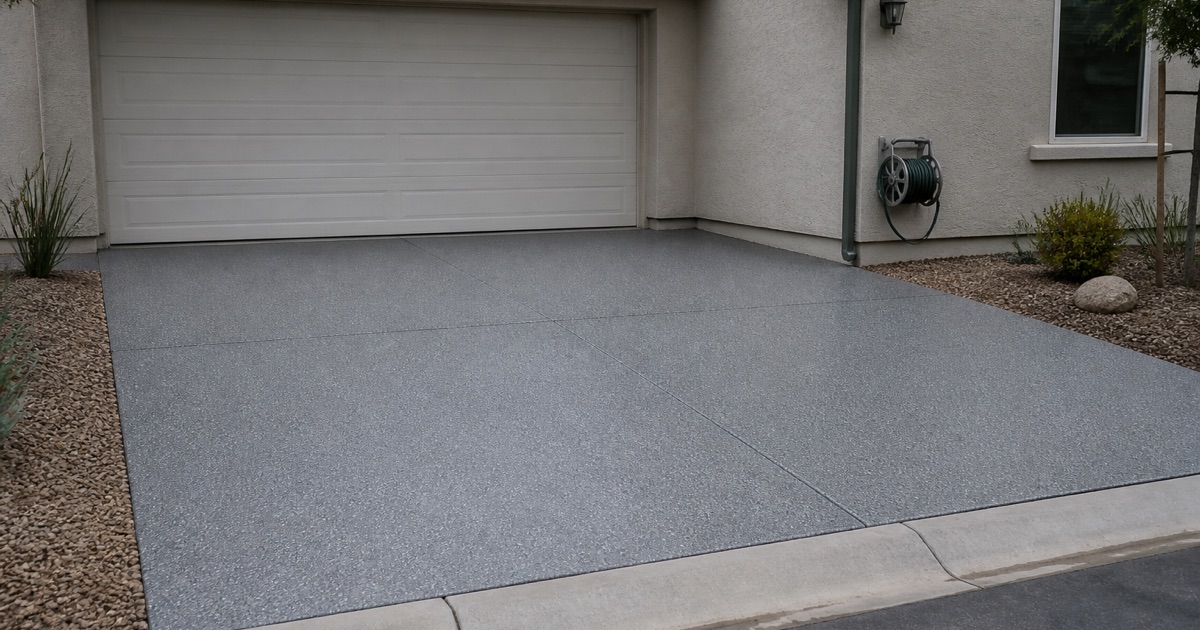
Where a resinous coating suits the slab, an aliphatic polyaspartic or polyurea system with aggregate broadcast into it gives color stability, chemical resistance against oil and fuel, and quotable slip resistance. It needs a sound, tested slab underneath, because a coating cannot bridge a failing one. We moisture test exterior slabs as well, because a driveway sitting over damp ground drives vapor upward exactly as an interior slab does.
Preparation on an Exterior Slab
Assess Before Quoting
The first question is whether the problem is the surface or the slab. Scaling, spalling, crazing and worn appearance are surface conditions and coat or resurface well. Widespread structural cracking, settlement or a slab rocking under load is a replacement problem, and we will say so rather than sell an overlay that fails inside a year. Partial replacement combined with resurfacing is sometimes the sensible middle answer, and it is worth pricing both ways before deciding.
Cracks That Move and Cracks That Do Not
A dormant shrinkage crack can be repaired and covered. An active crack still moving with load or settlement telegraphs through anything placed over it, so it is either addressed structurally or carried through the new surface as a deliberate joint rather than hidden and forgotten. Reading which kind a crack is comes from its edges and its pattern across the slab, and where it is genuinely ambiguous we say so.
Profile, Not Pressure Washing
Bond comes from mechanical profile. We grind or shot blast to the concrete surface profile the system requires and remove sealers, coatings, curing compounds and contamination first. Pressure washing takes off what is loose and leaves precisely the bonded layer that has to go. That is why a quote naming pressure washing as its preparation is quoting a different and shorter-lived job.
Oil Contamination
Most driveways have an oil-saturated area somewhere, and oil defeats a bond as thoroughly as dust does. Contaminated concrete is treated before anything goes over it, because oil that has soaked in will bleed back through a finish laid on top of it. The contaminated area is usually obvious and localized, and treating it properly costs far less than dealing with the debonded patch it would otherwise become.
- 20+ Years Experience
- Free Estimates
- Every Slab Moisture Tested