Colton Epoxy Flooring installs epoxy flooring in Canyon Lake, CA, and here the operational constraints matter more than anything technical about the slab. We have more than twenty years of concrete coating behind us in this region, and Canyon Lake is the one place on our service area where a job can be stopped at a gate rather than by a floor. That is an unusual thing to have to plan around and it is entirely manageable once you know the rules.
Canyon Lake is a privately gated incorporated city. The property owners association states plainly that access is permitted only to residents and their guests, and it operates three gates rather than one, with different rules attached to each. Which gate applies to which vehicle is not something to work out on the morning of the job.
For a coating crew arriving with a trailer, a planetary grinder and a dust extraction rig, those rules are not background detail. They decide which entrance we use, who authorizes the entry, and what hours the machine is allowed to run. All three of those get settled before a date is agreed rather than after.
The Gate Decides How the Job Runs
A Grinder Trailer Cannot Use the Main Gate
The association’s own wording is that all commercial, oversize and recreational vehicles must access the community through the East and North Gates, and that commercial and oversized vehicles are not allowed entry at the Main Gate.
That is a specific, practical routing requirement rather than a preference, and it applies to exactly the kind of vehicle this work arrives in. Knowing it in advance is the difference between a crew starting on time and a crew being turned around at an entrance. A turned-around crew is a lost day that nobody can recover, and it is completely avoidable.
The Homeowner Authorizes, Not the Contractor
Access here is pre-authorized by the member rather than arranged by the contractor. The association classifies contractors as Service Providers under its visitor system, and the member calls the crew in through the app, the website or the association’s line, with the driver presenting a valid driver’s license at the gate.
We cannot register ourselves in, and we would not claim otherwise. What we do is tell you exactly what we need authorized and when, well before the day, so the arrangement is made rather than improvised at seven in the morning with a trailer waiting. Being clear about what we need from the homeowner is part of the job here rather than an imposition.
Working Hours With Penalties Attached
Working hours here are legally enforceable rather than advisory — 6 AM to 6 PM in summer, no Sundays and no association holidays — with fines and stop-work orders attached to breaches.
That directly shapes what a job looks like. It decides whether a one-day floor really is a one-day floor, and it removes the early start that we would otherwise use to beat summer heat. We plan the sequence around those hours rather than hoping to run over. Working past a permitted hour risks a stop-work order on the member’s account, which is not a risk we would ever take with somebody else’s property.
Looking for epoxy flooring closer to Grand Terrace? See Epoxy Flooring in Grand Terrace.
What That Means for Scheduling
Planning Around a Fixed Window
A twelve-hour permitted window sounds generous until it meets a coating with a short pot life on a hot afternoon. Pot life on a common system runs about 60 minutes at 55 degrees and collapses toward 20 minutes at 95 degrees, with the recoat minimum shortening alongside it.
Where a floor needs a recoat inside a window that closes at six, the sequence has to be planned rather than improvised. Occasionally the honest answer is that a floor takes two days here where it would take one elsewhere, and we say that at quoting rather than discovering it. An honest two-day quote is better than a one-day quote that becomes two days on the morning of the second.
Deliveries and Equipment Movements
Material deliveries and equipment movements are subject to the same access rules as the crew, so they get scheduled rather than assumed. A pallet of material arriving at the wrong gate is a genuine problem rather than an inconvenience. It can hold up a whole day’s work for the sake of a delivery instruction nobody confirmed.
We consolidate what we bring for that reason, and we confirm the arrangements with the homeowner in advance. It is a small amount of coordination that prevents most of what can go wrong on a gated property.
Communicating With the Association
Where a job is larger than a single garage, it is usually worth the homeowner giving the association notice rather than relying on gate authorization alone. That is not a requirement we impose; it is simply what makes a multi-day program run smoothly in a community with active rules.
We will provide whatever detail is useful — vehicle descriptions, expected hours, the number of days — so a member can pass it on. Making that easy is part of the job here. The smoother the association side runs, the less the homeowner has to think about any of it.
The Slab Itself
Middle-Aged Concrete, Not Old
The housing here inverts the usual argument for this region. No units predate 1960 and the great majority were built in the 1970s and 1980s, so the pre-vapor-retarder story that carries most of our service area does not apply.
What that produces is a middle-aged slab: 40 to 55 years of service, typically with control-joint cracking, threshold lipping, oil staining and often a failed one-part paint or consumer kit on top of it. That is a predictable job rather than a risky one. It also means quotes here tend to hold, because there is far less hidden in the slab than in an older community.
Testing Anyway
We still moisture test every slab before ordering, using the ASTM F1869 calcium chloride test for a vapor emission rate at the surface and the ASTM F2170 in-situ relative humidity probe for the state of the slab at depth, with thresholds read from ASTM F710.
The California Residential Code exempts garages from the under-slab vapor retarder requirement, so a garage slab may have nothing beneath it regardless of when the house was built. The test is quick and it removes the one variable capable of destroying an otherwise sound floor.
Preparation and Finish
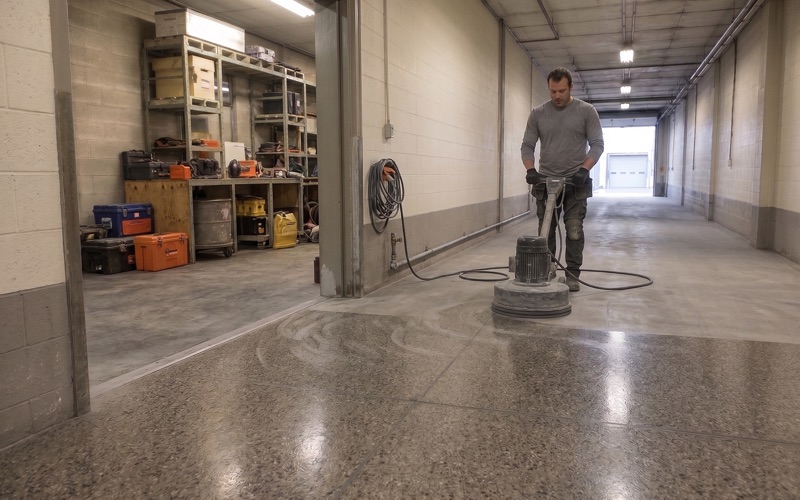
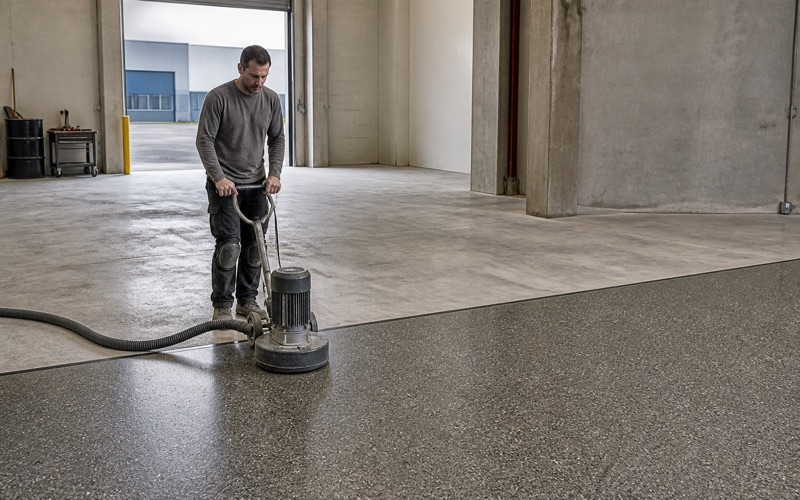
Preparation is mechanical — diamond grinding to a measured ICRI concrete surface profile, with the diamond segment bond chosen against slab hardness and continuous HEPA dust extraction running. We never acid etch, and on a hard-troweled slab it could not produce a consistent profile anyway.
Where a previous coating has to come off, we shear it with polycrystalline diamond tooling before switching to a conventional grit sequence for the concrete underneath, and we price removal as its own line so the difference between a bare slab and a previously coated one is visible rather than buried in a rate.
Finishes and What Owners Ask
Choosing a Finish on a Middle-Aged Slab
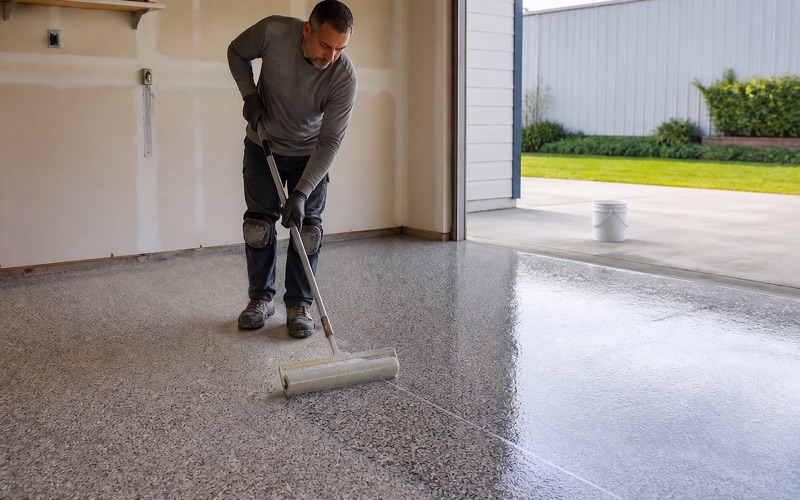
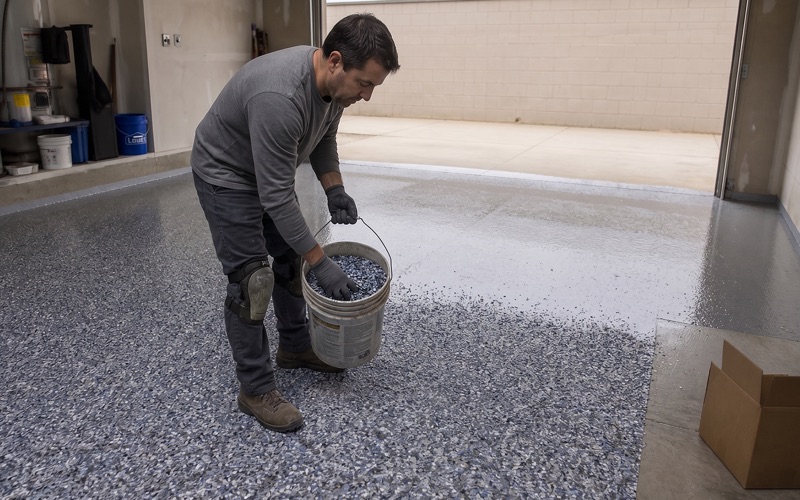
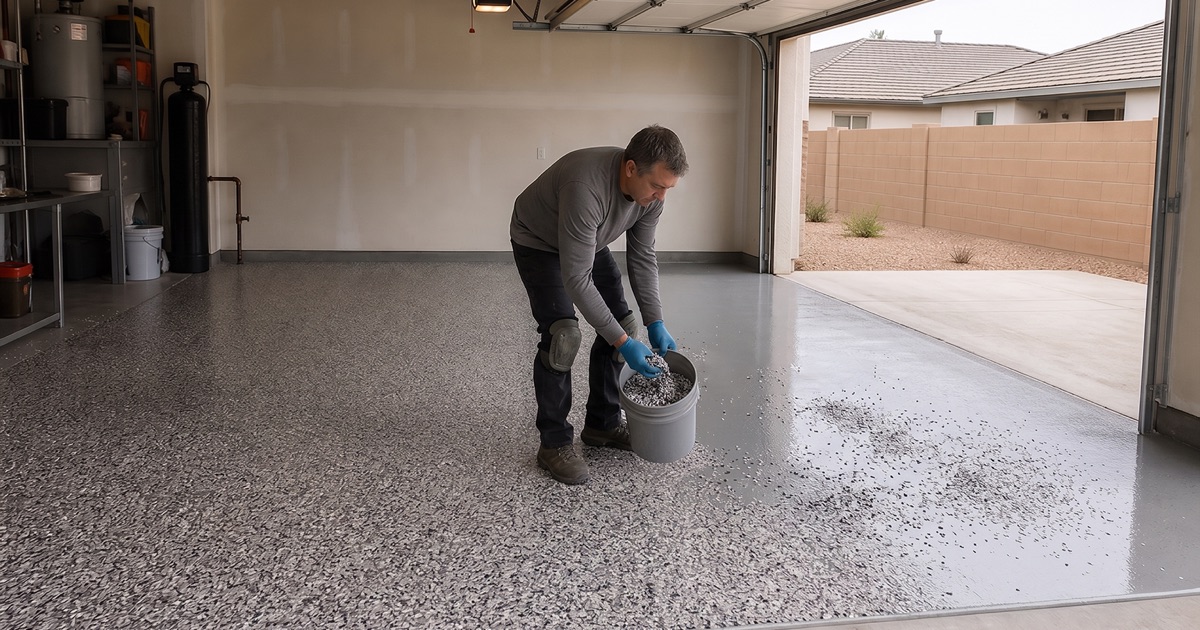
Because most floors here have some repair in them — joint fill, spall patching, a removed coating — the finish is doing concealment work as well as decoration. A full flake broadcast throws chip to refusal until no base color shows, which hides that repair work in a way a light scatter does not.
Flake blends are sold under proper names at specified chip sizes, so we put the blend, the chip size and the broadcast rate in pounds per square foot into the written scope. Without those three numbers two quotes for a gray flake floor may be describing genuinely different products at genuinely different prices.
How Long the Floor Is Out of Use
The question we get asked most here is when the garage can be used again, and the honest answer is that cure rather than labor sets it. Foot traffic comes first, then light use, then vehicles and hot tires last, and every one of those gates moves with slab temperature rather than with the calendar.
We read return-to-service against the actual surface temperature and dew point on the day rather than a label average, and we give you the vehicle date before we start. On a property where the garage is the only place to put a car, that date is usually the most important number in the whole quote.
Whether a Previous Floor Can Be Recoated
Sometimes an existing coating is sound enough to abrade and recoat, which is genuinely cheaper and quicker. More often a floor that has already failed did so for a reason recoating does not address, and putting fresh material over a compromised bond buys about a year.
We test adhesion and look at how much of the floor is still holding before recommending either route. Where the answer is full removal we say so plainly, because the alternative is doing the work twice inside two years and paying for it both times.
- 20+ Years Experience
- Free Estimates
- Every Slab Moisture Tested