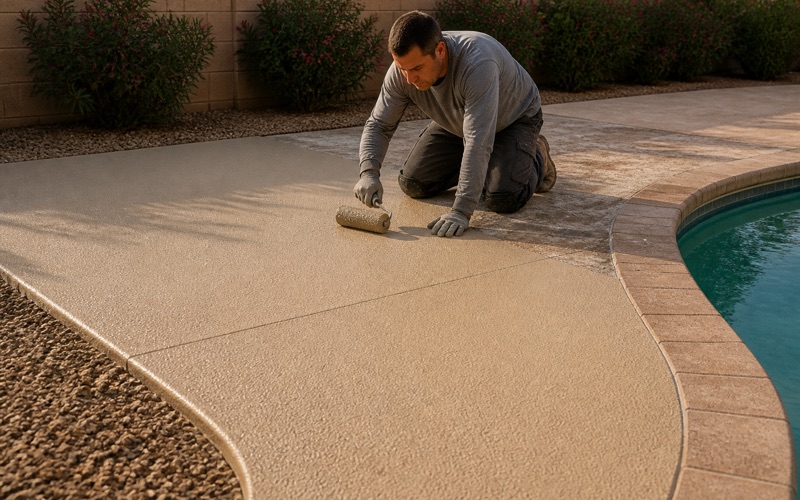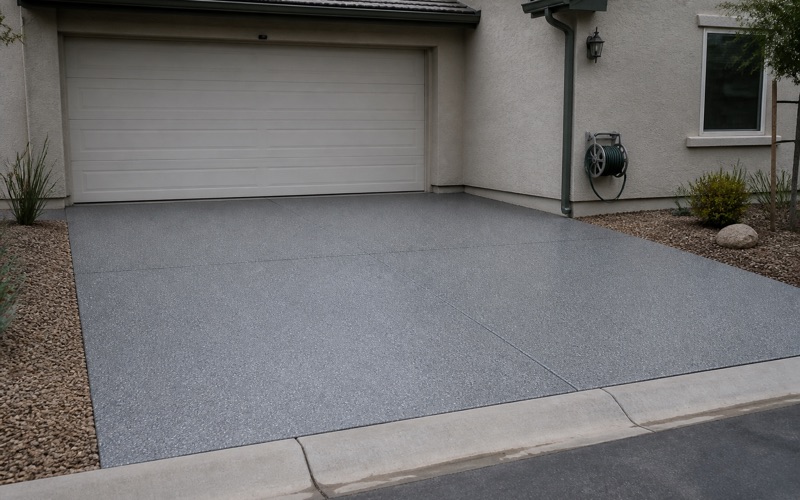
Colton Epoxy Flooring installs epoxy flooring in Calimesa, CA, and the question we field most often here is one that barely comes up elsewhere in this region: is the concrete ready yet? It is a better question than most people realize, and the answer decides whether a floor succeeds or blisters.
Calimesa inverts the pattern of the communities around it. In most of these foothills the story is an old slab poured before modern practice, while here 22.7% of the housing stock is under fifteen years old and 8.4% is under six. That recent-build share runs several times what the neighboring communities carry, and it changes the whole conversation. A contractor arriving with the standard old-slab argument is describing the community next door rather than this one.
A new slab is a different technical problem rather than an absent one. Concrete needs roughly 28 days before it can be coated at all, and a slab in its first year is still releasing the water it was mixed with, which is not something a good product or careful preparation can work around. No amount of grinding accelerates the chemistry, and no product tolerates being applied over a slab that is still wet inside.
Is the Slab Ready to Be Coated?
Twenty-Eight Days Is a Minimum, Not a Target
Fresh concrete needs around 28 days before a coating should go anywhere near it, and that figure is a floor rather than a goal. It is the point at which the concrete has developed enough strength and shed enough of its initial moisture for a resin system to be considered.
Waiting longer is frequently better, particularly on a slab poured in cooler months when everything proceeds more slowly. We would rather tell an owner to wait another month than take the job and produce a floor that blisters, and that advice costs us the booking rather than costing them the floor. It is also the fastest way to establish that we are worth calling back when the slab is ready.
A First-Year Slab Is Still Giving Up Water
Concrete is mixed with considerably more water than the chemical reaction consumes, and the excess leaves slowly over months. A slab in its first year is actively releasing that moisture, which is exactly what defeats an impermeable coating bonded on top of it.
That is why a moisture test on new concrete is not a formality. We use the ASTM F1869 calcium chloride test to read a vapor emission rate at the surface and the ASTM F2170 in-situ relative humidity probe to read the state of the slab at depth, with the threshold numbers taken from ASTM F710 rather than from the test methods themselves. Those two tests measure genuinely different things, and on new concrete both are worth running.
The Vapor Retarder Cuts Both Ways
Here is the counterintuitive part, and it surprises people who assume newer means safer. A modern under-slab vapor retarder does its job by stopping ground moisture entering the slab from below — which also means the mix water cannot escape downward and has to leave through the top.
So a well-built modern slab can read higher for surface moisture in its first year than an older one would, precisely because it is doing what it was designed to do. That is not a defect and it is a genuine reason to test rather than to assume. It is the single most misunderstood thing about coating modern construction, and it catches out experienced people.
Looking for epoxy flooring closer to Home Gardens? See Home Gardens Epoxy Flooring.
Working With New Construction
Coordinating With a Builder’s Program
On new construction the floor coating sits at the end of a build sequence somebody else controls, and the useful thing we can do is be clear about what we need rather than flexible about it. A slab that has cured properly, is free of curing compounds and sealers, and is available for a full working day is what produces a good floor. Being specific about those three requirements early is more useful to a builder than being accommodating about them late.
Curing compounds are worth flagging specifically, because they are routinely applied to new slabs and they have to come off entirely before a coating goes down. That is a grinding job rather than a wash, and it belongs in the scope rather than arriving as a surprise. A curing compound left in place is a guaranteed bond failure, and it is invisible to anyone who has not looked for it.
Preparation Does Not Get Easier
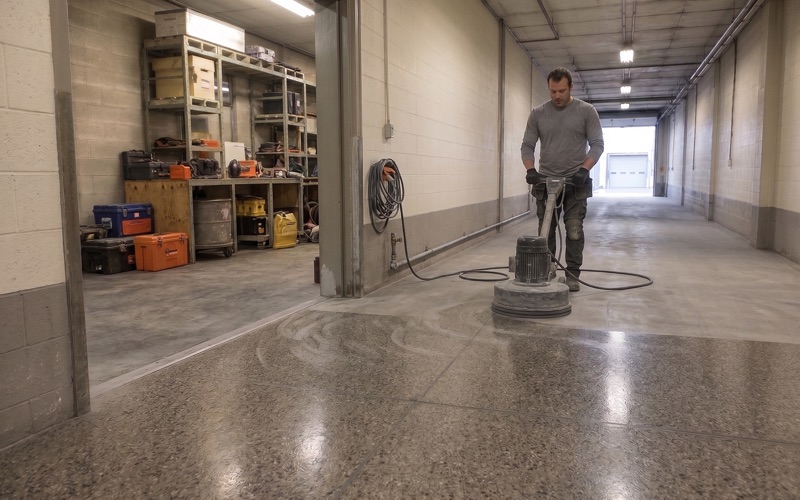
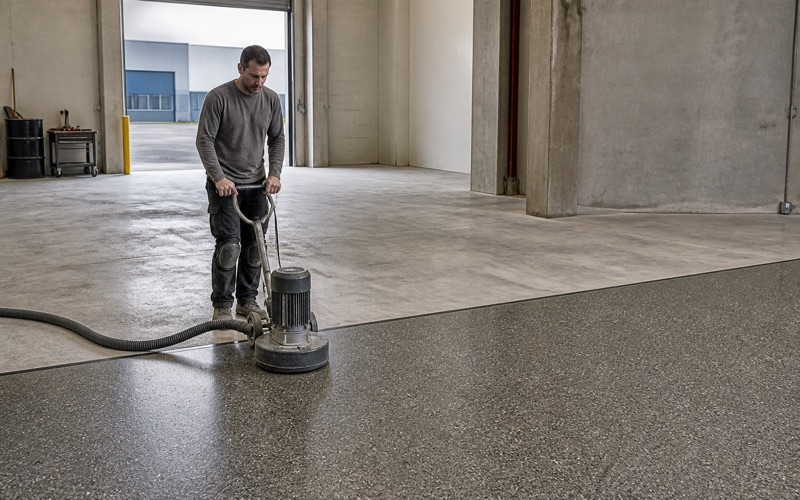
New concrete still has to be opened mechanically. A power-troweled slab is dense and low-porosity, so we grind to a measured ICRI concrete surface profile with a diamond segment bond chosen against the hardness of the slab, under continuous HEPA dust extraction.
An acid etch is no more acceptable here than anywhere else, and on a tight new slab it is less effective still — it cannot produce a consistent profile, it softens what it does reach, and it leaves residue behind. Newness is not a substitute for preparation. If anything the preparation matters more on new concrete, because the surface is tighter than an older slab would be.
Builder Warranties and Coating Warranties
Where a house is new enough to still carry a builder’s warranty, it is worth knowing which party is responsible for what before a coating goes down. A slab defect and a coating failure are different claims against different people, and a floor bonded over the top can complicate the first.
We raise that at quoting rather than after. It rarely changes the decision and it occasionally changes the timing, and either way it is better established while everyone still has the paperwork to hand. Untangling that question two years later is considerably harder than asking it now.
The Rest of the Market Here
High Ownership, Small Pool
Ownership here runs at 89.3%, which is high, and the published pool is around 2,465 owner-occupied detached houses in a community of roughly 11,000 people, with only 213 detached houses rented. It is a small market and almost every one of those houses has a decision-maker living in it.
That tends to produce straightforward, considered jobs rather than volume work. People here are generally deciding about a house they intend to stay in, which favors a specified system over the cheapest available number.
Older Stock Still Exists
Calimesa is not uniformly new, and where the housing is older it behaves like older housing anywhere in these foothills. On that stock the pre-vapor-retarder question is live, and testing answers it rather than the build date.
The mistake worth avoiding is applying one story across the whole community in either direction. A page that treated Calimesa as entirely new construction would be as wrong as one that treated it as an old foothill town.
Heat, Elevation and the Working Window
Slab temperature governs the working day here as across the region. Pot life on a common system runs about 60 minutes at 55 degrees and collapses toward 20 minutes at 95 degrees, with the recoat minimum shortening alongside it.
We read the actual surface temperature and dew point rather than the air temperature, because a garage slab can differ substantially from the air above it, and a coating needs to go down at least 5 degrees above the dew point. Those are measurements rather than judgment calls, and they decide whether a day proceeds as planned.
Finish and Practical Choices
Choosing a Finish on a New Slab
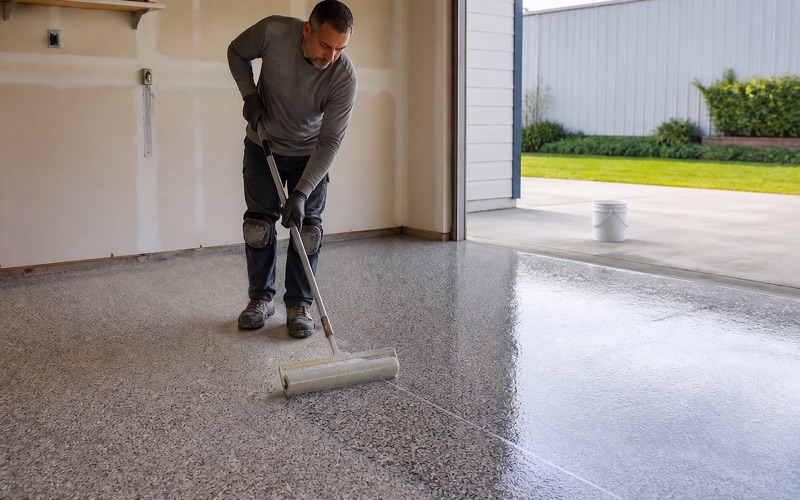
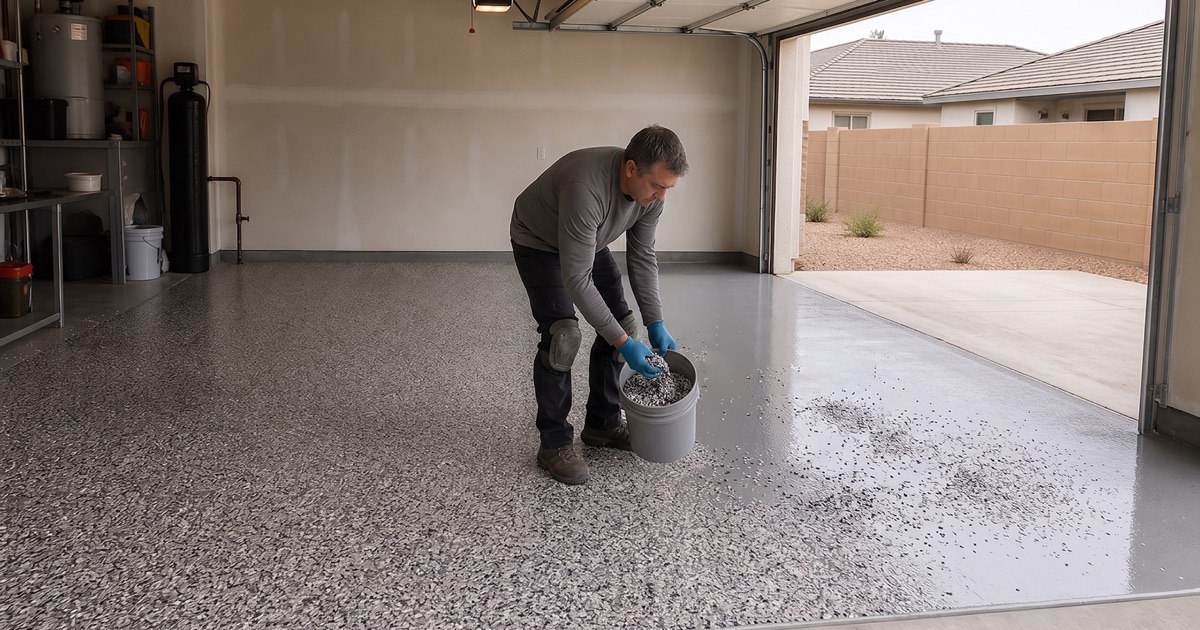
A sound, unpatched, never-coated slab widens the finish options more than most homeowners expect. On an older repaired floor a full flake broadcast is doing concealment work as well as decoration, but here a lighter scatter or even a plain solid color is genuinely viable.
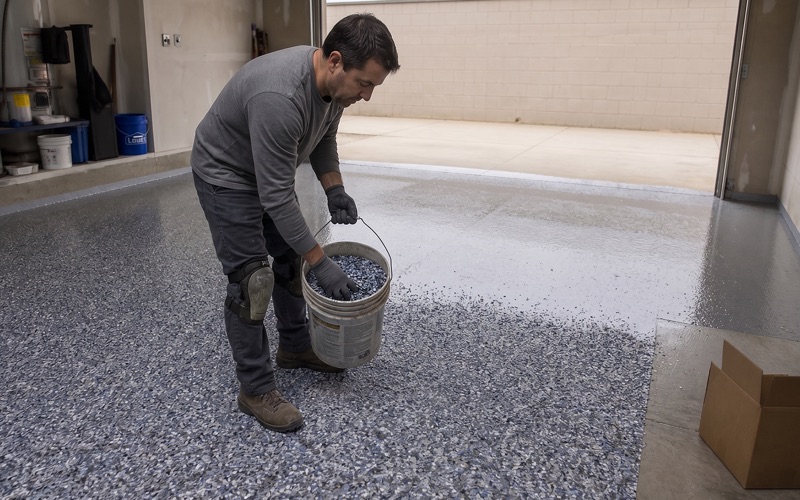
That is a real saving rather than a downgrade, and it is worth understanding before choosing from a sample board. Flake blends are sold under proper names at specified chip sizes, so we put the blend, the chip size and the broadcast rate in pounds per square foot into the scope, which is what lets you compare two quotes properly.
Exterior Slabs on a New Property
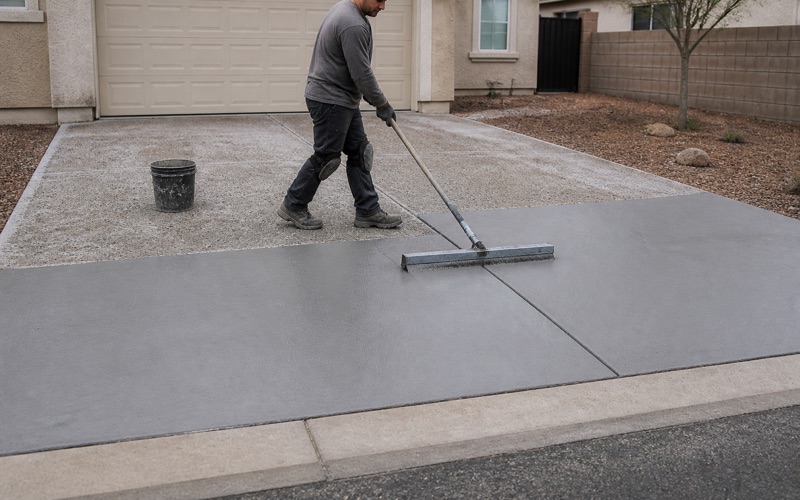
New construction usually arrives with a new driveway, patio and walkways, and those need a different specification rather than the same system used outdoors. Epoxy ambers under ultraviolet light, so exterior work uses aliphatic polyaspartic or polyurea chemistry with texture broadcast in for slip resistance.
Those slabs also need the same cure time as the garage, and often longer where they were poured later in the build sequence. Where a whole property is new, sequencing the coating work around the youngest slab rather than the oldest is what keeps the program honest.
Doing It Once, Properly
The temptation on a new house is to get a floor down quickly while other trades are still finishing. The better sequence is to let the concrete reach its cure, let the dusty trades finish, and then coat into a clean building.
A floor coated early takes damage from everyone who works after it, and touching up a resinous system is never invisible. Waiting a few weeks generally produces a better result and costs nothing but patience.
- 20+ Years Experience
- Free Estimates
- Every Slab Moisture Tested