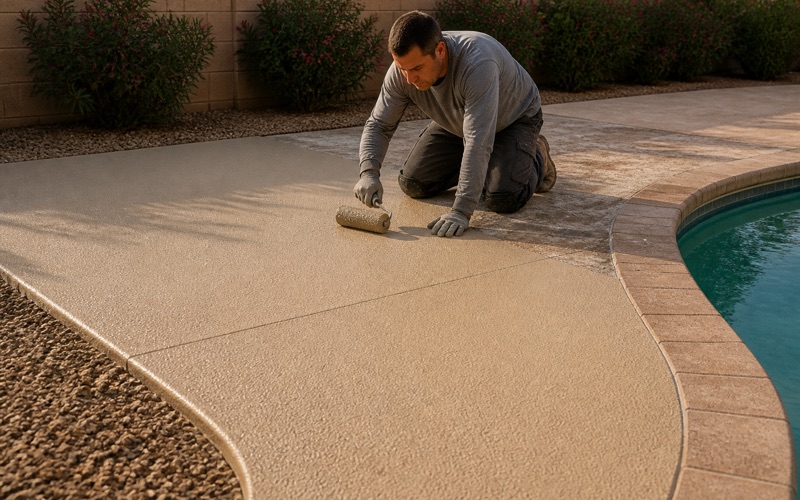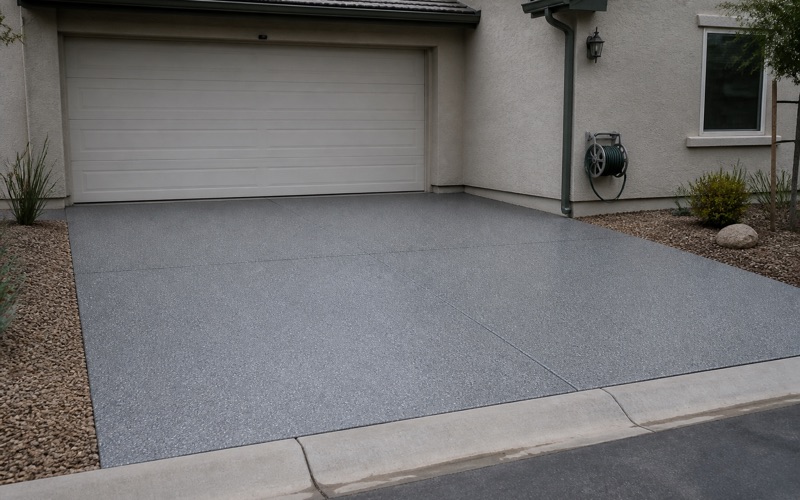
Colton Epoxy Flooring installs epoxy flooring in Bloomington, CA, and a good share of the slabs we coat here are not attached to a house at all. We have spent more than twenty years on concrete in this valley, and Bloomington is one of the places where the standard picture of a garage floor job stops matching what is actually on the property.
The reason is the parcels. Bloomington has 6,771 housing units at 77.8% single-family detached and 69.3% owner-occupied, sitting on large semi-rural lots where a ranch house commonly comes with a separate shop building, an equipment barn or an equestrian outbuilding. Those structures have slabs of their own, and those slabs are frequently the ones people want coated.
It is also a real market rather than a thin one being written up generously, and it carries built million-square-foot logistics operations inside its boundary. Both halves of that are worth taking seriously. A page that treated this as a bedroom suburb would miss most of the work available here, and one that treated it as purely industrial would miss the rest.
The Slab Is Often Not Attached to the House
Freestanding Shop Buildings
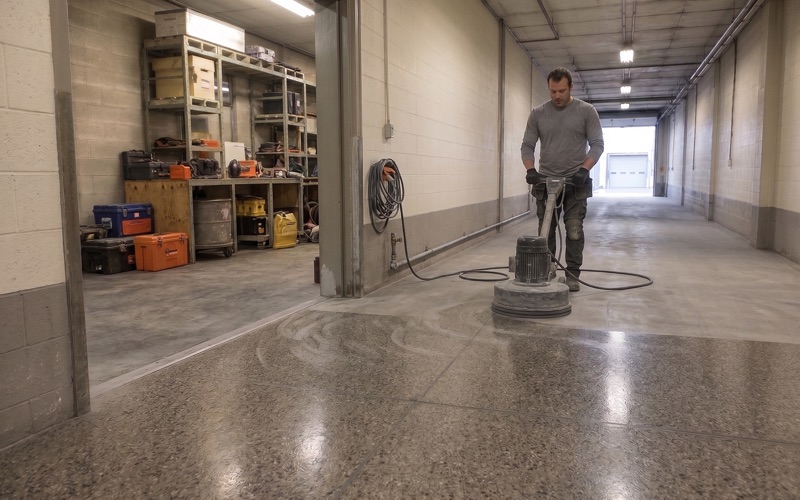
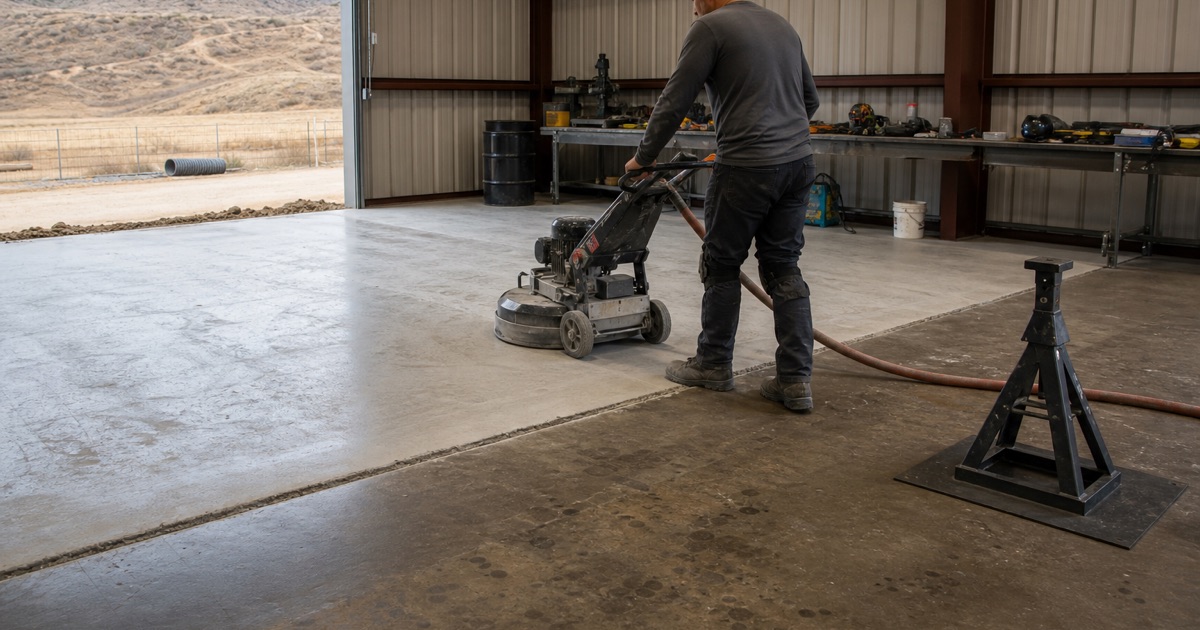
The most common job we quote here is a detached shop rather than a two-car bay off the kitchen wall. A shop slab is a different specification: it takes point loads from jack stands and engine hoists, dropped tools, welding spatter, solvent and hydraulic fluid, none of which a decorative residential system is built to handle. The failure mode is specific too: a decorative flake floor in a working shop chips at the point loads and stains at the solvent spills, and neither is repairable without redoing the area.
That changes the recommendation rather than complicating it. A shop usually wants a higher-build system with real chemical resistance and a finish chosen for cleaning rather than for looks, and it often wants no flake at all. A plain pigmented system with a hard-wearing topcoat cleans more easily and shows a dropped tool less than a broadcast surface does.
Barns, Equipment Buildings and Outbuildings
Larger parcels here carry equipment barns and general-purpose outbuildings, and their floors range from a properly placed slab to something poured decades ago with whatever was available. We test and assess those individually, because the variation between two buildings on the same property is often larger than the variation between two houses. One may be a properly placed slab with a vapor retarder under it and the next a pour somebody did themselves thirty years ago, and only testing separates them.
An outbuilding is also usually uninsulated, which matters more than people expect. The daily temperature swing inside one is wider than in an attached garage, so the application window is narrower and the surface temperature at the time of the pour is worth measuring rather than assuming. It also swings after the coating goes down, which affects the cure schedule as much as the application itself.
The Attached Garage Is Still Here
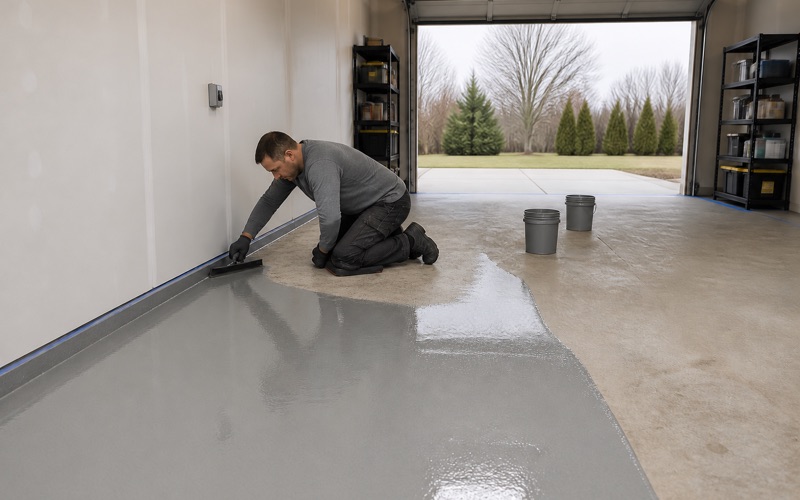
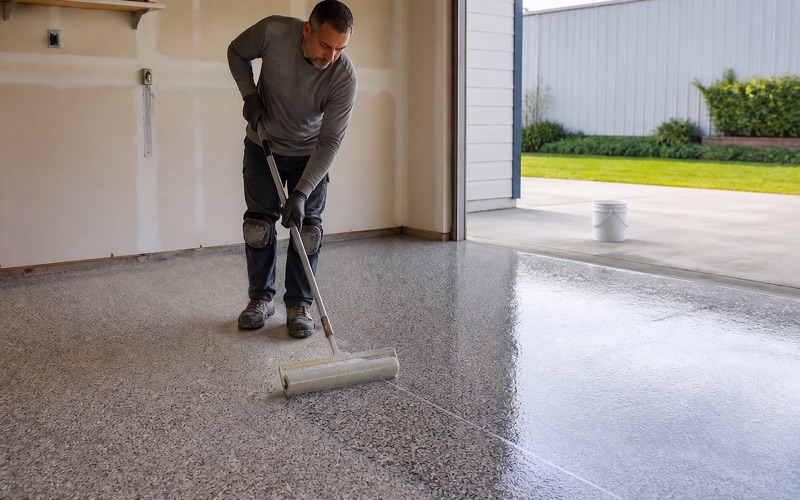
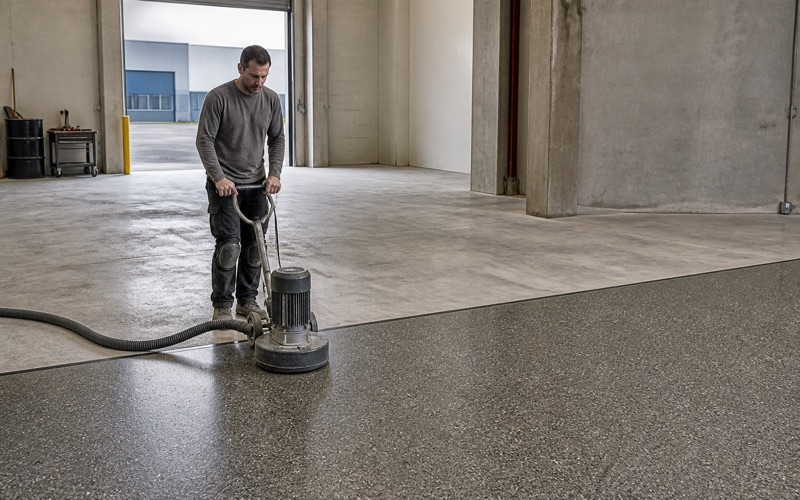
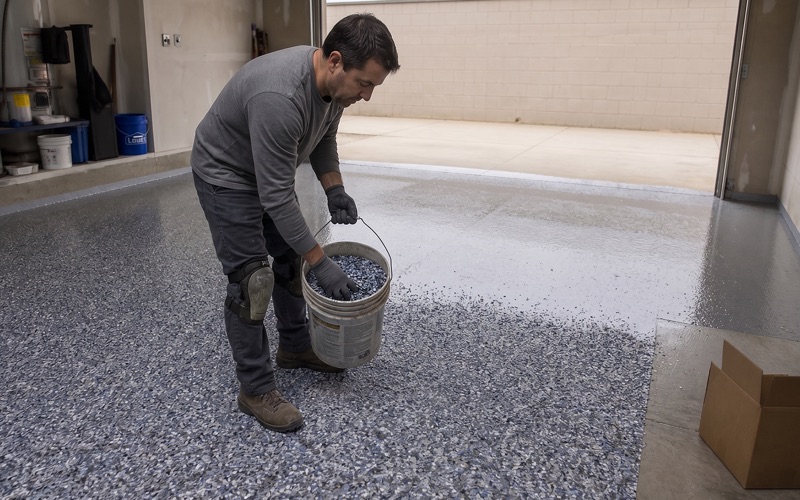
None of that means the conventional job is absent. Plenty of Bloomington houses have an ordinary attached garage and want an ordinary flake floor, and that work runs exactly as it does anywhere else in the valley — grind to an ICRI profile, fill the joints, prime, broadcast and topcoat. Those jobs are the most predictable thing we do and they are usually a single day on site plus cure.
What we try to avoid is quoting a property from a photograph of the house. On a parcel with three slabs, a single number for the garage floor tells the owner very little about what the whole job would cost. We would rather walk the property and price each slab for what it is, because doing all of them at one mobilization is normally cheaper per square foot than coming back.
Looking for epoxy flooring closer to Loma Linda? See Epoxy Flooring in Loma Linda.
Access, Staging and the Last Hundred Feet
Getting Equipment to the Slab
Bloomington sits on the valley floor on a grid of wide semi-rural streets with deep setbacks and long driveways. Getting a trailer-mounted grinder and dust extraction rig onto a property is generally easy, which is not something we can say everywhere in this service area. Some of the communities we cover have canyon roads, gated entries or grades that decide whether a job is even possible; here the road is rarely the problem.
The constraint here is distance rather than grade. A shop building set well back from the road means long hose runs and long power runs, and that gets planned before the day rather than discovered on it. A hundred feet of hose and cord is not a difficulty, but it is a difference, and it belongs on the plan rather than in a surprise.
Power and Water on a Rural Parcel
A planetary grinder and an extraction rig want real power, and an outbuilding at the back of a large lot does not always have it. We check what is available during the site visit and bring generation where it is not, because finding out on the morning of the grind costs a day. Grinding without adequate power means either a slower machine or a smaller one, and both change what the day actually achieves.
Water matters for the same reason on some prep methods, and on a parcel with a well rather than a meter it is worth confirming rather than assuming. It rarely stops a job, and it occasionally changes which preparation method makes sense.
Working Around What Else Is on the Property
Semi-rural parcels usually have animals, equipment, vehicles and storage on them, and the shop being coated is often the place all of that lives. Clearing the slab wall to wall is the same requirement as in a suburban garage, but the volume is frequently larger and the alternative storage is not obvious. A workshop that has been in use for twenty years does not empty in an evening, and pretending otherwise is how a start date slips.
We settle that in writing before the day. Where it helps, we will do the moving as part of the job rather than leaving the owner to shift a workshop the night before. It is quoted as its own line so the choice is visible rather than absorbed into a number.
Commercial and Industrial Floors Inside the Boundary
Logistics Floors Under County Jurisdiction
Bloomington holds genuine built logistics stock, and those buildings sit in unincorporated San Bernardino County rather than under a city. There is no Bloomington city hall and no city building department — the permit authority is County Land Use Services. There is no city council to approach and no local counter to visit, which is simply what unincorporated means and is worth knowing before anyone starts making calls.
For a warehouse floor the practical difference is procedural rather than technical, but it is worth knowing before a tenant improvement schedule is written, because the plan-check path is the county’s rather than a city’s. On a tenant improvement with a lease start date attached, that distinction is worth confirming early rather than assuming from the mailing address.
What a Distribution Slab Actually Needs
A high-cube distribution floor is large-area work over an existing power-troweled slab, and the specification starts from traffic rather than appearance. Joint filling stops hard-wheeled forklifts breaking down joint edges, crack repair keeps damage from spreading, and the coating or hardener is chosen on abrasion and impact resistance. We ask about wheel material and pallet-jack routes before proposing anything, because those two answers narrow the product range faster than square footage does.
Striping is laid out to the racking plan rather than to a standard, and it is worth knowing that no federal rule specifies a stripe width or color — that convention comes from industry practice rather than from the regulation itself. We lay striping out to the traffic plan and to whatever the operator’s own safety program requires instead.
Sequencing Around an Operating Building
Distribution tenants run around the clock, so coating an operating warehouse means working bay by bay against the dock schedule, with a full weekend shutdown reserved for the areas where nothing smaller will work. That sequencing is agreed with the operations manager before quoting rather than negotiated daily once the work has started.
That sequencing plan goes into the proposal. On a commercial floor it is usually the part that decides the real cost of the job, because the disruption is worth more than the materials. A plan that keeps the docks running is usually worth more to a tenant than any difference in the coating line of the quote.
Slab Age, Moisture and Heat
A Mixed-Era Housing Stock
Bloomington’s houses are not all one generation, so the moisture question gets answered per property rather than per city. Every slab is tested before product is ordered, using the ASTM F1869 calcium chloride test for surface emission rate and the ASTM F2170 in-situ relative humidity probe for the state of the slab at depth, with thresholds read from ASTM F710. The ASTM D4263 plastic sheet test is worth knowing as a screen, and it is asymmetric — a positive fails a slab while a negative proves nothing at all.
Where a reading comes back high, the answer is a moisture vapor barrier primer sized to that number. On an outbuilding sitting directly on grade with no perimeter drainage, that finding is more common than in a suburban attached garage. Where the reading is high enough, the honest answer is sometimes that the building needs drainage work before it needs a floor.
Inland Heat and the Working Window
The valley floor gets hot, and heat is what governs the working day. Pot life on a common system runs about 60 minutes at 55 degrees and collapses toward 20 minutes at 95 degrees, with the recoat minimum shortening alongside it. Those are published figures rather than rules of thumb, and they are the reason a summer schedule here looks different from a spring one.
That means early starts, smaller batches, and a sequence planned across the slab before anything is mixed. On a large shop floor it also means enough hands on site to keep a wet edge moving, because a batch that sets before it is back-rolled shows permanently. On a shop floor big enough to need two mixers going, the crew size is set by the slab rather than by habit.
- 20+ Years Experience
- Free Estimates
- Every Slab Moisture Tested